#ScamAlert chat room launched as digital and financial scams evolve

- Iza Estinopo shared her mother's near-victimization by a scam involving a hacked Facebook account, highlighting the importance of awareness and vigilance against digital scams.
- The #ScamAlert Laguna forum gathered nearly 200 participants to discuss rising digital scams and introduced a chat room for community members to report scams and share resources.
- Experts emphasized the evolving nature of scams, including the use of AI and the recruitment of money mules, while providing strategies for individuals to protect themselves from becoming victims.
This is AI-generated. Read the article for full context. Report any errors.
LAGUNA, Philippines – Iza Estinopo, a local resident of San Pedro, recalled a 5 am call from her mother, a senior citizen. Her mother said a friend had sent P3,000 and immediately got P25,000 back. She was sure it was real because she had been chatting with that friend on Facebook.
Her mother pressed Estinopo to send funds through GCash, which Estinopo did not have in her account. An hour later, her mother called again. The friend’s Facebook account had been hacked.
“Buti na lang napigilan siya at saka hindi pa siya marunong mag-GCash that time,” Estinopo said.
(Good thing we stopped her, and she didn’t know how to use GCash yet back then.)
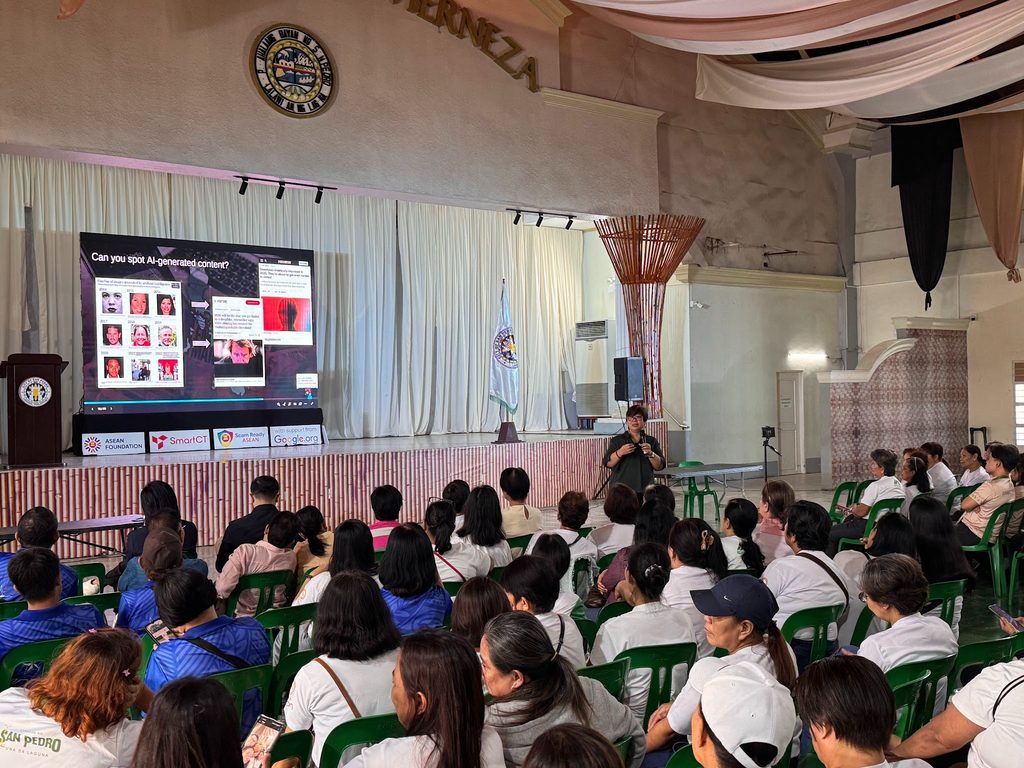
Stories like hers took center stage on Monday, October 19, at #ScamAlert Laguna, a forum that drew nearly 200 people, from senior citizens and students to barangay workers, to the Pacita Astrodome in San Pedro. The event called attention to a rise in digital and financial scams, and gave attendees tactics and resources to stay vigilant and protected.
The afternoon was hallmarked by attendees joining and engaging in Rappler’s new chat room, #ScamAlert, housed in Muni, a community-building platform found on Rappler’s free app.
During the forum, participants and organizers used the chat room to swap personal scam stories, takeaways and resources to become scam-proof.
Although the chat room was initially launched on-ground in San Pedro, Laguna, the space allows users to connect directly with authorities and fact-checkers, sharing screenshots to verify scam threats or learn about scammers’ latest methods to enforce community vigilance. It can be used by other individuals and groups in other areas as well.
A multi-sector response
The afternoon brought together partners across sectors to raise awareness around digital safety. Rappler’s civic engagement arm MovePH joined SmartCT, the Department of the Interior and Local Government (DILG) Laguna, and the City Government of San Pedro in organizing the event.
The convening was also part of Scam Ready ASEAN, a regional program implemented by the ASEAN Foundation with support from Google.org to build resilience and awareness among communities against online scams and fraud.
It also builds on MovePH’s ongoing #ScamAlert campaign launched in 2025, which has brought digital safety and scam prevention roadshows to various communities across the Philippines, including previous stops in Laguna and Manila.
“Events like this serve as the starting point for bringing together these types of stakeholders,” said Jay Beltran, Laguna Provincial Director of DILG.

New landscape, new threats
When SmartCT executive director Kris Libunao asked the room whether anyone had been scammed, dozens of attendees raised their hands.
Stories like Estinopo’s are why Libunao warns that no one is immune.
“Even if you are a tech person, even if you are an educated person, you can still be scammed dahil hindi ito naaayon sa inyong kaalaman, but sa emotions niyo,” Libunao said. (Even if you are a tech person, even if you are an educated person, you can still be scammed because it doesn’t depend on your knowledge, but on your emotions.)
Gemma Mendoza, Rappler’s head of strategic programs, walked attendees through how integrated the internet is in Filipinos’ daily lives, and how the current-day digital landscape allows scams to thrive.
“Hindi lang important na masaya tayo sa digital. Napaka-importante na maingat din tayo sa digital,” she said. (It’s not enough that we enjoy being online. It’s very important that we’re also careful online.)
During her presentation, Mendoza showed a deepfake video of Rappler CEO Maria Ressa spreading fraudulent claims about cures for diabetes, then broke down the digital forensics of the video. While her mouth, which did not match her speech, gave away the doctored video – the voice actually sounded like Ressa’s.
Digital scams, from phishing attempts to identity fraud, are already a mainstay of modern life, but artificial intelligence tools, like voice cloning, are rapidly scaling the number of scams, and the variety.
“Hindi lang nagbibigay ng impormasyon ang AI sa atin kundi, kumukuha rin ito ng impormasyon sa atin,” Mendoza said. “Kailangan maging maingat tayo sa pagshare ng impormasyon online.”
(“AI doesn’t just provide us with information, it also collects information from us,” Mendoza said. “We need to be careful when sharing information online.”)
But some threats seek to make everyday Filipinos complicit in crimes, warned lawyer Marco Mendoza of the Consumer Account Protection Office under the Bangko Sentral ng Pilipinas (BSP).
Scammers are now recruiting money mules – people who let criminals use their bank or e-wallet accounts to receive and move illicit funds – often for as little as P400 to P500, he said.
“Ang nagiging ano kasi nila approach nila ngayon is nag-re-recruit sila on a massive scale…. Tapos ‘yung mga nagbebenta, nagpahiram na ‘yon, hindi nila alam most of the time kung saan gagamitin ‘yung financial accounts nila,” Marco Mendoza said.
(Their approach now is to recruit on a massive scale…. And those who sold or lent [their accounts], most of the time, don’t know where their financial accounts will be used.)
Once a victim’s money lands in a mule account, scammers rarely leave it there. They “layer” the funds, splitting them and moving them across sprawling networks of accounts to make them harder for law enforcement to trace.
Under the Anti-Financial Account Scamming Act (AFSA), acting as a money mule is punishable by law.
Simulating the scam landscape
Clarence dela Cruz, project officer at SmartCT, led participants through the organization’s Be Scam Ready gameplay, which simulated some of the scams Filipinos may face in their everyday lives.
Testing the audience, Dela Cruz displayed fake texts and emails from claimed legitimate entities like government agencies and banks, breaking down the tell-tale signs of a scam message.
Libunao said the game is backed by behavioral science, and that training that simulates scams is key to understanding and preparing for the real thing.
“In the event of a fire drill, not an actual fire, we go over what we should do during an emergency,” she said. “If you play [the game] from your own perspective, you will actually see how you can become scam-ready.”
Knowing how to protect yourself
Mendoza of the BSP shared with the crowd how Filipinos can protect themselves, especially as consumers.
“Whenever you are conducting financial transactions or managing your financial accounts, take a second or two, pause for a moment… Use those two seconds to consider: what is the right course of action? Should I really click this? Do I need to provide this information, or should I verify it with my bank first?” Mendoza said in a mix of English and Filipino.
He stressed that one-time passwords or PINs (OTPs) and other sensitive personal information should never be shared with anyone.
Scam victims can dial 1326 to reach the Cybercrime Investigation and Coordinating Center, where they can report the incident and get assistance.
Individuals and institutions committed in fighting digital fraud can also join the #ScamAlert chat room for free. – Rappler.com
KioskNews shows a cleaned-up reading view extracted from the publisher’s page — the original always lives on their site, not ours.