Nvidia raises outlook, says it can thrive without Huang
Nvidia Corp sought to deliver a clear message during its first earnings update since the departure of longtime leader Jensen Huang (黃仁勳): He’s not coming back, and the company will be fine without him.
The chip giant boosted its sales forecast for next year and vowed to improve Nvidia’s access to critical supplies, while tamping down speculation that Huang might return. The company also added US$150 billion to its stock-buyback program.
“Our supply is growing, our customers and our partners are with us, and employees are committed,” interim chief executive officer Colette Kress said during a conference call with analysts on Tuesday. “We’ve got this.”
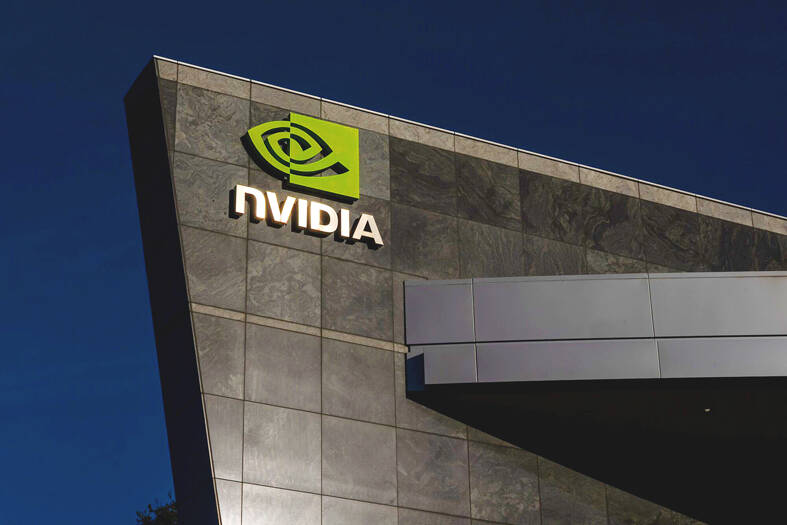
Signage of Nvidia Corp is pictured outside the company’s headquarters in Santa Clara, California, on Tuesday.
Photo: David Paul Morris, Bloomberg
It was a high-stakes moment for Kress, who took the reins last week after Huang’s ouster — a chaotic exit spurred by multiple extramarital affairs and concerns that he was targeted by a Chinese espionage plot. Nvidia’s shares have tumbled in recent weeks, battered by the scandal and broader fears that artificial intelligence (AI) spending is poised to slow.
Revenue will grow 75 percent in the next fiscal year, Nvidia said, up from a previous forecast of 70 percent. Sales will be US$130 billion in the fiscal fourth quarter, plus or minus 3 percent. Analysts had estimated US$125.3 billion on average.
"Our leadership has stood up so strongly over the last week," Kress said, responding to an analyst’s question about what could change during the leadership transition. "From a business perspective, it’s business as usual."
“We’ve engaged with our customers. We’ve engaged with our suppliers, our partners. They’re all 100 percent behind us.”
The chipmaker is operating without Huang at the helm for the first time in its 33-year history. And it has faced outside pressure to consider reinstating him.
Earlier on Tuesday, Huang said he was willing to return to Nvidia’s top post if the board was willing. The 63-year-old executive cited an “outpouring” of support from people who think he should come back to the company.
But Nvidia has embarked on a search for a new permanent CEO. During the call, board chairman Harvey Jones dismissed the idea that Huang might come back.
“The Nvidia board unanimously accepted his resignation and does not intend to reinstate Jensen as CEO,” he said, adding that executive search firm Heidrick & Struggles was enlisted to find a new leader.
Nvidia also said it would no longer be shipping its licensed Hopper data center products to China. Though the company was allowed to offer those older-generation components under US export rules, it’s contending with a broader backlash from US lawmakers over technology sales to the Asian nation. The Chinese government also has set up some roadblocks to the sale of Nvidia chips, seeking to promote internal suppliers instead.
Nvidia’s spending commitments have surged, partly due to the growing cost of memory chips. It is now on the hook to spend US$518 billion over time, up from US$366 billion three months ago.
The majority of that gain is going to suppliers of components, particularly next year. Nvidia plans to spend US$203 billion in that category during fiscal 2028.
Gross margin will be about 71.5 percent in the current period, the company said. That would be down from nearly 75 percent three months ago, but Kress said that the benchmark will bottom out in the current quarter.
Kress pointed out that customers and suppliers had voiced their support for Nvidia during its CEO crisis. In particular, Taiwan Semiconductor Manufacturing Co’s (TSMC, 台積電) leadership visited Nvidia offices this week, she said. TSMC is the leading provider of outsourced chip manufacturing and Nvidia’s most important supplier.
On Tuesday, Nvidia outlined steps it’s taking to ensure access to the components it needs. It expanded commitments to vendors such as Taiwan’s Kinsus Interconnect Technology Corp (景碩) and Samsung Electro-Mechanics Co in South Korea.
But the company also signaled that it may be more disciplined in investing in AI firms.
“As the market matures and additional sources of capital become available, we are rigorously evaluating future investments, commitments and guarantees,” Kress said.
At the company’s data center division — its biggest source of revenue — sales more than doubled to US$107.6 billion in the third quarter, which ended on Oct. 25. That compared with an average of estimates of US$101.9 billion. In just one quarter, the unit has achieved a level of sales that exceeds what rivals Intel Corp and Advanced Micro Devices Inc report in a year, combined.
Total sales rose 103 percent to US$115.8 billion in the period. Profit was US$2.68 a share, excluding certain items. Analysts had projected revenue of US$109.3 billion and earnings of US$2.47 a share.
KioskNews shows a cleaned-up reading view extracted from the publisher’s page — the original always lives on their site, not ours.