Taiwan inflation could rise if energy subsidies end: Central bank
Taiwan’s inflation remains under control, but consumer prices could face renewed pressure if government subsidies for state-run Taiwan Power Co (Taipower, 台電) and CPC Corp, Taiwan (CPC, 台灣中油) are withdrawn while global oil prices continue to rise, Central bank Governor Yang Chin-long (楊金龍) said yesterday.
Yang made the remarks while presenting a report to the Legislative Yuan’s Finance Committee after lawmakers questioned him about possible interest rate hikes. Taiwan’s consumer price index (CPI) had remained above the government’s 2 percent inflation warning threshold for five consecutive months through last month.
According to the central bank’s written report, Taiwan’s CPI is forecast to rise 2.03 percent this year before easing to 1.83 percent next year.
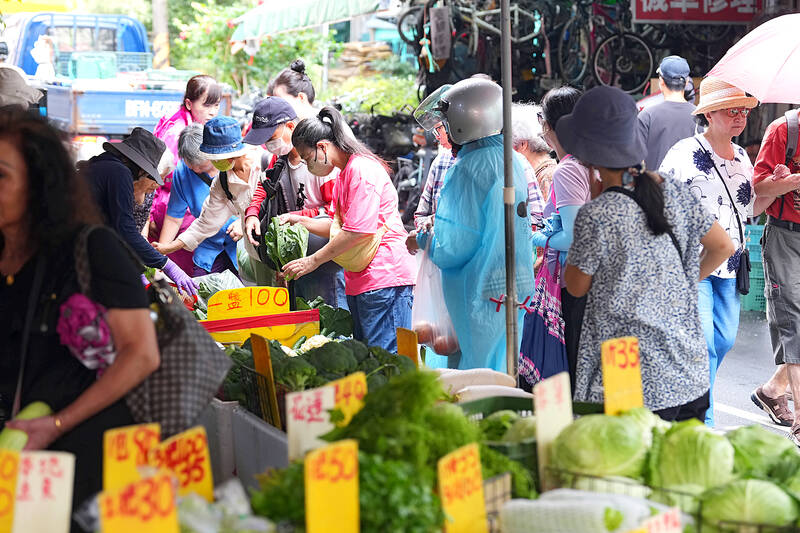
People shop for vegetables at a traditional market in Taipei’s Beitou District on Thursday last week.
Photo: CNA
Major domestic and international institutions, meanwhile, project average inflation of 2.04 percent this year and 1.89 percent next year.
Although CPI growth has recently remained above 2 percent, Yang said the central bank considers inflation manageable because most forecasters expect global energy prices to moderate, allowing inflation to fall below 2 percent next year.
He said higher oil prices are a supply-side driver of inflation and that the government’s measures to stabilize electricity and fuel prices are a more targeted and effective response than raising interest rates, which would have broader economic effects while doing little to curb supply-driven inflation.
Asked by ruling Democratic Progressive Party Legislator Lee Kuen-cheng (李坤城) when the central bank would consider raising rates, Yang said policymakers would closely monitor domestic prices, economic conditions and inflation forecasts.
Yang said inflation of around 2 percent next year would remain acceptable, but a much higher rate would require greater caution.
Lee also asked whether failure to approve budget allocations to support Taipower and CPC would fuel inflation.
Yang said inflation should remain manageable if the government continues its energy price stabilization measures even without the budget allocations.
However, if both budget support and energy subsidies are withdrawn while global oil prices continue to rise, inflation could increase further.
KioskNews shows a cleaned-up reading view extracted from the publisher’s page — the original always lives on their site, not ours.