Pope.L review – savage satire from Y-fronts-wearing trickster famed for gruelling ‘crawl’ across New York
Seven squares are pinned to the wall, each one painted in the high style of American minimalism: pure, austere variations on a theme. At the centre of each is printed the phrase “negro idea” followed by an apparently random number (51, 37, 666). What is Pope.L, the late, great trickster of contemporary American art, getting at?
Perhaps it is a critique of how minimalism, with its ethos of art-for-art’s sake, excluded politics from art? Or a comment on how racial categories are as constructed (and as subject to fashion) as the theories underpinning contemporary art? Or is it a riff on how the edifice of western modernism is built on stolen ideas? Then again, maybe the deployment of an outmoded racial category is simply designed to discomfort the liberal pieties of those people likely to visit this art gallery just off Piccadilly.
All that is certain is that Pope.L cannot be pinned down. Best known for his gruelling “crawl” across New York, this influential artist and writer didn’t use art to make himself understood. Instead, he used its tools to dismantle the liberal presumption that other people and communities can easily be understood, categorised and explained away. He was less interested in being “seen” than in making his audience look again at themselves and the world, and paved the way for a new generation of artists for whom identity – in the sense of conforming to external expectations – is not only a creative trap but a form of control.
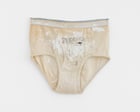
This is most apparent in Pope.L’s deep suspicion of the commercialisation of Black culture, and the stereotypes that serve to commodify and defuse it. His satire is savage and furious, closer in spirit and ambition to the provocations of Dada than to any more straightforward satire of the art world. Take the photograph Foraging (Mr Mau Mau), in which he appears in white Y-fronts and white bunny ears, with a note pinned to his chest referencing the Kenyan anti-colonial uprising (and Britain’s notoriously brutal repression). More Y-fronts are framed on the walls, smeared in brown and white fluid and handwritten insignia (“I have something important to share with you – Cliff G”). The numbered series is entitled Real Kitsch.
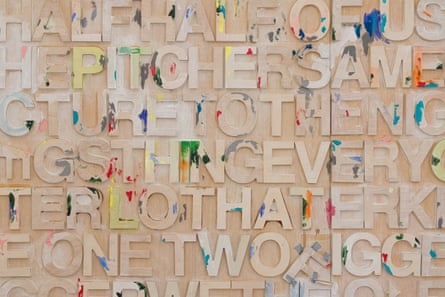
The way that words and images settle into fixed categories (cliche and kitsch, respectively) is a recurring theme. In Identity What We Lose to Real For, completed a year before the artist’s death in 2023, block wooden letters like those used to teach children the alphabet fall off their frame, further confusing a short text that reads like a dense concrete poem. The surface is spattered with paint, recalling painterly expressionism and a toddler’s paint-flinging (neighbouring series of scrawled Xs and Os likewise summon conceptual painting and a half-understood game of noughts and crosses). Art here is dismantling conventional ways of thinking and naming.
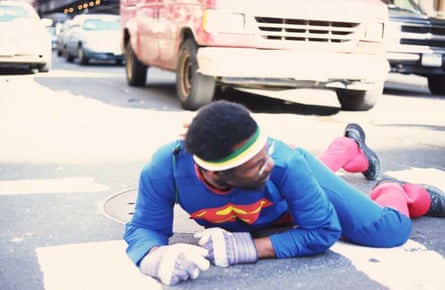
Short films documenting a selection of Pope.L’s performances are screened in a back room. Dressed in a figure-hugging Superman costume and with a skateboard strapped to his back, the artist crawls on his belly from the Statue of Liberty to the Bronx. As he is barracked by strangers, you wonder why so many are offended by the performance yet unmoved by the numerous homeless people in New York.
In a performance-lecture he situates his work on the “sidewalk of national consciousness”, and the world crowds into every work in this show: a white painting might look like a romantic abstraction but is in fact, as the text along its edge tells us, a picture of Martin Luther King’s Dick as Seen from Pluto. Fifteen years after Pope.L made this gag, incidentally, research was undertaken on Kazimir Malevich’s 1915 Black Square. It was discovered that the monochrome painting, long hailed as an icon of art’s transcendent possibilities, had a hidden title: Negroes Battling in a Cave.
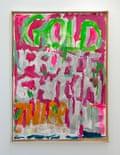
Here is more evidence for Pope.L’s argument that art can never entirely be insulated from the nature of the world that produces it, no matter how pure a painting might appear to the eye. This point is most clearly illustrated by his long-running and highly complex engagement with the work of Robert Ryman, a survey of his monochrome white paintings is now on show at the Barbican in London)
Pope.L memorably described himself as “the son” of Ryman and therefore duty-bound to “walk in his footsteps to the front door of the family mansion and burn it to the ground”. While it is a shame that this show does not include any of his most direct responses to the painter, the two exhibitions can constructively be seen in counterpoint.
KioskNews shows a cleaned-up reading view extracted from the publisher’s page — the original always lives on their site, not ours.