Some S’pore vets see up to 15% increase in respiratory or eye-related cases during haze
SINGAPORE – Several vets in Singapore have been attending to more pets with respiratory or eye-related illnesses in recent weeks amid the haze season.
While direct causation has not been established, most vets who spoke to The Straits Times estimate that the increase in visits ranges between 10% and 15%, adding that poor air quality and airborne pollutants
like PM2.5
can aggravate existing health conditions, especially for more vulnerable animals.
Dr Kenneth Tong, founder of Animal and Avian Veterinary Clinic (AAVC), said his clinic has seen an increase in respiratory illnesses and eye issues such as conjunctivitis and weepy or itchy eyes in recent weeks.
“For example, in a week, we usually just see three cases of eye issues, but now all of a sudden we are seeing five,” he said.
Common symptoms of haze-related illnesses reported include eye, skin and breathing problems for most pets. For pets with existing conditions such as chronic bronchitis, asthma or tracheal collapse, some cases may even require emergency treatment.
Dr Anne-Claire Duchaussoy from Beecroft Animal Specialist & Emergency Hospital said that respiratory problems are generally common in small-breed dogs, particularly in pomeranians, Yorkshire terriers and poodles. Toy breeds may also be genetically predisposed to conditions, such as tracheal collapse.
Poor air quality could aggravate these existing conditions, though not all respiratory cases can be directly attributed to the haze, she added.
The co-founder, who specialises in internal medicine, said that treatments for such respiratory issues depend on the severity of the symptoms and the underlying medical condition.
In one such severe case, Dr Duchaussoy had to perform a minimally invasive procedure called a bronchial stent placement on a pomeranian named Fluffy.
A specially designed stent was inserted into the dog’s airway to keep it open so that air can flow more freely into its lungs.
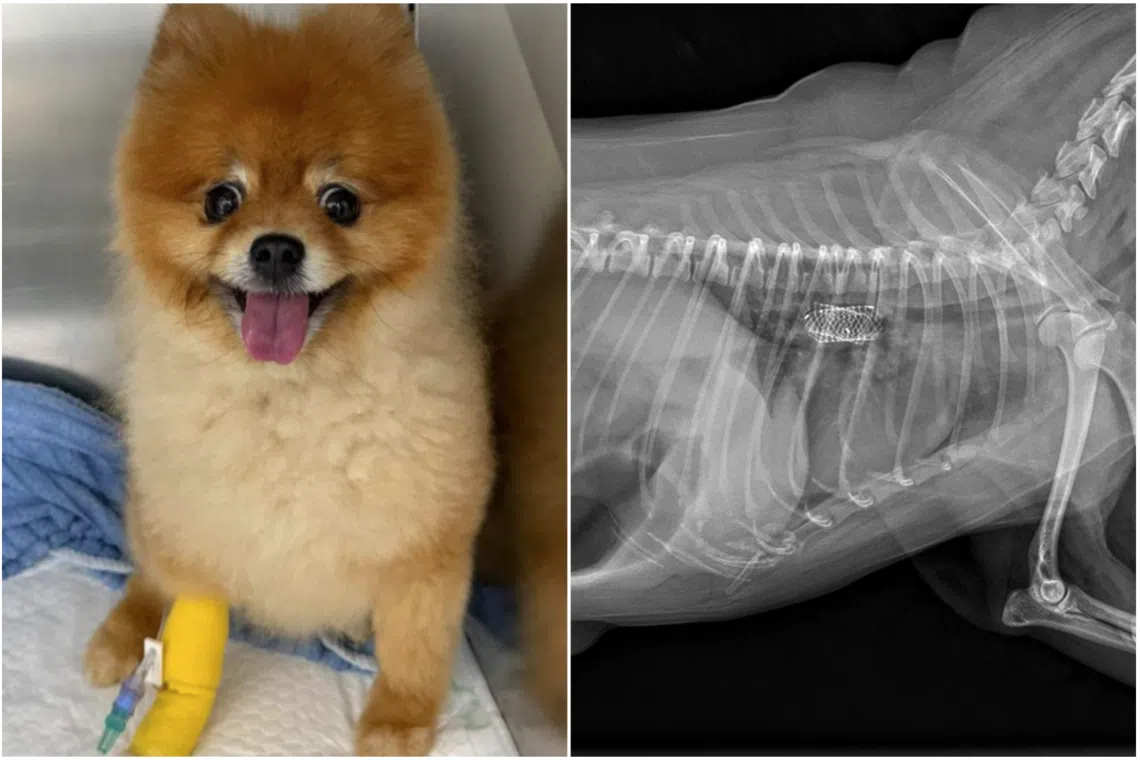
Poor air quality could exacerbate existing respiratory problems, especially for small-breed dogs like pomeranians.
PHOTOS: COURTESY OF BEECROFT ANIMAL SPECIALIST & EMERGENCY HOSPITAL
Oasis Vet’s Dr Sandhya Nair said that cats are prone to airway problems as well. As they groom themselves, cats may swallow particles that settle on their fur.
As an International Society of Feline Medicine (ISFM) Cat-Friendly Clinic, Oasis Vet sees many feline and eye cases, and the haze has made both more common, she said.
According to Dr Nair, the haze can bring on asthma-like symptoms for cats, such as coughing and wheezing, even in cats with no history of asthma. Cats with existing asthma can experience flare-ups.
“Last week, we saw a middle-aged cat whose asthma is normally well-controlled with an inhaler,” she said. “During the haze it flared up badly, and the cat needed oral steroids to get it back under control.”
But cats and dogs are not the only animals vulnerable to unhealthy air.
According to Dr Teo Boon Han, Senior Veterinarian and Pet Nutritionist at Canopy Veterinary Centre, birds deserve particular attention during the haze because of their highly efficient respiratory systems, which take in a lot of air. This makes them more sensitive to airborne pollutants.
“Owners of birds should be especially vigilant about maintaining good indoor air quality during haze episodes,” he said.
Dr Tong also said that the AAVC has seen cases of very small birds like canaries dying suddenly despite “looking perfectly okay”.
While he acknowledged that there could be other underlying factors, the increased occurrence from once a year to thrice in one week, for instance, has caused the clinic to attribute it to the haze as a precaution.
How can you care for your pets during the haze season?
In a statement on Oct 19, How Choon Beng, Group Director of Wildlife Management at NParks, advised pet owners to check air quality readings before taking their pets outdoors, and to pay attention to the environment at home.
His statement came a day after the 24-hour Pollutant Standards Index (PSI) hit a season high of 230.
In mid-October, vets in Malaysia similarly reported an increase in respiratory problems among pets amid the haze.
Veterinarian clinic director Muhammad Naim Md Kasim told Malaysia’s The Star newspaper that respiratory cases among cats had increased by an estimated 10% to 15% across several of his clinics since mid-September.
“When air quality deteriorates, pet owners should keep pets indoors as much as possible,” said Canopy Veterinary Centre’s Dr Teo. “Avoid prolonged outdoor walks, running and strenuous play, particularly when air quality is unhealthy.”
Pet owners should also watch for warning signs such as persistent coughing, unusual lethargy, eye irritation or changes in breathing, he said.
They should seek urgent veterinary attention if they notice open-mouth breathing in cats, pronounced abdominal effort when breathing, or blue or pale gums.
Dr Teo also advised pet owners to keep windows closed during periods of poor outdoor air quality and consider using air purifiers with a high-efficiency particulate air (HEPA) filter.
VetMobile founder Angeline Yang observed that many pet owners have made adjustments to their schedules when air quality is poor to minimise the risks.
For instance, they would choose to walk their dogs less or not at all, so as to keep cases of itchy skin or eye discomfort to a minimum.
Pet owners can also opt for simple indoor enrichment activities instead, said Dr Yang, who provides at-home veterinary services.
“In Singapore, some of these cases are seasonal,” she added. “They can happen throughout the year whenever the air quality is poorer or when the weather is dry or dusty.”
KioskNews shows a cleaned-up reading view extracted from the publisher’s page — the original always lives on their site, not ours.