He was one of the NFL’s most feared runners. Now Larry Johnson fears what football did to his brain
In his heyday, Larry Johnson was the NFL tailback you’d least want to line up against, the steamroller in pads who had defensive players and coaches questioning their life choices on every down. But since Johnson walked away from pro football in 2011, after seven seasons in the league and an All-Pro run with the Kansas City Chiefs, he’s the one doing the soul-searching, grappling with the toll all that gridiron glory has taken on his brain.
Johnson, who still cuts a fit and formidable figure at age 46, can scarcely recall his glittering career, much less its highlights. “I go up to maybe 2006, 2007,” he tells me. “Anything before or three years after, I really don’t remember.”
When Johnson was thriving as a pro in the mid 2000s, chronic traumatic encephalopathy (CTE), a degenerative brain disease associated with repeated head impacts, was not yet widely recognized as a risk of playing football. The NFL, however, had evidence that head injuries could cause lasting neurological damage, yet spent much of the decade publicly disputing the link as former players sought disability benefits for neurological problems – and were largely denied.
It wasn’t until Will Smith starred in the movie Concussion as Bennett Omalu – the forensic pathologist who sounded the alarm on CTE in American football players after examining the brain of Mike Webster, the Hall of Fame center who died in 2002 after years of cognitive decline and a range of behavioral problems – that Johnson began joining the dots between football and his own personality swings. Johnson has long suspected he suffers from CTE, even though the disease can only be diagnosed after death. A study published on Wednesday of former NFL players who died between 2008 and 2023 found that 74.5% had CTE. Of the nearly 400 players whose brains were donated for postmortem examination, 93.5% showed evidence of the disease.
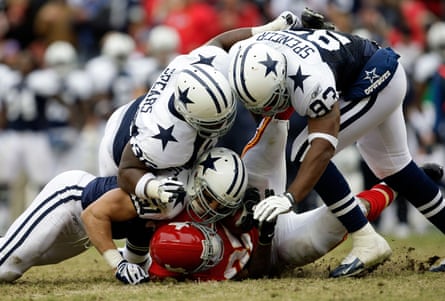
Johnson’s NFL career was defined by physical punishment, and he was a violent runner who welcomed the blows. Ahead of the 2003 draft, Johnson seemed like everything a team could want in a franchise running back. He had size (6ft 1in, 230 lbs) and speed (4.45s 40-yard dash). He capped a four-year career at Penn State by sweeping the Doak Walker Award for the nation’s best running back and the Maxwell and Walter Camp awards for the nation’s best player after rushing for more than 2,000 yards on fewer carries than anyone in history. He had backing from Joe Paterno, when that still meant something, and more hands-on guidance from his father, Larry Johnson Sr – the former Nittany Lions defensive assistant who’s now Ohio State’s associate head coach.
But when the Chiefs selected Johnson 27th overall as insurance for franchise running back Priest Holmes, they did so over the objections of head coach Dick Vermeil, who had watched a parade of Penn State runners disappoint in the pros and figured Johnson would be no different. Vermeil singled out Johnson’s preparation habits and maturity, joking that he needed to “take the diapers off”. But Vermeil had to eat his words after Holmes went down with a season-ending neck injury midway through the 2005 season and Johnson stepped in to rack up 1,750 yards and 20 touchdowns in nine weeks. (“Well, he’s a talent,” the coach conceded later.)

The following season Vermeil retired and Herm Edwards took over, and the bombastic defensive guru made Johnson the centerpiece of the Chiefs offense. He ran for 1,789 yards on a whopping 416 carries – an NFL record that isn’t likely to be threatened in the current era of pass-happy offense and running by committee. Whenever Johnson publicly shares his CTE fears, fans often find themselves looking back at the season for answers. Was that the beginning? Too many blows? “People forget: I didn’t get hurt during those 416 carries,” he says. “I didn’t really start until 2006. I was in the league for three years – maybe the only first-round pick battling just to dress. If Herm had told me straight up, ‘I’m gonna run you 416 times.’ I would’ve been like, Why can’t we do 500?”
Johnson reveled in his star status, famously signing on as an ambassador for Jay-Z’s Roc-A-Fella record label as it was growing into a lifestyle brand. The Chiefs workhorse was frequently spotted partying with LeBron James and other members of Jay-Z’s inner circle at the rapper mogul’s bygone 40/40 Club in New York, helping get Jay-Z in the door with the NFL and paving the way for his later relationship with the league office and commissioner Roger Goodell. Johnson celebrated touchdowns by tenting his hands into a diamond, a gesture popularized by Jay-Z and his associates known as “throwing up the Roc”.
But the southern Maryland native never quite cottoned to the scrutiny that came with the spotlight. He was slammed in the press for demanding a trade and threatening to sit out as leverage for a new contract. He clashed with Chiefs coach Todd Haley – questioning his credentials to succeed Edwards – and disparaged fans and media with homophobic slurs, prompting suspensions before he was eventually released by the team.
Johnson drew more troubling headlines for his alleged assaults on women: a Kansas City nightclub patron accused him of spitting a drink in her face, and an ex-girlfriend accused him of beating and strangling her at the Bellagio in Las Vegas. Between 2003 and 2012, he was arrested five times in cases involving allegations of violence against women – resulting in convictions for disturbing the peace, domestic battery and assault, with penalties that stopped short of jail time. Johnson shies from blaming football for those incidents, but it’s hard not to wonder what the game left behind in a man so handsomely rewarded for violence – or how much the game messed with his head. Johnson began playing tackle football at age nine, taking helmet-to-helmet hits long before he reached the NFL.
Life after football was deeply unsettling for Johnson. “I couldn’t find anything that really will test your manhood and also test your character like football,” he says. “I enjoyed lining up eight in a box and then trying to get five or 10 yards – and then I’m getting 50. As twisted as it may sound, the thing I wanted to do was to die on the football field. I always felt like I had to go to war, like I had to fight even when I don’t have to fight.”
He had hoped to transition into nonprofit work, but found the 9-to-5 office environment stifling. A hair-trigger sensitivity to light, noise and group settings made it impossible for him to hold down a job. He fought with the mother of his young daughter, Jaylen, over school pickup schedules; during a two-year court fight, with Johnson’s own mother acting as a go-between, he finally realized he was the one misremembering the times. He enrolled in a master’s program with a cohort of NFL retirees, but says he quit after flipping out on a professor during a group project.
All the while, Johnson wrestled with intrusive thoughts and inner voices telling him to harm himself and others. The voices come in waves, he says, “almost like a suggestion. Certain things scare me. I can’t be close to balconies anymore. If I’m walking, I’ll think, What if something falls out of the sky? Just a constant state of paranoia.” To cope, he isolated himself for long stretches and self-medicated with drugs and alcohol – making matters far worse.
Johnson’s father had little idea of his son’s quiet suffering until the ex-Chiefs star went public in a 2017 Washington Post profile. Johnson feared that his father might not understand or relate to what he was going through; he went from checking in with his dad for any reason, even if it was just to say he was heading home after a game, to pulling away from his great mentor. The Post article, though, “gave my father new eyes,” Johnson says. “People would tell him, ‘That’s a really good thing your son did.’ I think that made him a little bit more accepting. [Now] we’re back to our relationship – as if I’m still in the house, you know?”
Johnson had another major breakthrough around the same time, when the NFL granted him lifetime disability benefits, giving him the financial security to focus on his health without worrying about making ends meet. In a league infamous for publicly denying former players’ claims and using race-norming to limit disability payouts (disputes that were ostensibly addressed in a revised league settlement), that victory shouldn’t be taken lightly. Johnson knows how fortunate he was to last seven years in a league where the average running back’s career is around 2½ years, leaving little time to build a safety net. He believes the modern trend of devaluing running backs only serves a league that’s “trying to lessen payments.”
Johnson’s daily life is still punctuated by bouts of confusion. Light and noise still bother him, and he gets irritated anytime he hears himself slurring words or otherwise struggling to put sentences together. But Johnson has better ways of coping. Jaylen is old enough to drive herself – and her dad – around now, sparing him the embarrassment of getting lost on routine trips or confusing the TV remote for a car key fob. Johnson spends a lot of time talking through his feelings with his wife, who knows when to prod and when to leave him be. All of it helps keep the voices at bay, but he still hears them. He likens the intrusive thoughts to a movie. “Yours might last for a scene,” he says. “Mine is like a sequel. Then there’s part three and hidden features. It’s like Marvel at the end of the movie. It engulfs me.”
Social media tends to be where Johnson gets in trouble these days, courting controversy with conspiracy theories about Jews, Kobe Bryant’s death and Jay-Z, with whom he has since fallen out. Away from the online fray, though, Johnson keeps a cool head in group chats with former teammates, even as it frustrates him that his peers never want to talk about what they’re really going through. “All they’re talking about is each other’s birthdays and going out and drinking,” he says. “We are in an era where if you admit you were hurt, you’re soft – you know what I mean?”
His new dream is to create an app that connects former pros struggling with their mental health with people who understand what they’re going through – former NFL clinicians like Susan Wilson, his team therapist at the Chiefs. “I would love to be able to have a symposium for retired guys,” Johnson says, “so they can hear not only the horror stories, but share their similar histories of how to deal with mental health. It’s been too hush-hush and taboo for such a long time because guys are embarrassed.”
CTE researchers are always keen to build relationships with former players, too. Last month, Emory University announced a partnership with the Concussion & CTE Foundation and Boston University on a medical study of former football players experiencing depressive and cognitive symptoms. The study is testing whether an FDA-approved drug that reduces inflammation can also improve those symptoms, recruiting men aged 30–55 in the Atlanta area who have played at least 11 years of tackle football.
Whether researchers are any closer to diagnosing and treating CTE in living patients remains an open question. “CTE is both a complex physiological and psychological issue,” says Concussion & CTE Foundation co-founder Chris Nowinski, a longtime advocate. “Learning you have CTE can have a positive mental impact for some, and a negative one for others. That’s why it’s critical to have a multi-pronged approach advancing diagnosis, treatment and mental health support.”
Johnson tries not to let his emotions get the better of him when watching football now. He appreciates the safety measures the league has introduced to protect players, but laments what they’ve taken away from the physical brand of football he once defined. It broke the ex-Chief’s heart to see his former AFC rival Chris Johnson opening up about his ALS battle. “To watch these players who could basically run 4.5, 4.4 40s be in wheelchairs, like, that haunts me,” he says. “If this could happen to Chris Johnson or Steve Gleason, it can happen to any of us, right?”
In an effort to keep tabs on his own neurological condition, Johnson has taken to posting videos of himself on social media and scrutinizing them for signs of decline – the ultimate mental health self-scout. Early replies describing his delivery as “mean” or “condescending” helped him modulate his behavior and even led to some online friendships. With a firmer handle on his general well-being, Johnson thinks differently about being tested for CTE now, while he’s alive.
“When I first said that, it was like, yeah, I would want to know,” he says. “But at the end of the day, I know I would obsess over it. I would be paying attention to every little micro movement and emotion. I would drive myself crazy thinking I don’t have much time, so let me act out. If there was a way we could figure out before then, at least I would know the damage. Whether I know it or whether I can feel it, I know something is there.”
KioskNews shows a cleaned-up reading view extracted from the publisher’s page — the original always lives on their site, not ours.