NSW’s next big thing? A giant pink slug
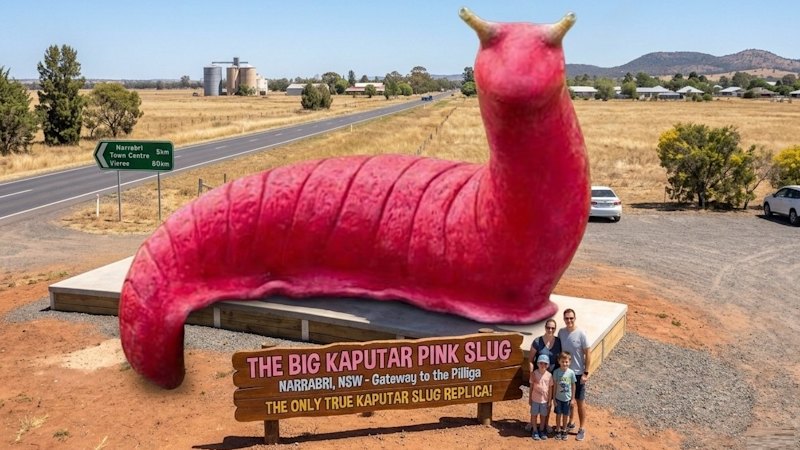
Australia has embraced the Big Banana, paid homage to the Big Pineapple and marvelled at giant trout and the Big Mower.
Now the northern NSW town of Narrabri believes it has found the next contender to join the nation’s quirky collection of roadside attractions: a spectacular fluorescent-pink slug found nowhere else on Earth.
The Narrabri community is rallying behind plans by the shire council to create a larger-than-life monument to celebrate one of Australia’s most unusual creatures and boost tourism to the town of about 5500 residents.
The proposed monument would shine a spotlight on the endangered Mount Kaputar pink slug, a land mollusc found exclusively in the high-altitude subalpine forests atop Mount Kaputar, an extinct volcano about 50 kilometres east of Narrabri.
Known to be notoriously elusive and emerging only in wet, misty conditions, the slugs have been observed to grow up to 20 centimetres in length and carry fluorescent hot-pink colouring – making them one of Australia’s most distinct creatures.
The species was feared to have been wiped out during the Black Summer bushfires of 2019-20, disappearing from observations for several years.
However, subsequent field surveys by the NSW National Parks and Wildlife Service confirmed that small populations had survived on isolated rock faces near the summit. The rediscovery prompted the launch of the Slug Sleuth mobile app, enabling citizen scientists to record rare sightings.
Now the species could be making a comeback larger than anyone thought possible with Narrabri Shire Council working to bring the idea of a giant Mount Kaputar slug monument to life.
“We’re a big country, we love our big things and we think it would neatly fit into Australia’s eccentric collection of oversized attractions,” Narrabri Shire Mayor Darrell Tiemens said.
“Even though it’s highly rare to see them, I’ve had the honour and privilege of spotting them twice and it’s not until you see them that you realise just how brightly coloured and spectacular this species is.
“They may not be as cuddly as koalas or platypuses, but they are so unique [and] having a monument in their honour would be a great way of celebrating the wonderful wildlife we have in our country.”
Along with drawing attention to the region’s unique environment and ecology, Tiemens said the monument could strengthen Narrabri as a tourism destination in its own right.
“Because we’re on the Newell Highway, we tend to be a pit stop for a lot of travellers,” he said.
“We want to be known as more than just a place where you can fill up the car and stop for McDonald’s. We want to be known as a destination where you can stay for a few days, explore the national park and learn about our environment.”
The idea for the monument originated more than 600 kilometres away in Sydney, where Randwick councillor Alexandra Luxford proposed it as part of the two councils’ sister-city relationship. Randwick Council has now working to help Narrabri pursue grants and funding.
Tiemens said the final size of the sculpture would depend on the money raised, with the council considering a monument between 10 and 20 metres long, or potentially larger.
“We’re very mindful that it should be done tastefully as an iconic art piece rather than in a tacky, touristy way,” he said.
“At the end of the day, we really think it’s a way of encouraging more people to explore the amazing environment we have in Australia and the wildlife that exists nowhere else on Earth.”
The Morning Edition newsletter is our guide to the day’s most important and interesting stories, analysis and insights. Sign up here.
KioskNews shows a cleaned-up reading view extracted from the publisher’s page — the original always lives on their site, not ours.