3 ex-SC justices: 'Avelino' case not applicable to impeachment vote threshold
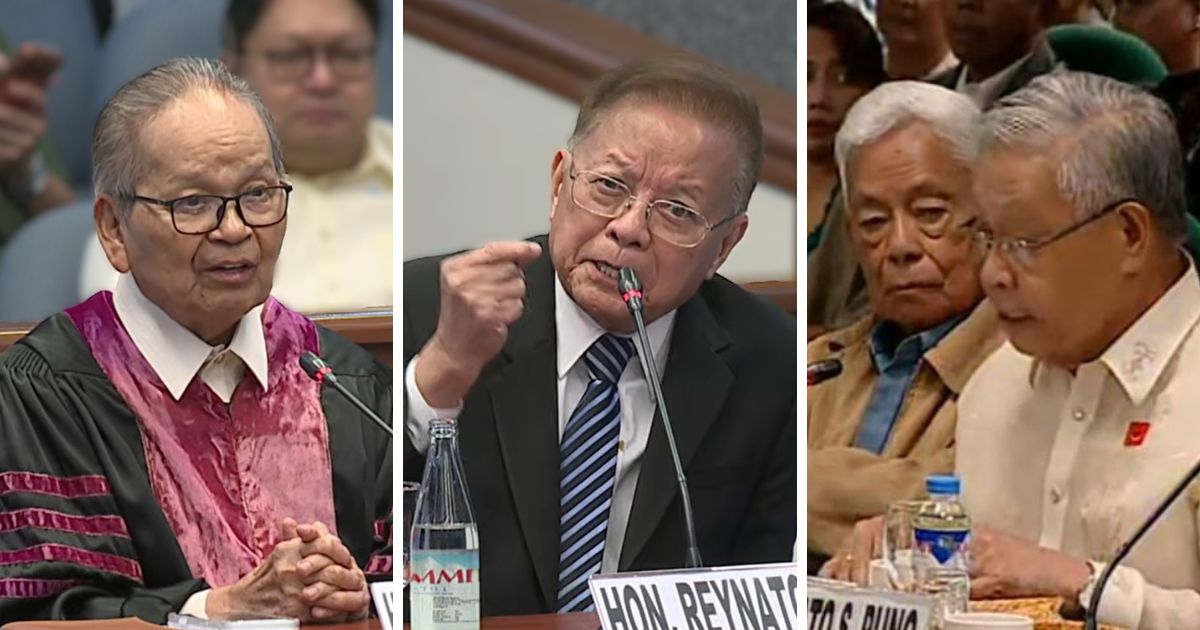
Three former Supreme Court justices on Wednesday said the Supreme Court's ruling in Avelino v. Cuenco, which excluded senators beyond the Senate's coercive jurisdiction from the official count for quorum, does not directly apply to the impeachment trial of Vice President Sara Duterte.
The retired jurists said the Avelino case dealt with the determination of a quorum, not the voting threshold for convicting a respondent in an impeachment case.
“The Avelino case is not the perfect precedent that will resolve the problem of how to properly interpret Article XI, Section 3(6) of the 1987 Constitution. First, what was resolved in Avelino is the right number to constitute a quorum, not the right number to convict a respondent in an impeachment case,” former Chief Justice Reynato Puno said during Day 26 of Duterte's impeachment trial.
Puno is one of four former SC justices whom the Senate invited as amici curiae (friends of the court) to shed light on the voting threshold for the impeachment case.
The invitation came as four senators have not participated in the trial due to detention stemming from pending plunder charges, being in hiding, or being on medical leave overseas.
“What was interpreted in Avelino is a constitutional provision that is differently worded, that is, ‘a majority of each house shall constitute a quorum to do business, etc.’ Avelino addressed only the problem of an absent senator outside the coercive jurisdiction of the Senate,” Puno said.
“The ratio decidendi of the Avelino decision is not as solid, not as clear, as it has to be deduced from the different opinions of the participating justices,” he added.
Rather, Puno said the Avelino case could be used as one of the tests in interpreting Article XI, Section 3(6) of the 1987 Constitution.
“It fits the approach of the contextualist, functionalist school of thought that disfavors the literal approach which straightjackets and prevents the use of other relevant provisions of the Constitution as additional lens to discover its spirit and intent,” Puno said.
Former Supreme Court Associate Justice Adolf Azcuna expressed a similar view, saying the Avelino case was decided under the 1935 Constitution, not the 1987 Constitution, which is in force today.
“It (Avelino case) was decided on the basis of the 1935 Constitution where the wording involved was different. It involved quorum and the quorum requirement under the 1935 Constitution says majority of the Senate. It didn't say all the members, yes, majority of the Senate,” Azcuna said.
“And so it's not applicable. Whatever interpretation of that majority of the Senate for purposes of quorum is different from the two-thirds of all the members of the Senate required in impeachment cases,” he added.
Former Chief Justice Hilario Davide Jr., who presided over the impeachment trial of then President Joseph Estrada from 2000 to 2001, also said the Avelino case does not directly apply to an impeachment case.
“The matter in issue in this Avelino vs. Cuenco case was purely relative to the determination of quorum in a Senate exclusively acting as a legislative body, and performing exclusively legislative functions, and not as an Impeachment Court,” Davide said in his written position submitted to the Senate impeachment court.
Davide was unable to appear in person because he had recently undergone surgery.
Davide, however, said the Avelino case could be considered to have “persuasive value.”
Former Supreme Court Chief Justice Artemio Panganiban agreed with Davide that the Avelino case could be relatively applied, noting that several Supreme Court decisions are similar to the issues raised in Avelino.
Panganiban said his presentation cited jurisprudence dating back to the 1924 case of Fuentes v. Director of Prisons and the often-cited 1949 case of Avelino v. Cuenco.
He noted that while Fuentes v. Director of Prisons was decided before the adoption of the Philippine Constitution, it was decided under the Jones Law, the enabling act in force at the time.
"From the case of Avelino versus Cuenco, there are several other cases, up to the 2026 case of Generillo versus Senate. With which your Honors must be familiar, since it also involves the present Senate and the present Vice President,” Panganiban said.— MCG, GMA News
KioskNews shows a cleaned-up reading view extracted from the publisher’s page — the original always lives on their site, not ours.