Seniors with dementia use objects from the past to rekindle memories under NTUC Health programme
SINGAPORE – Seniors with mild to moderate dementia are getting help to recall their personal memories with vinyl records and other familiar items from a bygone era, under a new programme by NTUC Health.
The heritage-based dementia engagement programme uses physical objects from the 1950s to 1980s – such as vinyl records and old movie tickets, picture kits – and a digital app with thematic images, captions and audio clips to also help seniors spark conversations and connect with their peers.
Launched in September, it will be run at five daycare centres by 2027.
NTUC Health developed the eight-week structured programme with the National Heritage Board, with clinical inputs from Khoo Teck Puat Hospital and the Geriatric Education and Research Institute (GERI) leading the research evaluation.
A pilot study conducted by GERI, with input from Khoo Teck Puat Hospital, had shown that 72% of the participants had sustained positive moods and became more expressive after going through the programme.
The programme’s key benefit is helping these seniors with mild to moderate dementia with memory reactivation, which include remembering how their family was like, contrasting life then and now, and bringing back smells, sounds and colours into their lives, said Yu Chou Chuen, who led the pilot study when he was a senior research fellow at GERI.
“We were surprised that through just looking at a simple picture, they can start to sing songs and talk about movies that they liked back then,” he said.
The pilot study observed 25 clients across four NTUC Health daycare centres alongside qualitative interviews with care staff between October 2024 and March 2025.
Along with two facilitators, participants in the programme attended a 45-minute session once a week for eight weeks.
Yu, who is now the deputy head of gerontology programmes at the Singapore University of Social Sciences, said eight weeks is a sweet spot as it allows time for familiarity and rapport to be developed among the group while balancing manpower constraints at each centre.
At a session at the NTUC Health Senior Day Care in Jurong West on Oct 19, senior community care associate Beh Swee Suan, using a mix of Mandarin, Hokkien and Malay, interacted skilfully with a group of seven participants.
Calling the seniors individually by name to get them to speak, she and dementia practitioner Kuo Yen-Chun kept up the conversation and injected a lively mood to the session. Kuo also spoke one-on-one with the quieter participants.
When shown a photo of the old Cathay cinema, 85-year-old Foo Ngiap Tong told the group that he used to attend movie screenings there. He is among those who spoke up more often.
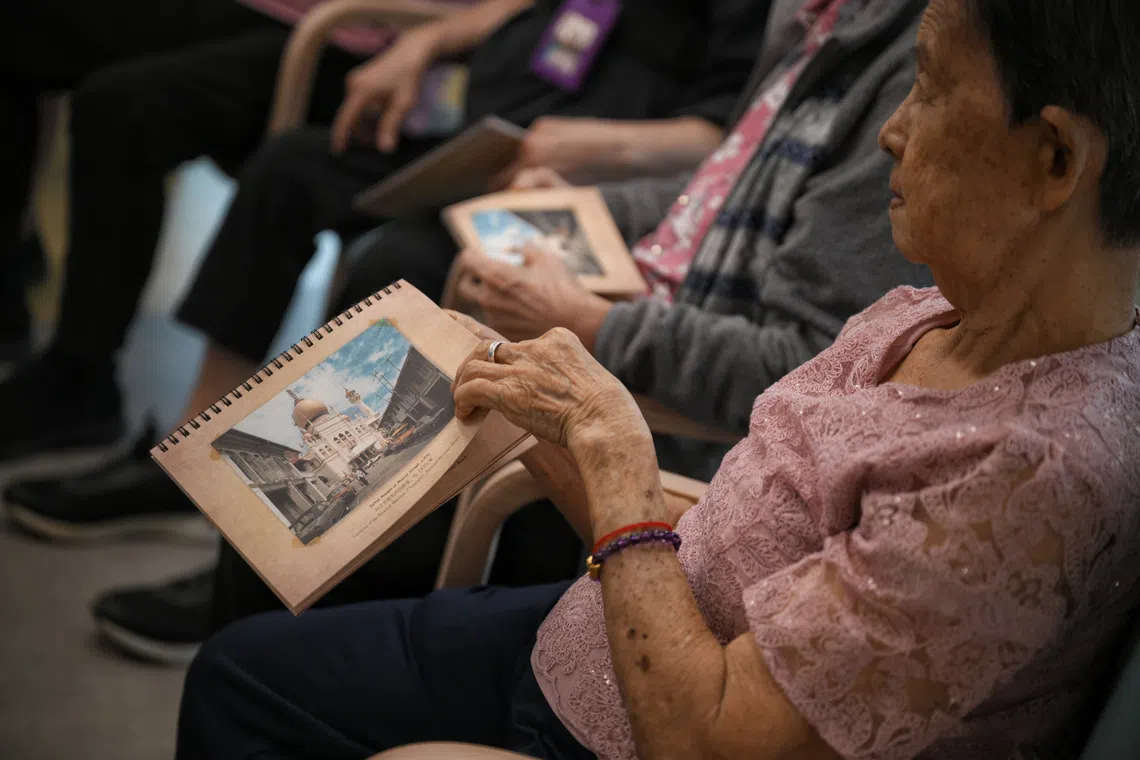
Seniors with mild to moderate dementia are getting help to recall their personal memories with vinyl records and other familiar items from a bygone era.
ST PHOTO: MARK CHEONG
But Beh also said she has seen the quiet ones slowly opening up and talking about their past, including a client who used to remain quiet in the presence of his wife, who attends the same daycare centre.
NTUC Health has trained 10 facilitators for the programme so far. Its manager of dementia care, Cindy Koe, said they plan to expand the dementia engagement programme to 27 centres in around three years’ time.
Slightly more than half of its 2,400 seniors across 27 of its daycare centres are currently living with dementia.
Alongside the expansion of the programme, NHB’s heritage-based resources will be incorporated more broadly across NTUC Health’s existing daycare activities and programmes, said Koe.
KioskNews shows a cleaned-up reading view extracted from the publisher’s page — the original always lives on their site, not ours.