US, Japanese lawmakers back Taiwan
WASHINGTON MEETING: Japan’s Hirofumi Takinami said participants rejected the idea that the US should limit its defensive perimeter to the Second Island Chain
By Jonathan Chin / Staff writer, with CNA


US and Japanese lawmakers agree that the US must defend the First Island Chain, including Taiwan, and should not fall back to the Second Island Chain, while “a Taiwan contingency is a Japan contingency and therefore a US-Japan alliance contingency,” media reported after a meeting between officials of the two nations in Washington on Tuesday.
A delegation of Japanese lawmakers from the Liberal Democratic Party met with US Senator Thom Tillis, co-chair of the Senate Taiwan Caucus, and US Representative Ami Bera, co-chair of the US Congressional Taiwan caucus, to discuss issues concerning East Asia and the Taiwan Strait.
The Japanese and US lawmakers concurred that deterring China is key to preventing a conflict across the Taiwan Strait, Nippon.com reported.
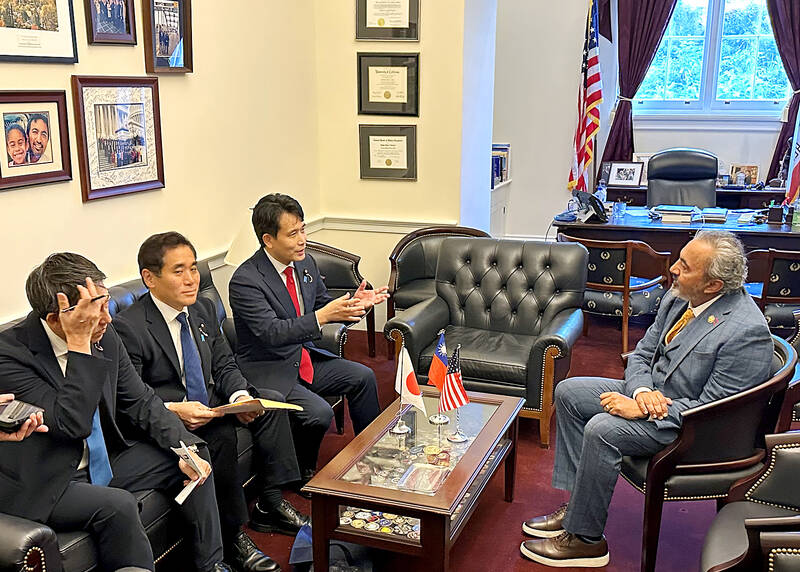
From left, Japanese House of Councilors members Daichi Suzuki, Kazuhiro Miyamoto and Hirofumi Takinami speak with US Representative Ami Bera in Washington on Tuesday.
Photo: CNA
“We were able to share the understanding that a crisis involving Taiwan is indeed a crisis for Japan and a crisis for the Japan-US alliance,” the news Web site quoted Japanese House of Councilors member Hirofumi Takinami as saying.
The US lawmakers expressed support for Japanese Prime Minister Sanae Takaichi’s statement in the Diet in November last year that the use of force by China could constitute a “survival-threatening situation” for Japan, potentially satisfying a legal condition for exercising collective self-defense, it said.
Takinami told the Central News Agency that the participants rejected the idea, reportedly advocated by some Washington think tanks, that the US should limit its defensive perimeter to the Second Island Chain in the event of a regional conflict.
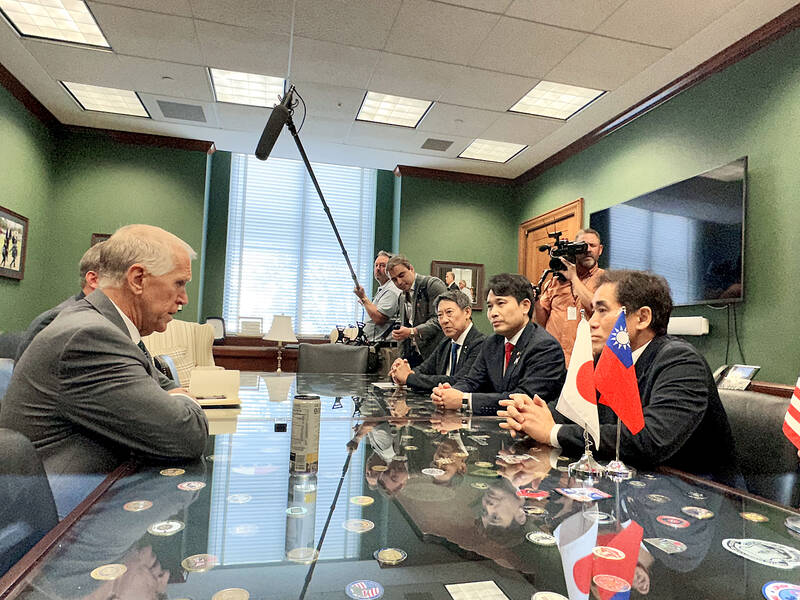
From right, Japanese House of Councilors members Kazuhiro Miyamoto, Hirofumi Takinami and Daichi Suzuki speak with US Senator Thom Tillis, left, in Washington on Tuesday.
Photo: CNA
They instead stressed the importance of defending the First Island Chain, including Taiwan, he said.
The participants at the meeting were in full agreement on the importance of Taiwan to Japan and the US, he said.
Takinami said the participants agreed on the connection between a Taiwan contingency and the security of Japan and the US-Japan alliance, and on the value of strengthening coordination through parliamentary exchanges, in line with Takaichi’s and former Japanese prime minister Shinzo Abe’s stance on Taiwan.
Abe said while he was prime minister that “a Taiwan contingency would be a Japan contingency.”
They acknowledged that the semiconductor industry in Taiwan plays a critical role in US and Japanese economic security, which is intrinsic to their national security interests, he said.
The delegation also included House of Councilors members Daichi Suzuki and Kazuhiro Miyamoto.
Bera issued a statement following the meeting.
“I was pleased to meet with members of the Japanese Diet to discuss how we can continue strengthening the alliance between our two nations,” he said. “There remains strong bipartisan support in Congress for maintaining peace and stability across the Indo-Pacific and supporting our democratic partner Taiwan. Congress and the Japanese Diet have an important role to play in strengthening cooperation at the legislative level to help deter conflict, uphold the rules-based international order, and preserve a free and open Indo-Pacific.”
Separately, US Senator Pete Ricketts said that the US would not tolerate any attempt to change the status of Taiwan by force.
He spoke at the Hudson Institute think tank on competition with China. Reporters afterward asked him whether Taiwan would be discussed during an expected meeting between Chinese President Xi Jinping (習近平) and US President Donald Trump at the White House on Thursday next week.
Trump should address the issue within the context of the US’ position, which has not changed, Ricketts said.
“We are not going to tolerate a change in the status of Taiwan by force,” said Ricketts, who is chairman of the Senate Foreign Relations Subcommittee on East Asia, the Pacific and International Cybersecurity Policy.
Trump in December last year approved a US$11 billion arms package for Taiwan, the largest to date, Ricketts said.
Asked about a proposed US$14 billion arms package for Taiwan that has not yet been approved by the Trump administration, he said that the immediate priority should be delivering weapons already promised to Taiwan.
“That’s the best thing we can do for the Taiwanese,” he said, adding that the US was about US$30 billion behind in arms deliveries.
Taiwan should continue to improve its deterrence capability against China, including through increased defense investment and efforts to reform the reserve system, he said.
Ricketts said that the US should avoid being “held hostage” by supply chains dependent on China, particularly for critical minerals and pharmaceutical precursors.
The goal is to avoid war, he said, adding that a conflict between the US and China would be harmful to both countries and the rest of the world.
KioskNews shows a cleaned-up reading view extracted from the publisher’s page — the original always lives on their site, not ours.