KMT aims to pass NT$20,000 cash handout bill soon
By Lin Hsin-han / Staff reporter


The Chinese Nationalist Party (KMT) caucus said it hopes to pass the third reading of its drafted “public sharing of economic achievements and stabilizing people’s livelihoods special act” on Friday, to fund a NT$20,000 (US$608) cash handout this year.
President William Lai (賴清德) in August announced that the government would allocate NT$235.7 billion in next year’s budget to fund a NT$10,000 public cash handout.
The KMT caucus last month proposed the bill to raise the amount to NT$20,000 per person and for it to be distributed this year. The bill’s first reading was passed by KMT and Taiwan People’s Party lawmakers, who together hold a majority in the legislature, on Oct. 16.
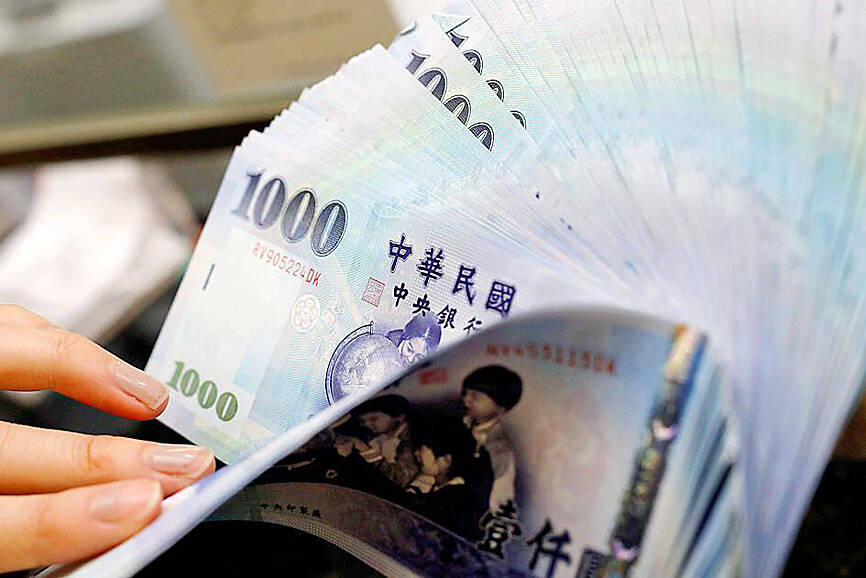
A person counts NT$1,000 banknotes at a bank in Taipei in an undated photograph.
Photo: Reuters
KMT caucus secretary-general Hsu Yu-chen (許宇甄) on Sunday said the caucus plans for the bill to go into cross-party negotiation today, and hopefully pass the third reading by Friday.
The government’s tax revenue this year significantly exceeded its original estimation, so it should be returned to the people this year, she said.
“The government’s pockets should not become fuller while the public’s wallets grow thinner,” she said.
The Ministry of Finance’s latest statistics showed that as of the end of last month, the central government’s actual tax revenue reached NT$2.857942 trillion, exceeding the original 10-month budget target of NT$2.067221 trillion by NT$790.721 billion, Hsu said.
Issuing a cash handout of NT$20,000 per person would require approximately NT$471.4 billion, less than half of the projected surplus, she said.
She questioned why people should not “share in the fruits of economic growth.”
The KMT supports establishing a permanent legal framework for universal cash handouts, including the trigger conditions, funding sources, and distribution procedures, Hsu said.
Executive Yuan Secretary-General Xavier Chang (張惇涵) yesterday said that several bills proposed or passed by the legislature over the past month are expected to add about NT$600 billion in government spending.
While sharing economic gains with the public is a good thing, the government must spend within its means and avoid burdening future generations with debt, he said.
The Executive Yuan insists on following three principles: no additional borrowing, no cuts to other policies, and legal and constitutional compliance, he added.
Meanwhile, in response to lawmakers’ questions, central bank Governor Yang Chin-long (楊金龍) yesterday said the universal cash handout policy was only possible because of this year’s strong tax revenue, but making it a permanent measure is not appropriate and certain limits must be maintained.
Additional reporting by Rachel Lin and Chen Mei-ying
Data show that Taiwan’s fiscal discipline is quite strong, but if universal cash handouts are funded purely through incurring debt, it “somewhat violates fiscal discipline,” Yang said.
If such cash handouts could stimulate economic growth and thereby increase tax revenue, that would be a different story, but that “rarely seems to happen,” he added.
KioskNews shows a cleaned-up reading view extracted from the publisher’s page — the original always lives on their site, not ours.