Pala-era Vishnu sculpture sold for Rs 8.16 crore, over 9 times estimate
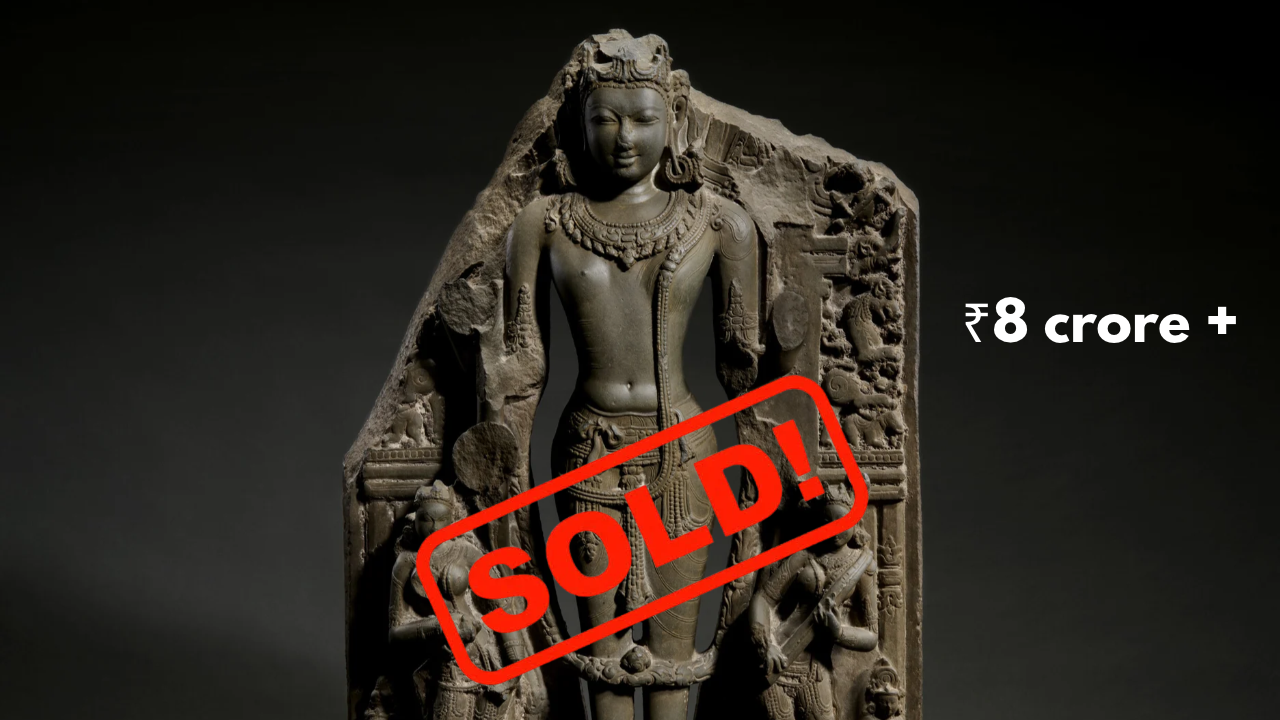
Photo credit: Christies
A blackstone sculpture of Vishnu, carved in northeastern India during the Pala period around the 11th or 12th century, has sold for £635,000 at Christie’s auction house in London. The sculpture had previously appeared at a Christie’s auction in March 1973, when it was part of the collection of René Jaquerod of Zurich, Switzerland.
The buyer acquired it at that sale and retained it for 53 years before it came to auction again in June 2026.According to the official website of Christie’s auction house, the sculpture realised more than nine times its high estimate at the June 11 sale, part of ‘Sublime Shadows: South Asian Art from a Distinguished Collection.’ Its sale price is equivalent to approximately Rs 8.16 crore. As per Christie’s, the work is a blackstone stele of Vishnu from northeastern India, dating to the 11th–12th century.
It stands 41.5 inches, or 105.4 cm, high. The lot was among 93 works offered from a single private collection at the London auction.
A detailed carving of Vishnu
According to Christie’s, the sculpture is a finely carved work that demonstrates the skill of artists working in northeastern India during the Pala period. Although parts of the stele are missing, the surviving sections show close attention to Vishnu’s facial features, body contours, clothing and jewellery.
A delicate sash appears almost transparent as it crosses the deity’s torso. Necklaces, a ‘vaijayantimala’ cord and armbands are carved with fine detail.
The treatment of Vishnu’s belt and dhoti, visible beneath the softly modelled abdomen, also reflects the sculptor’s attention to the human form.The surviving back panel includes the figures of Lakshmi to Vishnu’s left and Saraswati to his right. Other details appear in low relief along the upper side panel, including an elephant, a ‘vyala’ a mythical creature and a ‘makara,’ a composite creature found in Indian art, alongside a youthful male figure.
The lower section beneath the throne is decorated with lotus blossoms and donor figures. These elements form part of a composition in which the central image of Vishnu is surrounded by smaller figures and decorative details.
From a Swiss collection to a 1973 auction
The sculpture’s recorded provenance begins with the René Jaquerod Collection in Zurich. Christie’s catalogue states that it appeared at the auction house’s London sale on March 19, 1973, as lot 113, and was acquired from that sale by the owner represented in the later provenance.
The sculpture remained with its buyer for the following 53 years before being offered again at Christie’s in June 2026.According to Christie’s press release, the June 11 auction realised a total of £18,909,996 and was completely sold by both lot and value. The 93 works in the sale came from a collection formed during the 1990s and early 2000s, with a focus on Bengal’s artistic legacy and the development of modern South Asian visual culture. The Vishnu sculpture was one of the sale’s notable results, achieving more than nine times its high estimate.
KioskNews shows a cleaned-up reading view extracted from the publisher’s page — the original always lives on their site, not ours.