Jensen Huang’s scandal exposes Nvidia’s ‘key-man risk’. What does it mean?
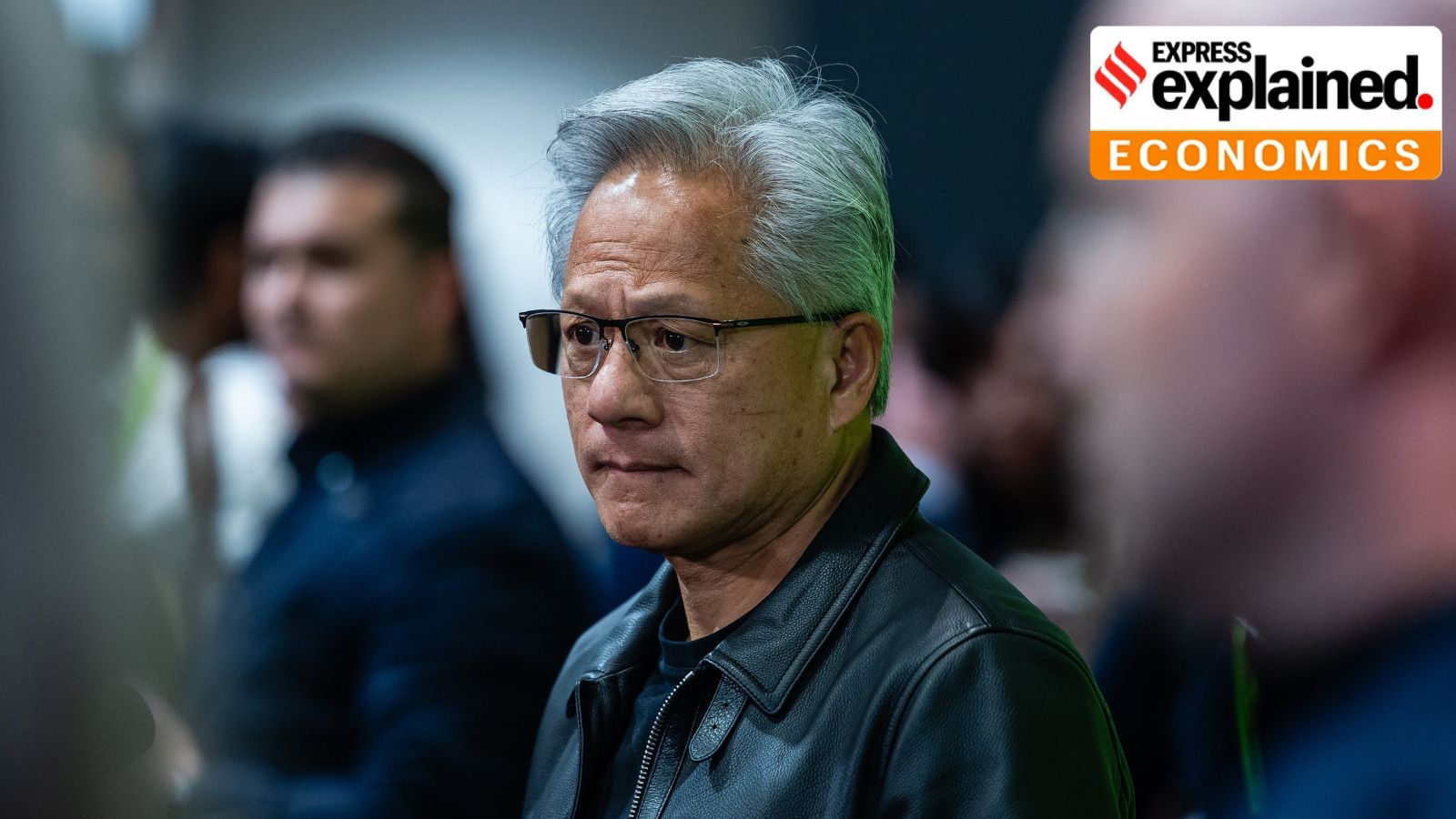
Nvidia key-man risk: Nvidia CEO Jensen Huang’s extramarital affair with an alleged Chinese spy, already being billed as the ‘most expensive extramarital affair in corporate history’, is yet another reminder of a growing concern among big businesses on Wall Street: ‘the key man risk’.
Simply put, the key man risk refers to the potential impact stemming from the loss of a key employee, typically a founder or an influential CEO, whose contribution is critical to business success.
Some business owners see the company’s reliance on them as a badge of honour, and Huang, a key figure in the artificial intelligence revolution, pretty much fits the bill. A close adviser to US President Donald Trump, Huang has consistently spoken out against regulating the industry so as not to let China gain the upper hand in the AI race, while also relentlessly campaigning in favour of sales of advanced Nvidia chips to China.
Bernstein analyst Stacy Rasgon warned that the controversy has exposed substantial leadership concentration risk at the $400-price-target chipmaker. “The revelations over the weekend also highlight the considerable key man risk that NVIDIA faces,” the Bernstein analyst said in a November 9 report titled NVIDIA (NVDA): Stirring the (honey)pot?.
Mohamed El-Erian, the Rene M Kern Prof of Practice at Wharton, has said that “the so-called key-man risk looms large here (Nvidia)”, and that it was doubtful if markets had adequately priced this risk in. “This will not be easy for the board to navigate”, he said in a post on X Monday.
Why the controversy comes at a difficult time for Nvidia
The scandal couldn’t have come at a worse time, right when the AI trade is on really shaky ground, with a brutal industry-wide valuation slide underway after the US midterms results.
Story continues below this ad
The risks for Nvidia are heightened given that the chip-maker increasingly resembles a family firm: Huang’s daughter and son hold senior executive positions, and Huang himself is the larger-than-life brand mascot in what is a purely business-to-business operation. If the AI race were a gold rush, Nvidia is currently the one selling most of the shovels. In that sense, Nvidia was seen as relatively insulated from the larger AI monetisation risk, which the large language model developers are faced with. But in Nvidia’s case, a lot rests visibly on Huang, and the big question mark is whether he will be forced to step down, given that the Federal Bureau of Investigation is now investigating the case.
The American government is said to have commenced its surveillance of the Chinese operative more than a year ago, when it first believed that her employer – Singapore-based Megaspeed – was illegally smuggling Nvidia’s GPUs into China. Marco Rubio, the US secretary of state, reportedly readied a confidential note earlier this year warning officials in the administration in DC about Huang’s involvement with a suspected Chinese spy. Months later, when Trump took executives with him on a trip to China, Nvidia’s chief was initially left out, but then included at the very last minute.
Huang has consistently called for sales of advanced Nvidia chips to China, and this has been his position for many years, and something that likely precedes his meeting with the alleged Chinese spy. But his positions will be under fresh scrutiny given the revelations of the affair. According to Isaac Stone Fish, CEO and founder of Strategy Risks and Visiting Fellow at the Atlantic Council, “Beijing usually dislikes when American companies receive massive press attention for being too pro-China. It wants the mechanics — around honey trapping and influence campaigns – to stay in the shadows. So far, Beijing has denied the allegations and claimed that this is a smear campaign against China. Nvidia needs to have a deep understanding of what its China exposure is and price out the risk of offending the US versus offending China”.
The global artificial intelligence (AI) boom has propelled Nvidia into becoming one of the world’s most valuable companies, as technology giants such as Google, Microsoft, Meta and Amazon spend billions of dollars building AI infrastructure powered by its advanced chips. Nvidia’s graphics processing units (GPUs), which were built for gaming consoles but serendipitously proved useful in AI server stacks, have gone on to become central to training and running sophisticated large language models, giving the chip-maker a dominant position in the market for AI computing hardware.
Story continues below this ad
What is ‘key-man risk’, and why does it matter?
Ideally, no business of scale, especially with public shareholders, should be overly reliant on a single person. When a business owner, or a key figure running operations, is seen as disproportionately contributing to a company’s success, the inherent risks associated with this ‘key man’ are seen as posing a fundamental threat to the business. If this individual were to suddenly leave or is suddenly incapacitated, the company could flounder, both operationally and financially.
The key man risk is visible across the American corporate world. Would Tesla perform as well if Elon Musk quit? Or would Meta adapt to Mark Zuckerberg leaving? Or Jamie Dimon at JP Morgan Chase? Increasing numbers of systemically important companies are now overwhelmingly dominated by single individuals.
How Tesla illustrates the risks of dependence on one leader
Early last year, this risk was flagged in the American corporate sector after Tesla chief Elon Musk, the world’s richest man, managed to bulldoze the Austin-based automaker’s board and shareholders into approving a record-breaking pay package that could be worth up to $1 trillion.
Story continues below this ad
While the scale of the potential payout has drawn widespread criticism, the Tesla board’s counterargument has been that Musk might leave the company if it was not cleared – and that Tesla could not afford to lose him. And that again went on to highlight ‘the key man risk’ and how some business owners see the company’s reliance on them as an indispensable feature that can be milked for eking out personal gains. Musk had built on a self-propagated assertion that the company simply cannot do without him. He’d threatened to resign multiple times earlier too.
The payout was predicated on Musk drastically raising the electric car firm’s market value over the next decade to $8.5 trillion from under $2 trillion, and getting a million self-driving Tesla Robotaxi vehicles into commercial operation.
Unlike Huang’s track record at Nvidia, the way Musk has run Tesla in recent years does not exactly inspire confidence: given that he has a solid track record of overpromising and underdelivering. Earlier last year, for instance, Musk promised to deliver driverless taxis in several American cities, secure regulatory clearances in Europe for his self-driving software and push sales up 30 per cent or so. Instead, his driverless robotaxis are restricted to just two US cities – Austin and San Francisco – and even in these places, they have human safety professionals inside. European regulators are still to approve his self-driving software, while Tesla sales continue to plunge across markets, including China and Germany. Tesla has failed to update its jaded line-up of cars and is being beaten hollow by Chinese upstarts including BYD and Xpeng.
Many investors have come out in open support of the Musk pay package, including New York-based Baron Capital Management, whose founder Ron Baron termed Musk “indispensable” to the company. Critics include the biggest American public pension fund, Calpers, and Norway’s sovereign wealth fund, which have argued that the pay is excessive. The Norwegian fund has even flagged concern that the Tesla board that cleared the proposal before it went to shareholders included Musk’s own brother and that it is not “independent enough”, the Associated Press had reported in 2025.
Story continues below this ad
Even the Vatican has weighed in, admonishing the growing wealth inequality in the world and red flagging the trillion dollar pay package in particular. “If that is the only thing that has value anymore, then we’re in big trouble,” Leo said in the comments quoted by AP last year.
KioskNews shows a cleaned-up reading view extracted from the publisher’s page — the original always lives on their site, not ours.