‘Our aim is that children are protected’: besieged West Bank school fortifies its defences against settler violence
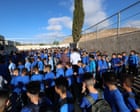
This year, parents in al-Mughayyir had to be persuaded to send their children back to school. Israeli settlers had killed five teenage students last academic year – one of them at the school gates.
To reassure parents, teachers of the public secondary school gave a tour of the facilities, which they had spent the summer break fortifying. Metal fences now towered over the schoolyard’s walls and the door had been replaced by a sturdy metal gate. A new wall shielded the classrooms from a hilltop where last academic year a settler had shot dead two people, including a student.
Al-Mughayyir, a town of about 3,000 people north-east of Ramallah in the occupied West Bank, is under a siege by Israeli settlers. Armed settlers regularly raid the village, assaulting residents, attacking homes and seizing livestock. Israeli soldiers set up checkpoints that prevent people from entering or leaving for hours at a time.
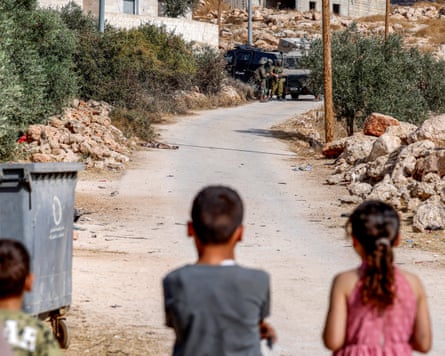
The school is isolated on the very edge of the village, close to its entrance. Settlers stage their raids around the school, attacking under the watchful eye of the Israeli military.
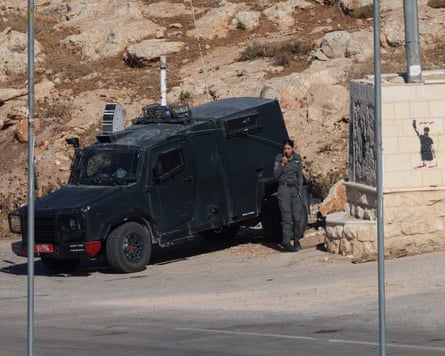
A single Israeli soldier stands at the entrance of the village, his rifle slung over his shoulder as he paces back and forth idly. It is he who decides who can come and go in the village. The excited shouting of schoolchildren playing can be heard from where he stands; the children’s voices echo across the otherwise quiet village, most shops shuttered despite it being a weekday.
Residents say the violence is part of a wider project to displace Palestinians from their land, one that has already driven smaller communities from their homes. Now, they fear the same tactics are being turned against an entire village in an attempt to make life so intolerable that residents leave.
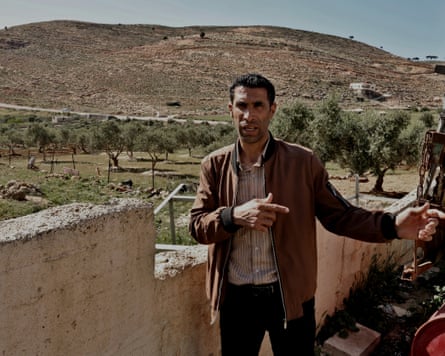
“When the settlers began their attacks, they began in the Jordan valley area, displacing communities of farmers consisting of 10, 20 people. Now, they are trying to displace entire villages. What’s happening in al-Mughayyir is the beginning of this project,” said Ameen Abu Alia, the 54-year-old mayor of the town.
Abu Alia has watched as the number of settler outposts – small groups of Israeli shepherds who establish outposts near Palestinian communities – has multiplied around the town over the last three years. In 2023, there was just one settler outpost near the town. Now, there are 12.
Settlers now enter the town on a regular basis, shutting down roads, and harassing residents as they graze their sheep on fields next to the school and deeper in the village. Residents say that settlers steal sheep from villagers, provoking fights with residents who depend on livestock for their livelihood. When villagers resist they can be arrested, or killed.
In 2024, settlers attacked a home in al-Mughayyir. Waheed Abu Naim, a 37-year-old schoolteacher, rushed to help defend it, trying to push the settler away. The settler put a pistol to Abu Naim’s breast and squeezed the trigger. Abu Naim closed his eyes, but no explosion followed – the settler had already fired his last bullet.
The settler siege is a tactic seen in the West Bank before. Small settler outposts run by teenagers and a few adults have popped up around small Bedouin communities in the Jordan river valley since 2023 and engaged in a steadily escalating campaign of violence to make life intolerable for the Palestinians living there. In Ras ‘Ein al-‘Auja in the south Jordan valley, settlers drove out the last inhabitants of the community in January after they could no longer endure the constant attacks, in a pattern similar to what is now happening in al-Mughayyir.
Despite settlements being considered illegal under international law, the Israeli government has taken few steps to curtail steadily expanding settler violence, beyond issuing a few condemnations. Extremist ministers in the Netanyahu government have equipped settlers with guns and vehicles and the rate of settlement expansion has soared under the current government.
The settler outposts are not visible from al-Mughayyir but are present just beyond the arid hills that ring the village. Residents drive fast along the winding 1-mile road that leads into the town, wary of how exposed they are to settler attacks along the way.
Local people describe close cooperation between Israeli soldiers and settlers. They often see them talking as settlers enter the town, and soldiers provide protection for settlers, only intervening when they – not Palestinians – are under threat.
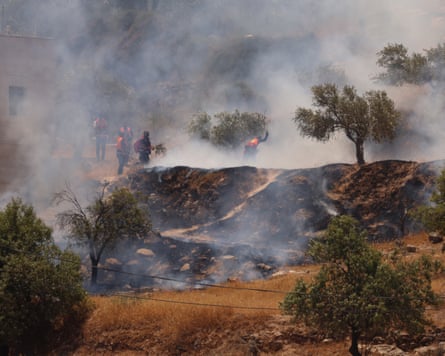
In early September two teenagers, Omar al-Nassan, 19, and Khalil Abu Alia, 16, were killed by settlers and Israeli soldiers as the pair tried to stop settlers from taking their sheep, Abu Alia said.
“The last theft was of 60 sheep in the centre of the village. Ten military vehicles came. They came into the centre of the village and laid siege to that area. They stole the sheep and opened fire on people,” said Abu Alia.
The Israeli military said that it entered the village to provide security for an Israeli civilian and police trying to retrieve livestock, and that it fired on “key instigators” when Palestinians threw stones at the soldiers.
The village’s olive groves remain unpicked, despite the arrival of the season’s first rains, which signal the fruit is ripe: villagers are wary of the settler violence they have seen accompany harvests in neighbouring villages. Settlers have carried out more than 170 attacks since the start of the harvest at the end of September, according to Yesh Din, an Israeli rights group.
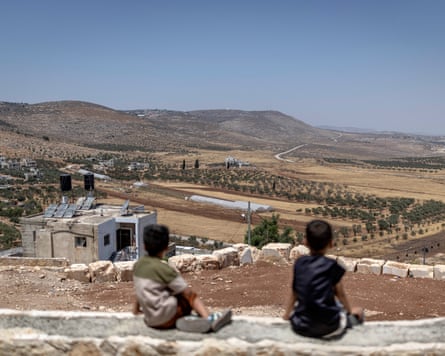
While settlers attack residents, the Israeli military is placing increasing restrictions on villagers. Olive production is a key industry, but residents have been prohibited from harvesting without prior military approval. The military closes the only entry to the village for several hours a day, several times a week, preventing people from going to work and teachers from reaching the school.
The result has been a slow strangulation of people’s livelihoods. Already, three families have left the village to be closer to their work, fearful of the constant road closures.
“Someone who has no money is now forced to sell part of their flock, and end their involvement in farming and search for other work,” said Abu Alia.
At the secondary school, teachers have developed emergency plans for settler attacks and incorporated lessons on avoiding confrontations into their curriculum, trying to preserve a sense of normality for their students.
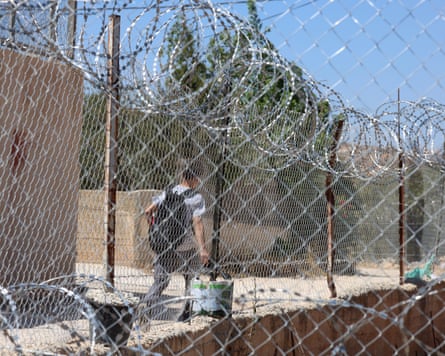
“The school’s aim is that when the children enter the school, and when they go home, they are protected,” said Bassam Abu Assaf, the 54-year-old principal of al-Mughayyir secondary school. “The amount of time we spend sitting is almost nonexistent. Our eyes are outside the school. We’re thinking, God forbid, there could be a settler attack against us.”
Despite the precautions, students’ educations have inevitably been disrupted. About 80% of the school staff live outside the village, and they are often prevented from entering the school by the Israeli military checkpoint. School is only in session for three days a week, and ends early so teachers don’t get caught by the road closure, which typically happens in the afternoon. Once, the Israeli army shot teargas near the school and the noxious fumes blew into the classrooms, with teachers powerless to stop it.
“Today there was news that settlers were present outside. Now, the student is sitting in front of you, but they’re not paying attention. He’s thinking about the danger that could come from the army, from the settlers. ‘Where are the settlers? Where is the army?’ That’s what he’s thinking about,” said Abu Naim, the teacher. His own brother was killed last April in a settler attack outside the school.
“You try as much as possible to make the student concentrate with you – but the educational gap becomes very large because of the number of days when the student can’t concentrate,” he said.
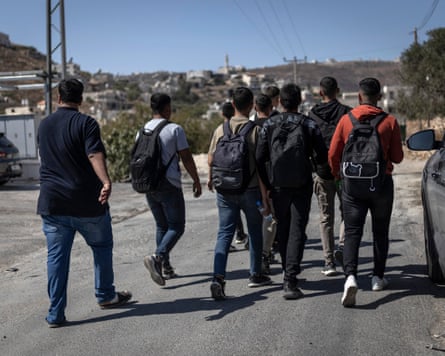
Abu Assaf, who attended the school he now heads, remembers a different childhood in the village, when children could roam freely through the surrounding hills.
“We could walk around, coming and going. Everything was open. We’d have fun, we’d barbecue. Now, the kids are stuck in their homes, seeing the world through their phones,” he said.
At noon the bell rang, marking the end of the school day. Students gathered in the yard as teachers peered over the gates to see if any settlers were about. Seeing none, they let the students out.
“There is a plan of displacement. But we will raise another educated generation regardless. Our aim is to confront these attacks through education,” said Abu Naim.
KioskNews shows a cleaned-up reading view extracted from the publisher’s page — the original always lives on their site, not ours.