US officials decide against backing Saudi Arabia in Yemen after meeting Houthi leaders
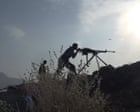
Officials from the US met Houthi leaders over the weekend at the country’s embassy in Muscat, Oman, it has been confirmed, leading to the US decision not to intervene to help Saudi Arabia drive back a Houthi advance inside Yemen.
The Houthis reassured the US that the ceasefire agreement between the two sides struck in 2025 still held and the movement had no intention of attacking US shipping in the Red Sea. Only Saudi-linked shipping was regarded as a target owing to its blockade of Yemen, the Houthis confirmed.
The meeting helps to explain the decision from the US president, Donald Trump, to condemn the Houthi advance down the west coast of Yemen for threatening freedom of navigation through the Bab al-Mandab strait, but so far to reject any military response in support of Riyadh. The US is already embroiled in an expensive and resource sapping conflict with Iran, which backs the Houthis.
The US labelled the Houthis as a foreign terrorist entity in March 2025, but in the recent past has met leaders from Hamas, Hezbollah and Iran. The US vice-president JD Vance confirmed on Monday that the US was in direct contact with the Houthis.
The US refusal to become directly involved has put pressure on Saudi Arabia to reach either a diplomatic solution with the Houthis over the future governance of Yemen, or to try to build a regional alliance with Pakistan and Turkey to force the Houthis back. In a lightning offensive last week, the Houthis seized control of large swathes of western Yemen along the Red Sea coast.
The former deputy US ambassador to Yemen, Nabeel Khoury, said a “kind of tacit understanding between the Trump administration and the Houthis” had been struck. Khoury added: “The Houthis are promising the American administration that American and international navigation will not be affected in the Red Sea, but the only danger is to Saudi ships or those carrying Saudi oil.”
In a bid to build popular support against the Houthis in the region, Riyadh made the controversial claim that the Houthis had fired a drone at the holy city of Mecca on Tuesday, but the missile had been destroyed by Saudi defence forces. It said the drone was entering a prohibited airspace close to Mecca’s most holy shrines. The drone was intercepted at about 6.50pm local time on Tuesday, coalition spokesperson Maj Gen Turki al-Maliki said in a statement.
Saudi Arabia said any attack on Mecca is a red line and the move was condemned in lengthy statements by the UN-recognised Yemen government based in Aden as well as the 57-country Organisation of Islamic Cooperation. The Pakistani prime minister, Shehbaz Sharif, condemned what he described as a “dastardly and heinous” attempted attack on Mecca. “The people of Pakistan are saddened and perturbed by this outrageous act,” he said in a statement posted on X.
Houthi leadership – followers of a Shia Zaydism that respects the pilgrimage to Mecca – dismissed the claim as the lie of the century, adding that such worn-out lies had been used before and had fooled no one.
The Houthi’s deputy foreign minister, Abdul Wahid Abu Ras, said “whoever opened the land of the two holy mosques to debauchery and entertainment parties, and whoever defiled the land of the two holy mosques by the presence of Zionist Jews in it, is the one who targets Mecca, Medina and the Islamic holy sites”.
The Houthis countered that they had shot down a Saudi F-15 plane close to Marib, and attacked an Aramco plant in the Red Sea port city of Yanbu. No supporting evidence was provided by the Houthi military spokesperson, but the head of the Houthi negotiating team, Mohammed Abdul Salam, said the downing of the plane was a warning to the west not to fall victim to Saudi propaganda.
Mohammed al-Farah, a Houthi political bureau member, said: “The truth is that Saudi Arabia is experiencing a real predicament in Yemen. It became embroiled in a war, a siege and an occupation, and then failed to achieve its goals.
“Today, it is looking for external solutions, so it is begging the international community, warning the world about Bab al-Mandab and requesting support from Pakistan, Turkey, America, Israel and Egypt. Then it is trying to mobilise Muslims with a false pretext called ‘targeting Mecca’.”
Separately, Israeli officials have leaked details of a secret meeting between military commanders from the US, Israel and several Arab states in Germany last week to discuss the war launched by Israel and the US against Iran. The report from Axios journalist Barak Ravid said the “private retreat” was organised by the commander of US Central Command (Centcom), Adm Brad Cooper.
after newsletter promotion
Citing two unnamed Israeli officials, Ravid reported that the meeting was attended by the military chiefs of staff of Israel, Saudi Arabia the UAE, Bahrain, Kuwait, Qatar Jordan and Egypt. It was the first such gathering since the US and Israel went to war with Iran more than six months ago. Israel, once a target for the Houthis, is offering to intervene in Yemen on Saudi Arabia’s behalf.
A meeting of the UN security council on Tuesday condemned any attempt to close the Red Sea, but the meeting was notable for the Russian envoy beginning to edge away from its previous stance that the UN-recognised government based in Aden was the only legitimate government inside the country.
In Beijing, the Iranian foreign minister, Abbas Araghchi, on Wednesday met his Chinese counterpart, Wang Yi, in a bid to secure Chinese support for its plans for the future administration of the strait of Hormuz. The strait remains effectively closed owing to separate Iranian and US blockades.
A Chinese foreign ministry spokesperson said China does not want to see further regional tension spill over into Yemen and the Red Sea. The Chinese called on the US to return to the talks based on the memorandum of understanding agreed between the two sides in June. Beijing, the main importer of Iranian oil, is eager for a settlement and is resisting any suggestion that US secondary sanctions applied to countries trading with Iran should apply to its own country.
Oil prices remain well over $100 (£74) a barrel and a key Saudi East-West pipeline remains closed because of a bombing incident.
KioskNews shows a cleaned-up reading view extracted from the publisher’s page — the original always lives on their site, not ours.