Taiwan elections: KMT holds Taipei, New Taipei but loses Taichung as challenges rise

The “nine-in-one” elections cover nine categories of local office across Taiwan, from city mayors and county magistrates down to village chiefs.
The KMT narrowly retained New Taipei, extending its 21-year grip on Taiwan’s most populous municipality as Lee Shu-chuan beat DPP candidate Su Chiao-hui.
New Taipei City was considered one of the highest-stakes battlegrounds going into the polls, and also a key test of opposition “blue-white” cooperation between the KMT and the smaller Taiwan People’s Party to maintain two decades of pan-blue rule.
The DPP, however, scored a victory in Taichung, a key swing city in the island’s politics. Ruling party candidate Ho Hsin-chun captured 50.6 per cent of the vote to wrest control of the municipality from the KMT, which also lost its 25-year hold on the northern tech hub of Hsinchu county in the magistrate vote.
With the DPP also retaining the mayoral seat in Tainan and the KMT holding Taoyuan, the balance of power in Taiwan’s six special municipalities shifted from four-to-two in favour of the KMT to an even three-three split.
The KMT also lost the county magistrate races for Yilan in the northeast and Changhua in central Taiwan. The two, together with Hsinchu county, were viewed as particularly vulnerable seats for the party ahead of the polls.
In Taipei, Chiang garnered more than 780,000 votes or nearly 54 per cent of the total against just under 46 per cent for his DPP challenger Puma Shen Pao-yang, according to official election results.
Chiang’s victory underscored the resilience of the KMT’s traditional electoral base in Taipei despite an emerging social media-driven political movement. The victory is also expected to strengthen his political standing within the KMT at a time when the party faces renewed questions over its electoral strategy ahead of the 2028 general election.
“I thank the great citizens of Taipei for using their sacred ballots to affirm the administration’s performance over the past four years,” Chiang told supporters outside his campaign headquarters on Saturday evening.
“This result validates the value of a rational, pragmatic and centrist approach. It also reveals that the silent masses in Taipei desire a stable life and a prosperous society, seeking practical solutions to problems rather than political turmoil and clamour.”
Shen conceded defeat in a speech earlier on Saturday evening, urging supporters to respect the election results and refrain from spreading unsubstantiated claims about voting irregularities.
“The results are in – I lost. I just called Mayor Chiang to congratulate him on his re-election,” he said.
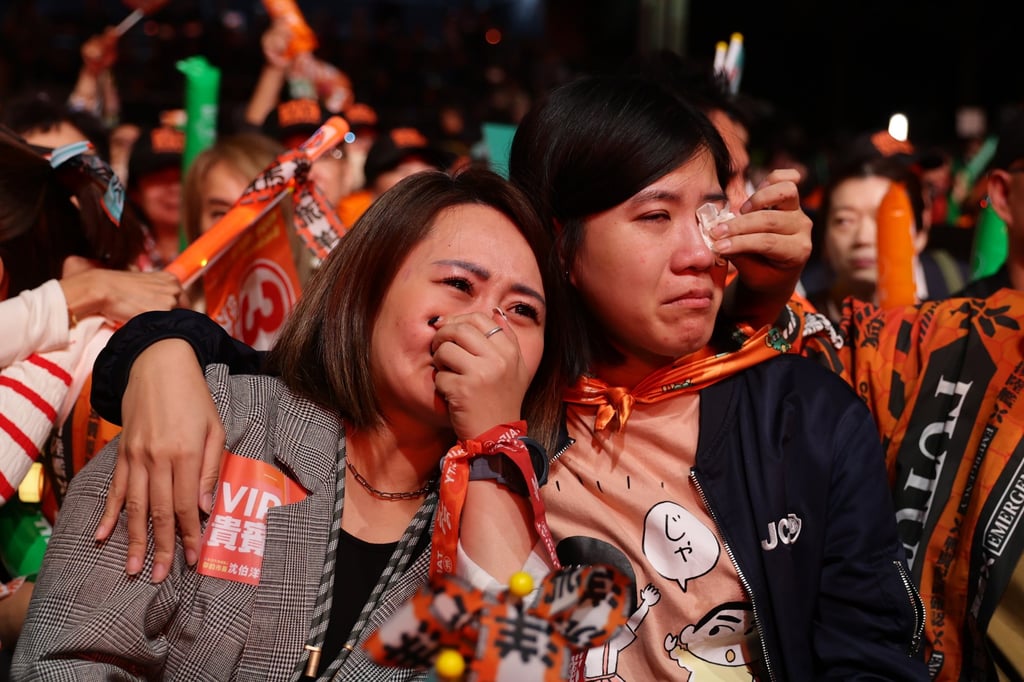
Analysts said that while Chiang’s victory highlighted the strength of the KMT’s traditional support base in the capital, the DPP’s gains elsewhere underscored the challenges facing the opposition as both parties turn their attention to the 2028 leadership race.
However, the DPP suffered a setback on a major policy issue. A referendum on nuclear power held alongside Saturday’s elections secured sufficient public support to pass, dealing another blow to the ruling party’s long-standing policy of a nuclear-free Taiwan.
With results in from more than 96 per cent of polling stations, some 7.16 million voters backed the proposal, compared with 4.4 million who opposed it, according to the Central Election Commission.
The outcome is expected to put further pressure on the William Lai Ching-te administration to reconsider its energy policy amid growing concerns over the island’s ability to ensure a stable electricity supply for its energy-intensive semiconductor and artificial intelligence industries.
Chang Yuan-hsiang, a political science professor at Soochow University in Taipei, said the six municipalities were the key battlegrounds in assessing the performance of the two major parties.
Although the experience of the 2018 and 2022 local elections showed that the results did not necessarily determine the outcome of subsequent leadership elections, they could significantly influence the political momentum of the KMT and DPP, Chang said.
At Chiang’s campaign headquarters, jubilant supporters waved flags and chanted slogans.
One of them said she had been worried by the strength of Shen’s campaign – known as yangliu, or “the ocean current” – particularly as many of her friends supported the DPP candidate, while KMT voters tended to keep a lower profile.
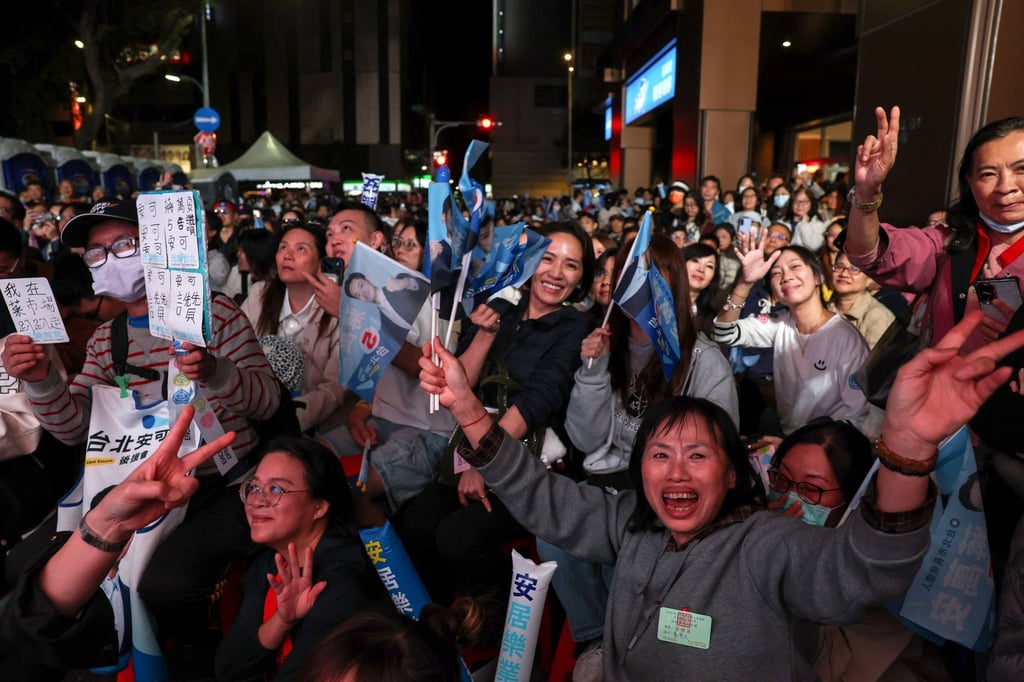
Another said he had been extremely nervous before the election because of the momentum generated by Shen’s campaign and had genuinely feared that the challenger might prevail.
Huang Huei-hua, director of the Taipei-based Taiwan Global Talk think tank, said the impact of the ocean current movement in Taipei had fallen short for several reasons.
“Many families in Taipei remain deeply loyal to the Chiang family,” she said, referring to the political legacy of the family of former Taiwanese leader Chiang Kai-shek.
“While Taipei residents may think highly of Shen, Chiang Wan-an’s four years in office have been free of corruption scandals. Voters therefore saw no compelling reason to remove him from power.”
Pre-election surveys also indicated that most Taipei residents were reasonably satisfied with their lives, Huang said.
However, she said the ocean current movement did appear to have had an impact on the contests in New Taipei and Taichung.
The results raise questions over whether the movement’s online momentum can translate into lasting shifts in voter allegiance.
02:55
Peace is a ‘common wish’: Taiwan opposition leader meets Xi Jinping in Beijing in rare visit
Du Sheng-tsong, head of the department of radio and television at Ming Chuan University in Taipei, said younger voters’ political preferences had become increasingly difficult to predict given the proliferation of short-form videos and changes in social media algorithms.
“Political manipulation may influence young people temporarily, but online sentiment shifts rapidly. Candidates who rely excessively on image-building may not necessarily be able to sustain their support,” he said.
“Both their policy proposals and actual performance must withstand a ‘stress test’.”
Ahead of Saturday’s vote, Beijing’s Taiwan Affairs Office directed sharp rhetoric at Shen, suggesting there would be no prospect of engaging with him should he become Taipei mayor.
Shen, a criminologist known for his research into disinformation and cognitive warfare, has been labelled a “diehard Taiwan independence separatist” by Beijing and placed under sanctions.
Beijing views Taiwan as part of China to be reunited by force if necessary. Most countries, including the United States, do not recognise Taiwan as an independent state, but Washington is opposed to any attempt to take the self-governed island by force and is committed to supplying it with weapons.
KioskNews shows a cleaned-up reading view extracted from the publisher’s page — the original always lives on their site, not ours.