The 2026 Bentley Supersports is what happens when you combine luxury with on-track performance
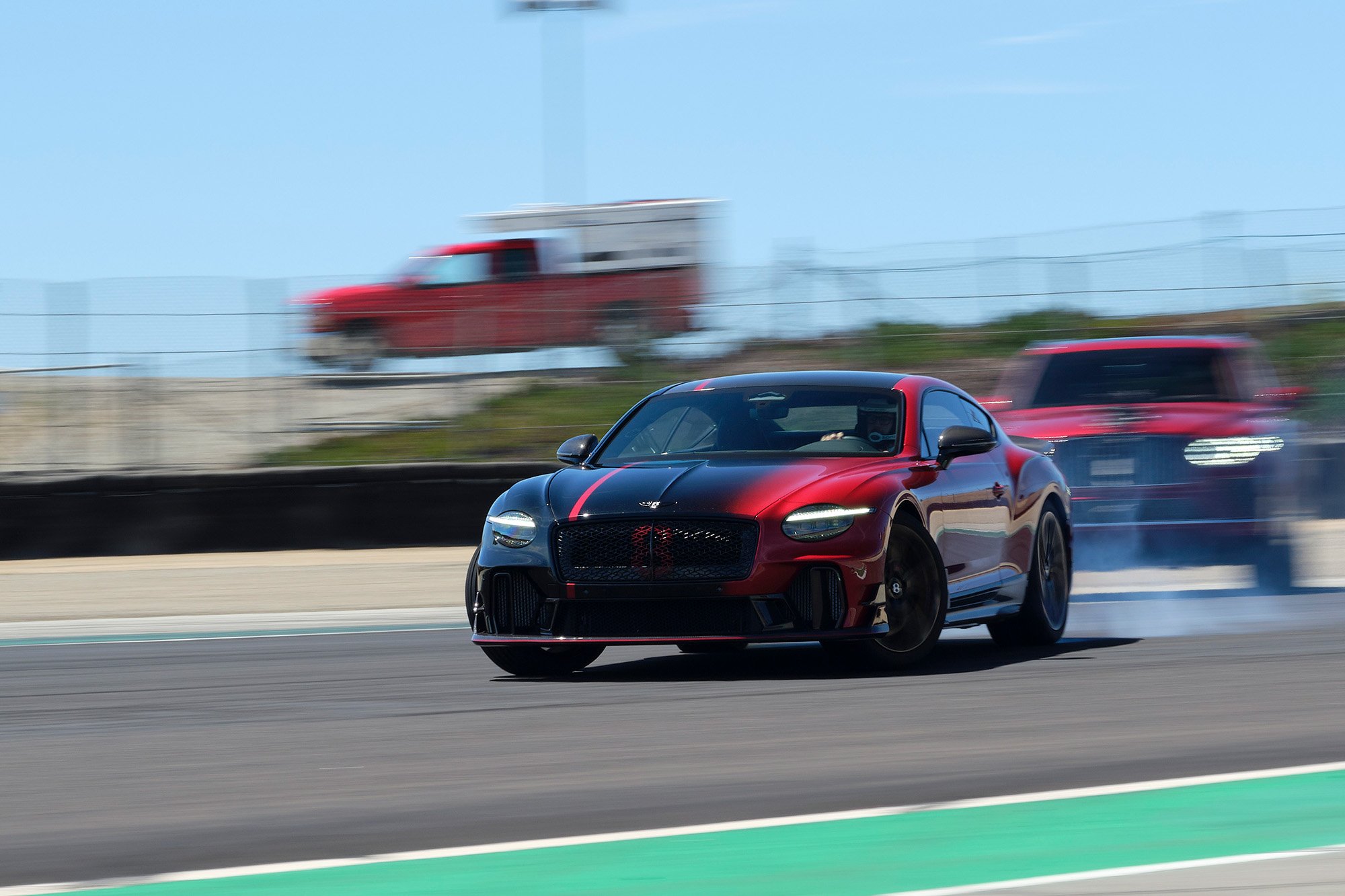
“Less is more” may seem a curious phrase when applied to a half-million-dollar, 199-mph, 657-horsepower twin-turbocharged V8 brute. But in the context of the posh luxury barges we expect from British automotive manufacturer Bentley, it’s applicable to the 2026 Bentley Supersports.
That is because this car is as notable for what it lacks as for what it has. The Supersports is a rear-drive, combustion-only version of the Bentley Continental GT. But where that car has always employed all-wheel drive, and the current generation uses a hybrid-electric powertrain, the Supersports is the result of a “what-if” project by Bentley engineers.
They wondered what was possible if they stripped the heavy all-wheel-drive and hybrid systems from the Continental GT and built a purely combustion-powered rear-drive car with track driving in mind. The answer is the Supersports.
“Half-million dollars” is an approximation. The official starting price in the US is $486,600, but Bentley has already sold the entire production run, and every car has been customized, ensuring none of the cars actually sold for the list price.
“Each client that has ordered a car has worked with our Mulliner division [which provides personalization] on co-creation,” said Rocco. Even while confirming that less is more, it doesn’t hurt to add a few extra goodies.
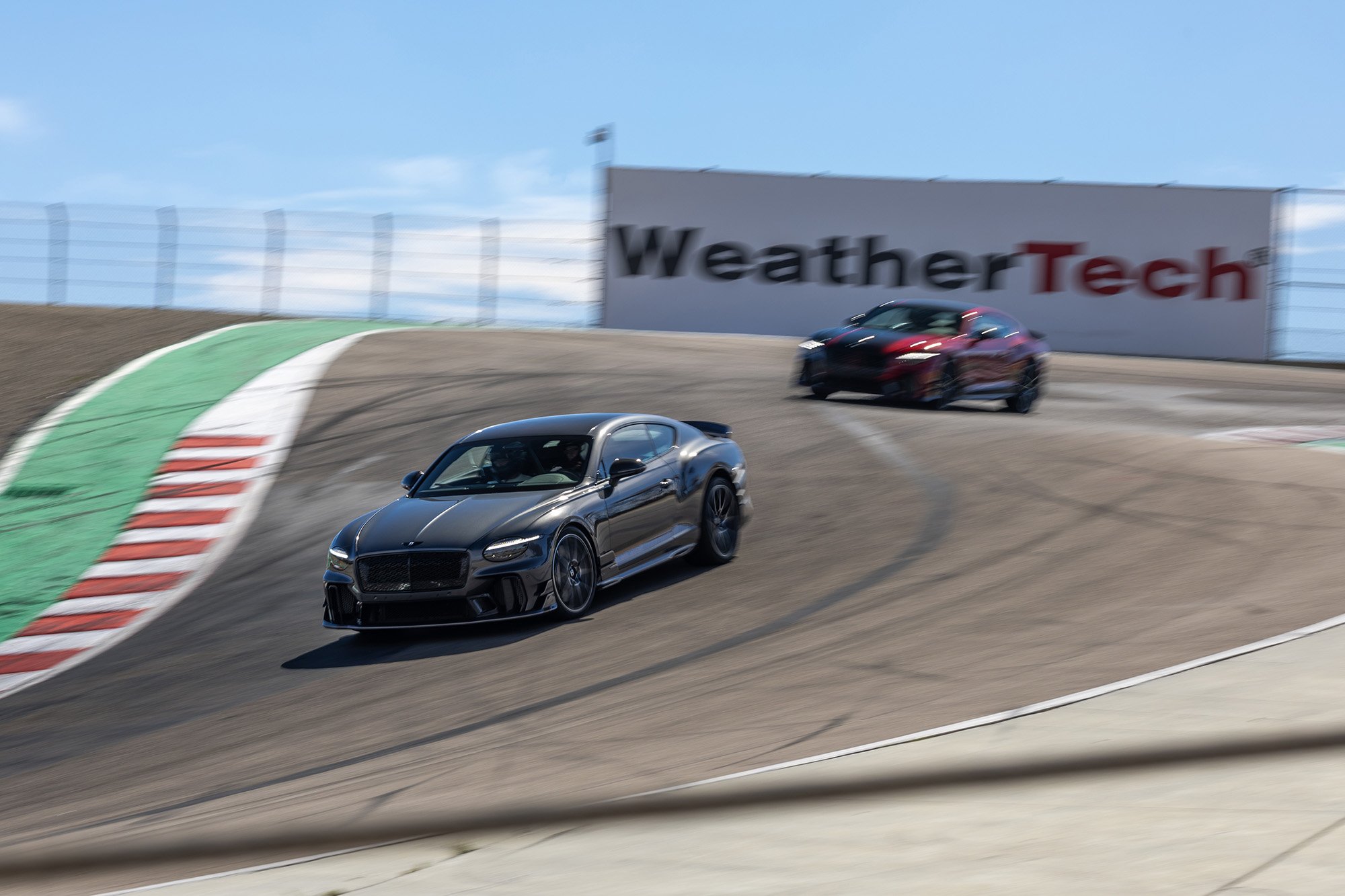
The same hybrid-electric system that contributed to the tranquility of the Continental GT Speed we tested previously also adds mass that is detrimental to on-track performance. Similarly, that car’s all-wheel-drive system provides security during trips to the ski chalet, but induces understeer in spirited track driving.
Eliminating those components not only creates a purer sports car, but it also eliminates an incredible 1,000 lbs. of mass. Carbon-fiber bodywork, lightweight forged aluminum wheels, and a titanium exhaust system also contributed to the Supersports’ diet. “If you look at the carbon fiber on the side of the car, it is all purposeful; it is for downforce and to help the wind clear and cool the car as it’s being driven,” explained Bentley Americas President and CEO Mike Rocco.
A souped-up version of the Continental GT’s twin-turbo 4.0-liter V8 delivers 657 hp and 590 lb.-ft. of torque without the aid of an electric motor and battery pack. The engine’s new parts include larger-diameter single-scroll turbochargers and a dual-mass flywheel.
The engine’s lovely, energetic exhaust note comes through an Akrapovič titanium active exhaust system, so when you’re at the race track and want to hear it, you can turn up the volume. And when you’re leaving home for the gym at 6 am on a Monday morning, you can dial down the volume and let your neighbors sleep.
The V8 powers the rear wheels through a ZF-supplied 8-speed dual-clutch transmission that delivers instantaneous, seamless gear changes, either automatically or through the steering wheel-mounted shift paddles. During laps around WeatherTech Raceway Laguna Seca in Monterey, Calif., the automatic programming for the transmission’s shifts was flawless, correctly clicking down through the gears under braking for the legendary Corkscrew turn and then back up again, working down the hill back toward the track’s front straight.
The torque-vectoring, electronically limited-slip differential minimizes the wheelspin and oversteer that the turbo V8, with its 590 lb.-ft. of torque, could produce accelerating out of the slower turns. But neither the differential nor the advanced electronic stability control system neuter the power, so pressing the accelerator with a little too much authority causes the Supersports’ back end to slither. It’s a good reminder to be a little gentler on the next lap! When pointed straight, the Supersports accelerates to 60 mph in 3.4 seconds.
The brakes provide the necessary deceleration with 17.3-inch carbon-silicon-carbide rotors and positively massive 10-piston calipers up front. Rear brakes are a comparatively paltry 16.1-inch rotors with commonplace 4-piston calipers.
These brakes provide huge stopping power without the annoying squeal common with high-performance carbon brakes during lighter braking. Pedal feel is good, and the friction is progressive, with none of the aggressive bite of Ferrari brakes in casual driving or the mushy vagueness of Lamborghini brakes at track speeds.
The various carbon fiber spoilers, diffusers, splitters, and dive planes do their job, creating effective downforce at speed, which makes braking more effective at high speeds. So rather than easing into the brakes as you might normally, the Supersports rewards heavy initial brake application that you taper as the vehicle slows and it loses downforce.
Tires are 275/35 ZR22 front and 315/30 ZR22 rear Pirelli P Zero Trofeo RSs on 22-inch forged aluminum wheels (it seems more appropriate to pronounce it al-yoo-MIN-ee-um for a Bentley, but then we’d also have to spell the rubber “tyres”).
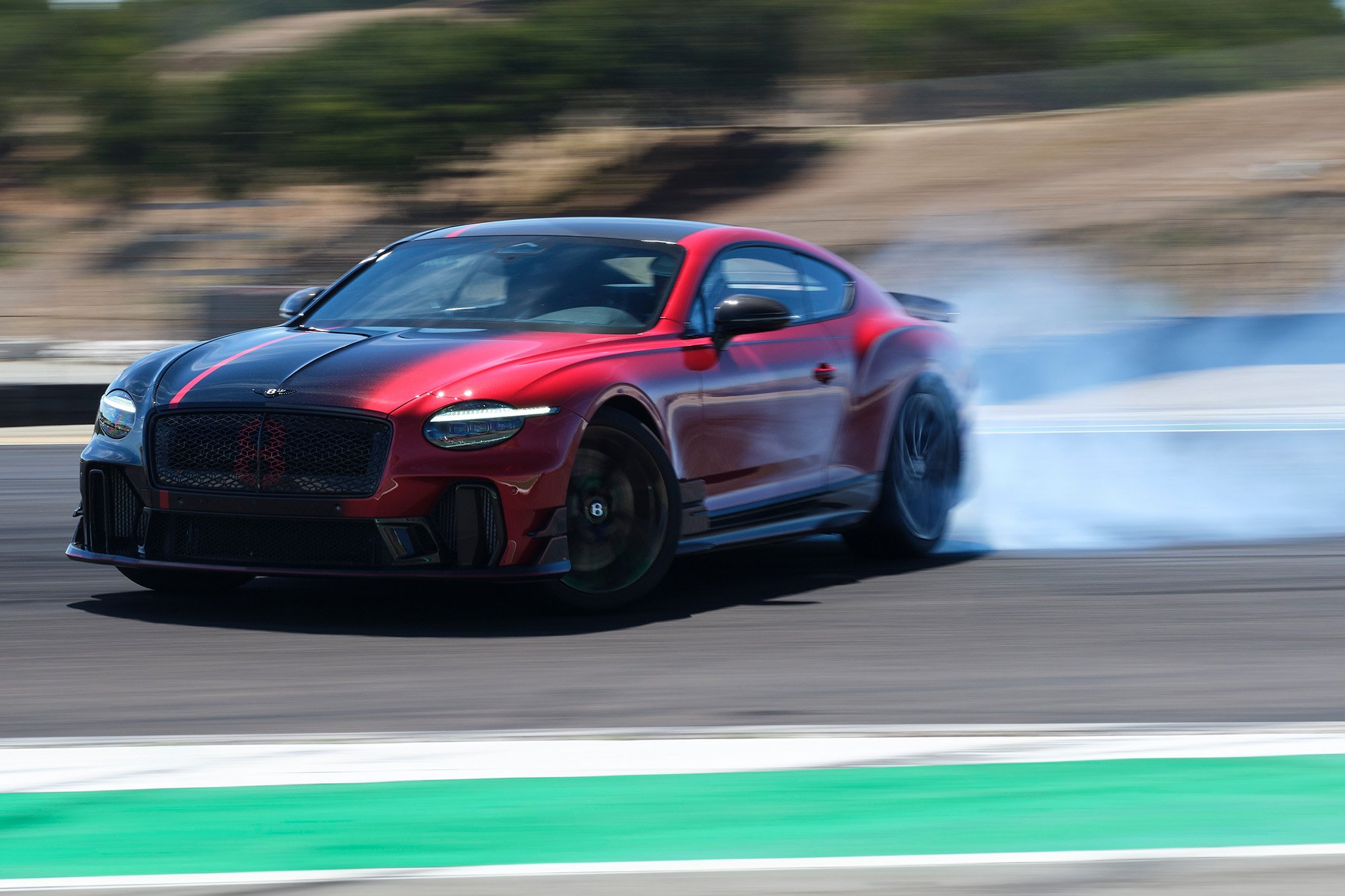
Despite the diet, the Supersports is still a heavy car, weighing more than 4,400 lbs. This makes its nimble handling all the more impressive. This agility comes courtesy of an active suspension system that uses twin-valve air springs and a 48-volt active anti-roll control system that replaces conventional passive steel anti-roll bars.
This lets the car’s suspension adapt in real time to driving conditions, keeping it stable and confidence-inspiring on the track without being punishing at lower speeds. It does an impressive job disguising the Sportsports’ weight, but the laws of physics take their inevitable toll on the tires and brakes, as they lose effectiveness with time on the track.
Alas, Bentley is building only 500 Continental GT Supersports, all spoken for. Perhaps the success of the Supersports program will convince Bentley management that additional minimalist rear-drive models would be good additions to the company’s product line. Could “less” mean more Bentley models?
KioskNews shows a cleaned-up reading view extracted from the publisher’s page — the original always lives on their site, not ours.