10 Most Perfect Movie Endings of the 2000s, Ranked

A New York native, Joe graduated from an avant-garde theater school upstate, where he was obsessed with sketch comedy. There, he and his lunatic friends founded The Sketchies — which still lives on at Skidmore College today. Living in New York City, a screenwriter friend of his then taught him how to write for film. This awakened a new passion in Joe. Since then his scripts have garnered over 200 festival selections, nominations, and wins all over the globe (including the BlueCat Best Feature award). Several of his screenplays have been made into feature films — some of them not that bad! Overall, he loves to create unique, hilarious, touching, and bizarre stories.
Sign in to your Collider account
The 2000s were a great decade for a wide variety of films, in numerous genres. This article is a good place to have all the greatest endings of a lot of these films spoiled, right here, right now. So, if you haven’t seen these now iconic films and their infamous endings and you don’t want them spoiled for you for life, you are kindly invited to skip down to the ads and just enjoy them.
Here are the most perfect endings from films made in the first decade of the new millennium. The aspects that contribute to a movie’s perfect ending can vary from film to film, but they typically feature a striking reveal, authentic acting, and evocative scoring or an epic song. All of these elements coalesce into a supremely satisfying finale that stay with the viewer for a long, long time. In the immortal words of Salvador Dalí, “Have no fear of perfection—you'll never reach it.” — but these stunning movies all come as close as cinematically possible.
10 'Requiem for a Dream' (2000)

Starting off this list, with a depression-laden nightmare, is Darren Aronofsky’s stark, exceedingly hopeless take on just how much drugs, of all ilks, can mess one up. Requiem for a Dream is a mostly hard to watch examination of addiction and how it ruins lives, but its ending is quite beautiful in its sheer bleakness.
So, the whole film, the audience has been watching the four main characters’ lives disintegrate, the further and further they become entrenched in the world of narcotics (and prescription drugs). They all begin the film with hopes and dreams of some sort. Yet, as each one succumbs to the substance they are addicted to, these aspirations go up in smoke. Tyrone (Marlon Wayans) ends up incarcerated in a grimy prison. Sara (Ellen Burstyn), the main character’s mom, winds up in a mental hospital, receiving electro-shock therapy. The female lead, Marion (Jennifer Connelly), ends up selling her body in a manner that is the very definition of “degradation.” And, most tragically, the male lead, Harry (Jared Leto) has let the needle-would infection in his arm get so bad that a doctor is forced to…saw it off. It’s one of the most viscerally disturbing moments of modern day cinema. Each character then curls up into a ball, symbolizing their abject vulnerability and longing for the womb (to start over). All this goes down as the haunting theme music plays, and the audience’s jaw is collectively dropped. The message is clear: don’t do drugs, kids. But for these tragic characters, that lesson came a little too late.
9 'The Mist' (2007)
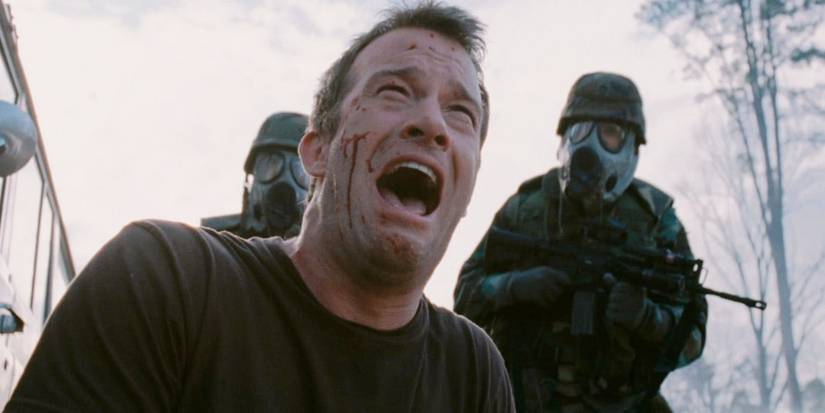
Speaking of depressing… Frank Darabont’s film adaption of the Stephen King novella The Mist is a pretty solid horror-action flick throughout. The end though, man, what a doozy of a finish. It’s a fascinating look at what happens when we make bold decisions…and those decisions turn out to be dead wrong.
The movie is about a mist, ironically enough, that overtakes a town. Within said nebulous fluid is a zesty collection of mostly massive, otherworldly monsters. A dude, David (Thomas Jane), takes refuge from the chimeras in a supermarket, along with his son, Billy (Nathan Gamble), and a bunch of other folks. When it seems like there is no way to stop the mist and it’s giddy gang of deadly creatures, David and some others decide it’s better to eat lead themselves than be shredded and devoured by the monsters. So, David shoots them, including his own son, and is about to remove himself from this mortal coil…when the mist clears and a legion of soldiers emerges, having just defeated all the monsters. Um…awkwarrrddd… The most ironic, and worst part of all, may be that David glimpses a woman who fled the grocery store earlier to save her kids, who was told she’d never make it. Oof. That stings. The general takeaway here is that it’s better to confront your fears than to take the “easy” way out. When Stephen King saw the ending, which was different and way sicker than his, King said he wished he’d thought of it …so you know it was good.
8 'Oldboy' (2003)

Some things are just wrong, oh so wrong. That’s precisely how the bizarre Chan-wook Park Korean action-thriller Oldboy plays out, with one of the most twisted reveals in movie history (borrowing a little bit from Chinatown, of course). Families should stick close together, but this is ridiculous.
The antagonist of this story is Lee Woo-jin (Yoo Ji-tae), a guy who would’ve benefited from some serious therapy. He’s held the main character, Dae-su Oh (Choi Min-sik), captive for 15 years — because when they were kids, Dae-su started an incest-tinged rumor that caused Woo-jin’s sister to kill herself. So, after Woo-jin releases Dae-su, Machiavellian style, he steers him into the arms of a younger woman, Mi-do (Kang Hye-jeong)…who just happens to be his (unbeknownst to both of them) daughter. Their romance is…gulp, consummated. Ok, so when Dae-su finds this out, he’s not exactly psyched. He goes to a hypnotist and has his mind erased. Now, here’s where it gets really weird. Dae-su reunites with (the still clueless) Mi-do. The final shot is of him smiling…but there is something in Dae-su’s cryptic smile that suggests he just may remember everything after all. It’s a fittingly ambiguous ending to a truly messed-up film.
7 'The Dark Knight' (2008)

The second, and hands-down best, installment in the Christopher Nolan Batman series really injected the franchise as a whole with new life. Yes, Batman Begins was a tremendous origin story, but The Dark Knight was the perfect expounding on Bruce Wayne’s journey. A juggernaut of a film, with enough action and character development to satisfy even the staunchest critic, this movie succeeds at every turn. So, naturally, you knew it was going to have one heck of an ending (that still managed to set up the subsequent film in an organic, non-annoying way).
Bruce (Christian Bale) has just defeated The Joker, played by Heath Ledger — in arguably the greatest movie villain turn of all time. However, it’s a bittersweet victory for the Batman, since he had to sacrifice his good (superhero) name to achieve it, as he takes the blame for the crimes committed by the two-faced Harvey Dent (Aaron Eckhart). This entire movie is about making those extremely difficult moral choices that life coldly serves up. Bruce plays the scapegoat and apparently retires from crime fighting, as the Gotham City Police Commissioner Gordon, played by a (rarely) understated Gary Oldman, delivers a touching monologue about the city’s tacit appreciation of the Dark Knight — all while he dismantles the Bat symbol light projector thing. Hans Zimmer's majestic score booms as Wayne rides his motorcycle off into the night. It’s a touching, poignant conclusion to a heart-pumping, excessively entertaining film.
6 'The Departed' (2006)
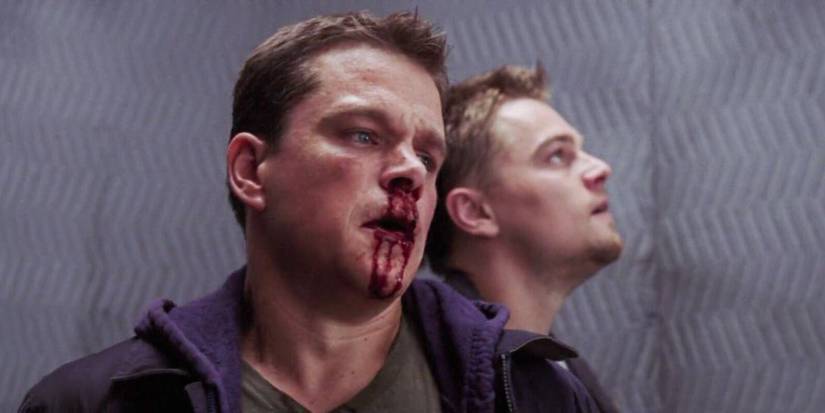
For the majority of Martin Scorsese’s The Departed, the audience is a step or two ahead of most of the characters, as there is dramatic irony galore. We know that Matt Damon, as “Colin Sullivan,” is a rat, as he cosplays cop — we also know that Leonardo DiCaprio is a metaphorical rodent as well, since he’s really a cop, Billy Costigan, working undercover as a newly-minted mob member. And then, the ending comes and all bets are off; we’re hit with a double-whammy surprise.
The final sequence of the film sees Billy suss out Colin and roughly cuff him — but then Billy is suddenly shot by Trooper Barrigan (James Badge Dale), another pesky mole working for the mob boss Frank Costello (Jack Nicholson), in quite the shocking moment (who thought the good guy was gonna die?). Colin has seemingly gotten away scot-free — but then, whoops, a protective booty-wearing Mark Wahlberg, as Sergeant Dignam, appears in Colin's apartment, and he puts a bullet between Colin’s eyes. Game over. It’s as shocking a final scene as it is a satisfying one. The final image in the film is, of course, the much-maligned rat that scurries across a Boston rooftop. People have lambasted this moment as being way too ham-fisted, but c’mon, this is just Scorsese having a little bit of fun — a hint of levity after such an intense climax.
Collider Exclusive · Oscar Best Picture Quiz
Which Oscar Best Picture
Is Your Perfect Movie?
Parasite · Everything Everywhere · Oppenheimer · Birdman · No Country
Five Oscar Best Picture winners. Five completely different visions of what cinema can be — and what it can do to you. One of them is the film that was made for the way your mind works. Ten questions will figure out which one.
🪜Parasite
🌀Everything Everywhere
☢️Oppenheimer
🐦Birdman
🪙No Country for Old Men
01
What kind of film experience do you actually want? The best movies don't just entertain — they leave something behind.
02
Which idea grabs you most in a film? Great films are driven by a central obsession. What's yours?
03
How do you like your story told? Form is content. The way a story is shaped changes what it means.
04
What makes a truly great antagonist? The opposition defines the protagonist. What kind of opposition fascinates you?
05
What do you want from a film's ending? The final note is the one that lingers. What do you want it to sound like?
06
Which setting pulls you in most? Where a film takes place shapes everything — mood, stakes, what's even possible.
07
What cinematic craft impresses you most? Every great film has a signature — a technical or artistic element that makes it unmistakable.
08
What kind of main character do you root for? The protagonist is the lens. Who you choose to follow says something about you.
09
How do you feel about a film that takes its time? Pace is a choice. Some films sprint; others let tension accumulate slowly, deliberately.
10
What do you want to feel walking out of the cinema? The best films leave a mark. What kind of mark do you want?
The Academy Has Decided Your Perfect Film Is…
Your answers have pointed to one Oscar Best Picture winner above all others. This is the film that was made for the way your mind works.
Parasite
You are drawn to films that operate on multiple levels simultaneously — that begin in one genre and quietly, brilliantly migrate into another. Bong Joon-ho's Parasite is a film about class, desire, and the architecture of inequality that manages to be darkly funny, deeply suspenseful, and genuinely shocking across a single extraordinary running time. Your instinct is for cinema that hides its true intentions until the moment it's ready to reveal them. Parasite is exactly that — a film that rewards close attention and punishes assumptions, right up to its devastating final image.
Everything Everywhere All at Once
You want it all — and this film gives you all of it. The Daniels' Everything Everywhere All at Once is one of the most maximalist films ever made: action comedy, multiverse sci-fi, family drama, existential crisis, and a genuinely earned emotional core that sneaks up on you amid the chaos. You are someone who responds to ambition, who doesn't want cinema to choose between being entertaining and being meaningful. This film refuses that choice entirely. It is overwhelming by design, and its overwhelming nature is precisely the point — because the feeling of being crushed by infinite possibility is exactly what it's about.
Oppenheimer
You are drawn to cinema on a grand scale — films that understand history not as a backdrop but as a force, and that place their characters inside that force and watch what happens. Christopher Nolan's Oppenheimer is a film about the terrifying gap between what we can do and what we should do, told with the full weight of one of the most consequential moments in human history behind it. You want your films to feel important without feeling self-important — to earn their ambition through sheer craft and the gravity of their subject. Oppenheimer does exactly that. It is enormous, complicated, and refuses easy comfort.
Birdman
You are drawn to films that foreground their own construction — that make the how of the filmmaking part of the what it's about. Alejandro González Iñárritu's Birdman, shot to appear as a single continuous take, is cinema examining itself through the cracked mirror of a fading actor's ego. You respond to formal daring, to the feeling that a film is doing something that probably shouldn't be possible. Michael Keaton's performance and Emmanuel Lubezki's restless camera create something genuinely unlike anything else — a film that is simultaneously about creativity, relevance, self-destruction, and the impossibility of ever truly knowing if your work means anything at all.
No Country for Old Men
You are drawn to cinema that trusts silence, that refuses to explain itself, and that treats dread as a form of meaning. The Coen Brothers' No Country for Old Men is a film about the arrival of a new kind of evil — implacable, arbitrary, and utterly indifferent to the moral frameworks we use to make sense of the world. It is one of the most formally controlled films ever made, and its controlled restraint is what makes it so terrifying. You want your films to haunt you, not comfort you. You are not interested in resolution if resolution would be dishonest. No Country for Old Men is honest in a way that most cinema never dares to be.
5 'Saw' (2004)

Nobody saw this ending coming, that’s for sure. With the meteoric rise of “torture porn horror" came the very best of this off-putting subset in James Wan’s Saw. The whole film is a creepy examination of what people are willing to give up in order to keep what they most cherish (often, body parts). This kind of Catch-22 game was played by John Doe (Kevin Spacey) in Seven, but here it’s taken to dazzling new heights of perversity.
Now, for the last scene. Through the whole movie, Cary Elwes, as Dr. Lawrence Gordon, and Leigh Whannell, as Adam, are chained up in a room together and given instructions, while a (seemingly dead) body lies in the middle of the room. After the harrowing, grueling, limb-losing journey the two of them have just endured, we learn that the “corpse” that’s been in their midst the whole time is actually John Kramer (Tobin Bell), the disturbed dude who’s orchestrated this whole sick “puzzle” game. As Kramer slowly rises, and the ominous score kicks in, we know it’s all over for the heroes; “Game over,” to be precise. A truly chilling surprise, and a very unforgettable finale.
4 'There Will Be Blood' (2007)

This Oscar-winning film, the first one of this nature by genius writer-director Paul Thomas Anderson, is the very definition of a slow-burn masterpiece. It’s a harsh look at old-timey America, that has, at times, quite torturous pacing. As the tension slowly burns, like oil bubbling under the earth’s surface, about to mightily burst forth, the audience can just feel that a very momentous conclusion is brewing.
The story of TWBB is that of a callous oil man, Daniel Plainview (Daniel Day-Lewis, who, wow, really knows how to pick the right roles), who is forced to confront a popular, young preacher man, Eli Sunday (Paul Dano, who absolutely nailed his first major part). After years of back-and-forth battling between the two, the movie concludes with Daniel finally drinking Eli’s milkshake. A little bowling alley, constructed under Daniel’s opulent home, is the oh-so-fitting location for the final showdown of these rivals…as Daniel bludgeons Eli to death with a bowling pin. One can view this as a metaphor for the fact that Daniel was simply “playing” with Eli this whole time. It’s a brutal scene, where the antihero finally emerges as the sociopathic victor we never really wanted to root for in the first place. Day Lewis’s conviction is what really made this closing moment so indelible in the history of cinema, and he was given the Best Actor Oscar (just in case anyone doubted him).
3 'Memento' (2000)

First off, to anyone who fully comprehended what happened at the end of Memento after just one viewing: *slow clap*. Indeed, wrapping one’s brain around the intricacies detailed in the closing moments of Christopher Nolan’s Memento is a challenge to even the most experienced thriller watcher. When the mental fog clears and the implication of exactly what Leonard (Guy Pearce) intended to do sinks in, dang, it hits quite hard.
After going with Len on his long amnesiac journey into the night, we, as the audience, are hungry to learn what really happened to him and his wife. Luckily for us (but not him), Len’s suspicious “friend” Lenny (Joe Pantoliano) has the answers. He’s been helping/playing Len this whole time, and reveals that he was the cop assigned to Len’s case. Working together, they found, and Len killed, the dude responsible for the attack. Yet, Len can’t remember it, so he is stuck in a loop of permanent revenge-seeking. Len comprehends this… and destroys the clues he’s given himself, so he can keep the vicious cycle still going. He chooses to stay on a vigilante path of retribution instead of accepting the truth; he’s really got nothing else to live for. It’s a mind-shattering finale to a fantastic film all around.
2 'Finding Nemo' (2003)

If Pixar has proven anything, it’s that they know how to make films that appeal to both kids and adults. This is possibly most evident in their earliest works, like Toy Story, A Bug’s Life, and, obviously, the delightfully fishy Finding Nemo. Directors Andrew Stanton and Lee Unkrich’s movie struck cords with essentially every age bracket imaginable, not just for its beautiful animation and genuinely funny moments, but because of the relationships forged between the complex (even if technically 2-dimensional) characters.
After the naive yet brave Nemo (voiced by Alexander Gould), and his justifiably neurotic dad, Marlin (the always heartfelt Albert Brooks), go on their separate adventures (each learning innumerable lessons of their own) and finally reconvene, it’s a truly touching moment. Yet it’s not until the very end, when Marlin finally lets go of his trepidation at letting Nemo go off on his own, and Nemo gives his dad an adorable hug goodbye before heading off to “school,” that the true message of the film is felt. Good thing they are underwater, or else there would be a lot of tears flowing.
1 'Gladiator' (2000)

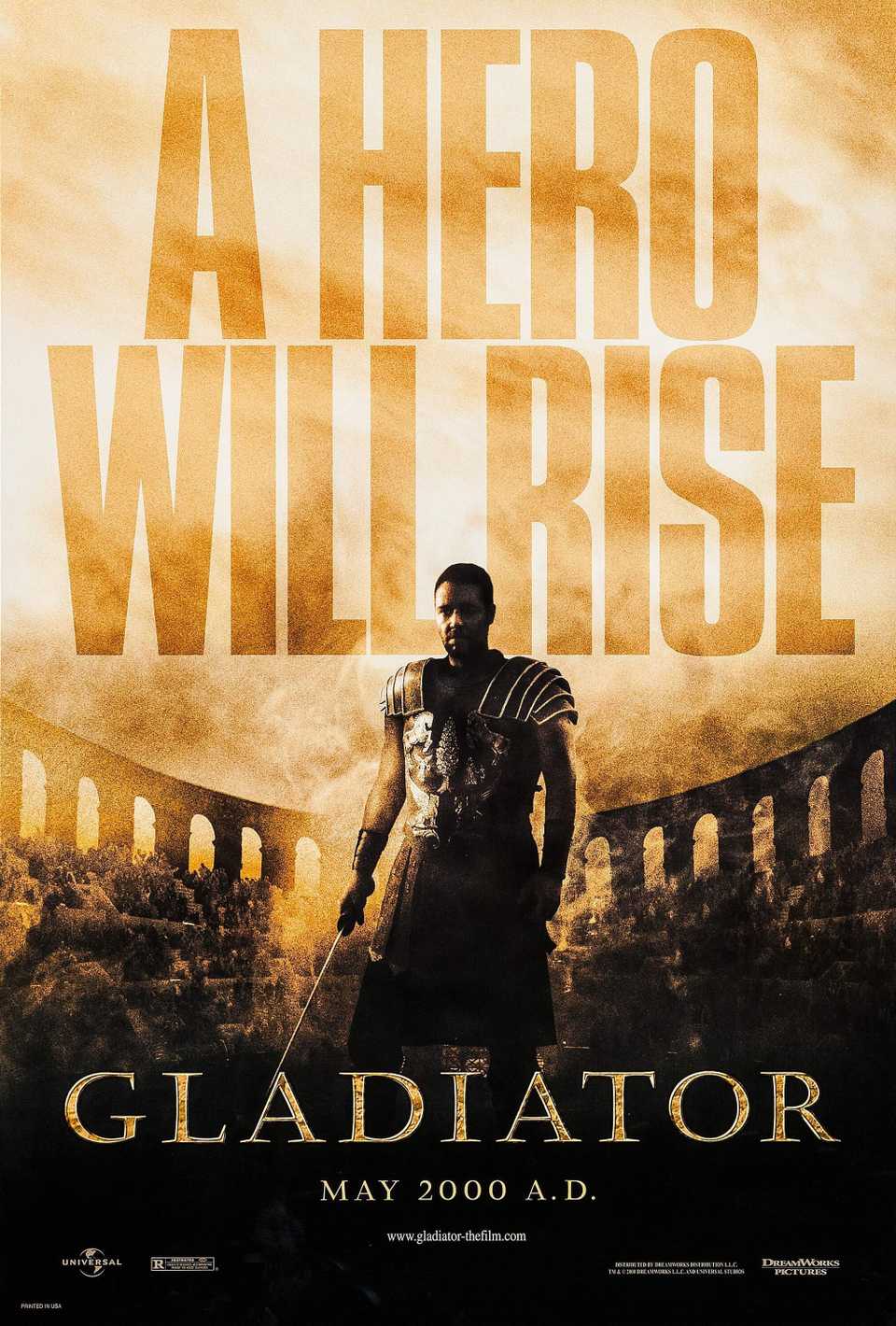
The Oscars were absolutely enthralled and enamored with Ridley Scott’s Gladiator. That’s because it’s the very definition of an action epic, the kind of movie that the Academy consistently fawns over. Actual movie-goers loved it, too, which is a rare combination. From start to finish, it’s a phenomenal film, with some of the coolest fight scenes, most clever fictionalized history elements, most dramatic costuming, and boldest characters of the decade.
Now, to the finale. Maximus (Russell Crowe, at his definitive peak) is a simple man. He’s also a natural-born fighter. When his family is taken from him in the most savage manner possible, he devotes the remainder of his life to avenging them. The audience knows that he is essentially on a suicide mission from the start — despite secret hopes that he will not only defeat Commodus (Joaquin Phoenix, histrionic but still amazing), but that he’ll also survive. Yet, the thing is, Maximus doesn’t want to live on…not in this realm. He dreams of reuniting with his wife and child, in the afterlife. After Maximus slays the corrupt psychopath Commodus (in the most satisfying, public way possible), and bleeds out himself, his theme music swells (a magically melodious motif) and he envisions his family in a field of grain. This is probably the first time in the film that he smiles, and there’s not a dry eye in the house. The very final scene sees Maximus’s fellow gladiator Juba (the magnetic Djimon Hounsou) at Maximus’s grave. He taps the earth, smiles wide and says, “And now we are free. I will see you again... but not yet... Not yet.” As the score booms again, every audience member is buoyed with a pure sense of jubilant fulfillment and poignant hope. It’s the perfect ending to a near-perfect film.
Gladiator
- Release Date
- May 5, 2000
- Runtime
- 155 minutes
- Director
- Ridley Scott
- Writers
- David Franzoni, John Logan, William Nicholson
KioskNews shows a cleaned-up reading view extracted from the publisher’s page — the original always lives on their site, not ours.