Rachel Roddy’s recipe for bread buns with cheese and apple | A kitchen in Rome
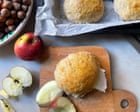
In Elizabeth David’s English Bread and Yeast Cookery, there’s a chapter called “Manchets, Mayn and Payndemayn”, all of which were 15th-century names for rarefied soft white bread made from the finest wheat flour. As well as pages of historical context that only she could make so lively, David includes a 1615 recipe for manchet from a book called The English Huswife that calls for meal to be ground into the whitest flower, mixed with ale yeast, salt and liquor (a mixture of water and milk), before being wrapped in a cloth, kneaded with feet, left to swell, shaped, then baked in a gentle heat.
It is this form of manchet that David sees as being the common ancestor of all English breakfast breads: baps, soft rolls and dough cakes, with the presence of milk (and, therefore, fat) ensuring both crumb and crust are soft. In fact, her recipe for breakfast baps (or, rather, a recipe from Mr CG Lockyer from Crewkerne) is almost identical to manchet, although without the millstones, dough tub and feet.
It is David’s breakfast baps that I have merged with a habit from Trentino-Südtirol, adding grated apple and cheese, both of which melt, resulting in the sort of plump, sweet-savoury rolls that William Verral, author of 1759’s The Cook’s Paradise, thought ideal “for steeping in vegetable soup”.
Mild cheeses will just get lost here, so instead you want a relatively pushy and rich one with a bit of edge and sharpness about it. Also, a cheese that melts well, so cheddar, parmesan or gruyere are all ideal, as are fontina, grana padano or pecorino. When it comes to grating, use the smaller holes of a box grater or a Microplane, so the strands are quite fine, which means they can be kneaded into the dough more easily and melt into the dough more readily. The apple, however, which should be unpeeled, can be grated on the larger holes of a box grater, because the soft bits incorporate well into the dough and dissolve as the roll bakes.
Once the rolls are out of the oven, they can be brushed with a little more milk or cream, for shine. If cut too soon, the crumb will be dense and a little gummy, so leave the rolls to cool for 20 minutes in order for the steam to escape and the crumb to dry a little.
Plump, savoury and sweet, these rolls are particularly good alongside orange soups: butternut squash and sage, carrot and coriander, red lentil and ginger. They’re also excellent split and spread thickly with unsalted butter and cloudy honey, or filled with more strong, sharp cheese and eaten with a crisp apple.
Bread buns with cheese and apple
Makes 10
1-2 apples (ideally, cox, russet or discovery; about 180g)
500g plain flour
, or a mixture of plain, wholemeal and rye flours
7g instant yeast
10g salt
160ml milk mixed with 160ml water
2 tbsp olive oil
100g grated cheese (fontina, parmesan, grana padano or cheddar)
Egg beaten with a little milk, for brushing
Grate the unpeeled apple – if the flesh seems wet, squeeze/press for a dryish texture. You should end up with roughly 150g grated flesh.
Working in a large bowl, mix the flour, dried yeast, salt and apple. Add the milk and water, then use a rubber spatula or your oily hand like a dough hook to mix until they come together into a shaggy mass. Cover the bowl and rest in a warm spot for 30 minutes.
Use your fist to make a big indent in the dough, then pour in the oil and grated cheese, and knead the dough to incorporate both. Shape the dough into a ball, cover again and leave to rest for another 30 minutes. Give the dough another knead, then cover again and leave the ball to rest in a warm spot for two hours, or until it has doubled in size.
Tip the dough on to a lightly floured surface, then divide into 10 pieces weighing about 100g each. Shape each piece into a neat roll, pinching the underneath join closed, then arrange the rolls spaced apart on a baking tray lined with greaseproof paper. Cover with a damp tea towel or clingfilm, and leave to rise for another hour. Brush with the egg-milk mix and bake at 190C (170C fan)/375F/gas 5 for 15-20 minutes, or until golden on top.
KioskNews shows a cleaned-up reading view extracted from the publisher’s page — the original always lives on their site, not ours.