‘The time is ripe’: ex-helicopter engineer poised to be Germany’s first female president

Germany has had 12 presidents since the end of the second world war, all of them men. Now, for the first time, the federal republic is on the brink of getting a female head of state. But Ilse Aigner, the lead candidate for the post, is unusual in more ways than one.
“No law degree. No marriage. No penis,” is how the left-leaning Taz newspaper put it this week – a wry, if blunt, assessment of what a break with history the 61-year-old Bavarian represents.
Friedrich Merz, Germany’s Christian Democrat (CDU) chancellor, put Aigner forward as his candidate this week after months of speculation, saying it was “high time” a woman took up the role.
If elected in January, Aigner will succeed Frank-Walter Steinmeier in what is a largely ceremonial role but nonetheless Germany’s highest state position. And as she has the backing not only of Merz’s CDU but his Social Democrat partners and the opposition Greens, little is standing in her way.
Some are delighted. Jörg Thadeusz, a liberal writer and popular TV presenter with a penchant for satire, has taken his enthusiasm for Aigner so far as to have the name Ilse tattooed on his upper left arm. Pictures of him revealing the tattoo on TV this week made headline news, as media talked of the Aigner-Welle (Aigner wave) to describe the unexpected ripple of enthusiasm for the Catholic Bavarian – among the political establishment, at least.
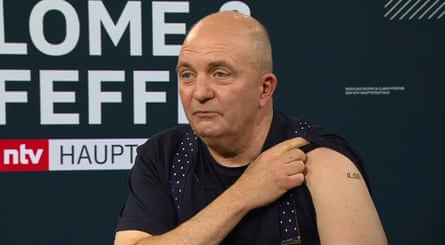
“Ilse Aigner is … a candidate who right now could really do Germany some good,” said Thadeusz. Unlike far-right populists who were polarising the country with their demands for “Deutschland First”, he said, Aigner embraced a form of Heimat (homeland) that was “neither folklore nor a political battle cry”.
Not everyone shares his enthusiasm. Aigner’s relationship with the populist Alternative für Deutschland, the largest opposition force in the Bundestag, got off to a tricky start this week after she turned down their demand to present herself to them as a candidate. Alice Weidel, the AfD’s co-leader and the most prominent woman in German politics, accused Aigner of failing to respect “democratic culture and manners” as well as “the millions of voters we represent”.
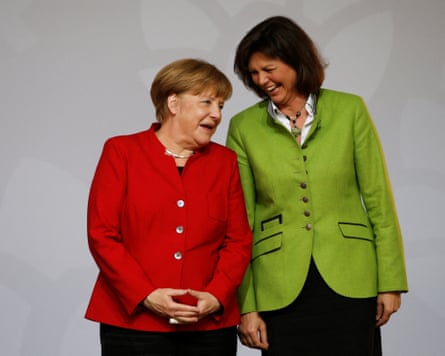
Despite having held a cabinet position, as agriculture minister from 2008 to 2013 under Angela Merkel, Aigner is not a household name. She began in local politics 30 years ago and entered the Bundestag in 1998. Instead of the usually prerequisite degree, she has a vocational qualification as an electrical engineer with a speciality in manufacturing helicopters, her job before entering politics.
“She’s the first head of state of the Federal Republic of Germany who can personally repair a government helicopter,” Thadeusz quipped this week.
In her nomination speech this week, Aigner said she hoped to inspire aspirational Germans: “As the first woman in the highest state office, I would stand with my person and my background as a symbol of the promise of upward mobility in our country.”
Aigner has spoken openly about surviving two serious tumour diagnoses – one in her spinal cord when she was 17, and thyroid cancer in her 40s, when she was a minister – saying they had given her perspective as a politician.
Now feted by the Christian Social Union (CSU), the Bavarian sister party to the CDU, she once struggled to be recognised. Her attempts in the early 90s, aged 27, to become mayor of her birth town, Feldkirchen-Westerham, south-east of Munich, failed because she was unmarried, which the party of arch-conservatives said was “too unclear a condition” and made her unsuitable to serve.
after newsletter promotion
She still lives in Feldkirchen-Westerham, a Bavarian town of 10,000 people, where her parents ran an electronics shop. There she shares a house on a 1970s estate living under one roof with three generations of her family, including her three older sisters and their offspring. Local people refer to her affectionally as “die Ilse” (equivalent to “the Ilse”, or “our Ilse”), and describe her as being a regular attender at town celebrations. She typically cycles, “whether to the butchers and bakers, or to the opening of a new windfarm”, one resident said.
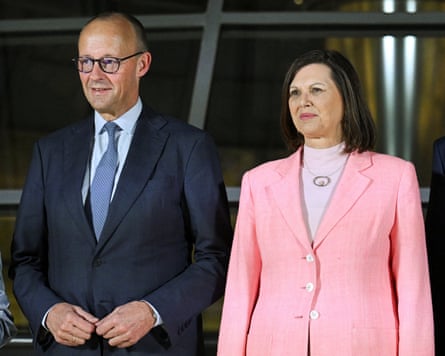
For Merz the chance to back the first female presidency is a chance to shed his reputation as a Frauenfeind (misogynist), an image that goes back in part to his decades-long rivalry with Merkel, but has been underscored to some extent by his leadership style in office. In an editorial this week, the Münchner Merkur noted that Aigner’s perceived strengths neatly complemented the chancellor’s deficiencies: “Her approach compensates for what Merz lacks: approachability, popularity, a warmth that can absorb the effects of polarisation.”
Merkel was regarded as a powerful female trailblazer not just in Germany but around the world. She was referred to at home as “Mutti” – both a term of affection and patronisingly used to describe her supposedly maternal stewardship of the country. Five years after her departure from the political stage, feminist commenters hope Aigner might prove a symbolic boost.
“The time is ripe for a woman. We have such an under-representation of women in society, in politics, in business, and it’s high time a woman held this highest office in the land. I’m very happy about that,” said Britta Hasselmann, a leading Green MP, in a podcast interview this week.
But even more important, Hasselmann emphasised, was the extent to which Aigner might draw together a country deeply divided by ideological rifts and economic tensions, where extremists are snapping at the heels of the political centre. The presidency needed someone “who can unite people, especially in such polarised times, who is empathetic, down to earth, and who tries to send a strong signal that common ground is valued in a democracy. And I believe she is capable of that,” Hasselmann said.
KioskNews shows a cleaned-up reading view extracted from the publisher’s page — the original always lives on their site, not ours.