Overlap, underlap or sit back? How Premier League teams use their full-backs

Overlapping. Underlapping. Inverted. Traditional. The role of full-back has evolved dramatically. Once a defensive-first position that provided some auxiliary attacking support, the role has developed into something far more multifaceted.
Just ask right-back Ben White, who – with Riccardo Calafiori on the left – has been an important figure in Arsenal’s superb start to the campaign. Talking a few years ago, he said: “Playing full-back the way [Mikel Arteta] wants is completely different to any other manager. To play full-back for him, you’ve got to be a centre-midfielder, a centre-back, a winger and a No 10.”
Between them, White and Calafiori have contributed to six goals for Arsenal already in the Premier League this season (White: three assists; Calafiori: one goal, two assists). No other defender has registered more than three goal involvements so far. The Arsenal duo are a great illustration of the impact full-backs can have. But, with the position more demanding than ever before, how does each Premier League team deploy theirs?
Where do full-backs take their touches?
The graphic below shows the average height and width of the touches of each Premier League team’s full-backs, sorted from highest average position to lowest. The most obvious takeaway is that Arsenal’s full-backs have the highest average touch location of any Premier League side this season, coming 58.2 metres from their own goal.
That is a reflection not only of Arsenal’s territorial dominance, but also the license White and Calafiori are given to push into the attacking line. White averages 3.4 touches in the opposition box per 90 minutes, the most of any full-back or wing-back in the division. Calafiori ranks third, with 2.9.
Arsenal’s full-backs also have the narrowest average touch locations of any team, emphasising how far they have moved away from the traditional full-back role of maintaining width. Instead, they are encouraged to drift inside and operate in central areas.
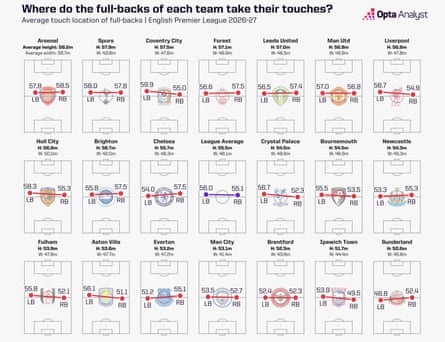
Tottenham also deploy their full-backs extremely high up the pitch. For most of the campaign, that has been Archie Gray at right-back and Andy Robertson on the left. Of course, analysing a player’s influence is not limited to what they do on the ball. Thanks to Opta Vision, we can also track what they do without it.
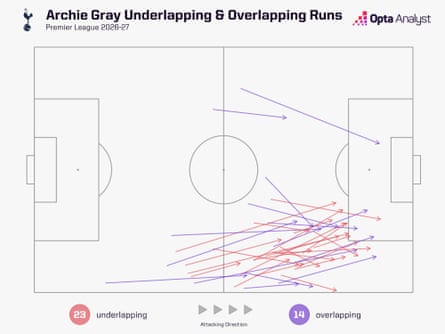
Gray is particularly noteworthy, given his exceptional work rate. He ranks first among Premier League full-backs for underlapping runs, both in total (23) and per 90 minutes (2.9), and also ranks fourth for overlapping runs per 90 (1.8). That shows the benefit of deploying an attack-minded player at full-back, with Gray showing energy and an ability to get beyond the ball and offer another option in the final third.
Robertson is no slouch on the opposite flank, either. The 32-year-old ranks seventh for underlapping runs per 90 minutes (1.4) and sits inside the top 20 for overlapping runs per 90 (1.1). He has also received more passes ending in the final third (159) than any other full-back.
It might be more of a surprise to see Coventry’s full-backs play so high, given they have not dominated the ball at all (39.1% possession, second-lowest) and they start their attacks from deep (40.2m away from goal, sixth-lowest). It is, however, something they did to good effect in the Championship last season (average height of 56.8m, sixth-highest).
Frank Lampard has also used a back five at times, which means his wing-backs naturally play higher up, but he has been brave with pushing his defensive line up in general. Coventry have provoked the second-most offsides of any team so far (30).
That has allowed Milan van Ewijk and Jay Dasilva to push forward on the flanks. The pair have each created eight chances, with only Jack Rudoni (12) creating more for the Sky Blues.
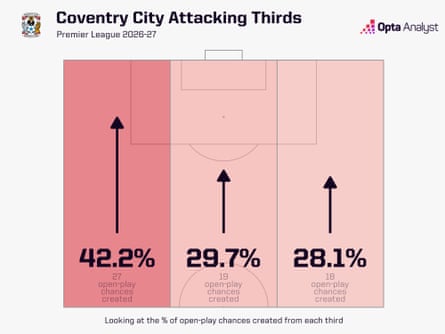
Dasilva is a particularly important outlet down the left. He takes his touches higher up the pitch than any other full-back in the division, and Coventry have created 42.2% of their open-play chances down his side, the highest proportion of any Premier League team.
Wing-backs v full-backs?
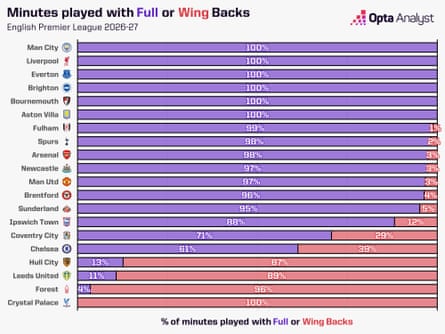
It makes sense that Nottingham Forest and Leeds also see their full-backs touch the ball high up the pitch, given they are two of the biggest users of wing-backs. That pair are two of just four teams that predominantly play with wing-backs, with the back three/five becoming a rare breed in the modern Premier League.
For Leeds, Jayden Bogle has been particularly influential going forwards. He has made more runs ending in the opposition box than any other full-back this season. They’ve come at an average of 3.9 per 90 minutes, the second-highest rate in the division, behind only Nico O’Reilly, who has played just 54.3% of his minutes at full-back.
Crystal Palace, meanwhile, are feeling the effects of losing the influential Daniel Muñoz. Despite playing solely with wing-backs, they have gone from having the highest average full-back positioning in the Premier League in 2025-26 to sitting below the league average this season. Muñoz was relentless in his work up and down the right flank last term, and his absence has clearly affected the extent to which Palace are able to push their right-sided wing-back up in those wide areas.
The Colombian is now at Nottingham Forest with his former manager Oliver Glasner. They have gone from having the fifth-lowest average touch location for their full-backs to the fourth-highest. That is not only down to Muñoz, but having someone who is able to put in consistent lung-busting runs – he is behind only Ipswich Town’s Leif Davis for the average length of his off-ball runs – helps a lot.
We can’t talk about the league’s most energetic full-backs without mentioning Adrien Truffert, who has continued where he left off last season. The Frenchman is the overlapping king, making more of those runs than any other full-back in the division (23). That comes after he made almost twice as many overlapping runs as any other player across the entire league last season. His manager, Andoni Iraola, may be gone, but he’s clearly got the same license to bomb on from Bournemouth’s new head coach, Marco Rose.
Continuity or change?
Iraola is now at Liverpool, and his full-backs are one of the most asymmetric duos in the league. Milos Kerkez – just as he did at Bournemouth under Iraola – has freedom to push forward and is one of the biggest overlappers in the league, completing 15 such runs thus far. On the other side, Ronald Araújo – who is more of a converted centre-back – plays a far more reserved role.
Manchester City are a curious case. Despite averaging the most possession in the division (65.4%), completing the most passes per game (566) and recording the highest territorial dominance, as measured by field tilt, Enzo Maresca’s team do not use their full-backs in advanced areas to exert that dominance.
Their average full-back touch location is 53.1 metres from goal, making them the fourth-deepest team in the division. That is a huge contrast from Pep Guardiola’s last season, when City ranked third-highest for average full-back positioning. There are plenty of ways to play full-back in the Premier League, but the growing importance of the position is the same for every team.
KioskNews shows a cleaned-up reading view extracted from the publisher’s page — the original always lives on their site, not ours.