Human harps, massive bananas and dogging: the 20 best Busby Berkeley dance routines – ranked!
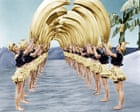
20. Sittin’ on a Back Yard Fence from Footlight Parade (1933)
So you thought Cats (2019) was tacky? Wait until you see Ruby Keeler (AKA Mrs Al Jolson) gambolling around as a fluffy white feline, being wooed by an ogling tomcat, or chasing Billy Barty, a child actor with dwarfism, costumed as a mouse.
19. The Girl at the Ironing Board from Dames (1934)
Joan Blondell (seven months pregnant during filming) livens up workaday laundry tasks by fantasising about the men whose underwear she hangs out to dry. And the underwear flirts right back. Who cares if you can see the wires?
18. Fascinating Rhythm from Lady Be Good (1941)
If this were a tap dancing Top 20, Eleanor Powell would be at No 1, but Berkeley wisely stands back and showcases her epic skills with minimal fuss. All the tricksiness took place out of frame, where stagehands were pushing grand pianos out of her way.
17. The Lady in the Tutti Frutti Hat from The Gang’s All Here (1943)
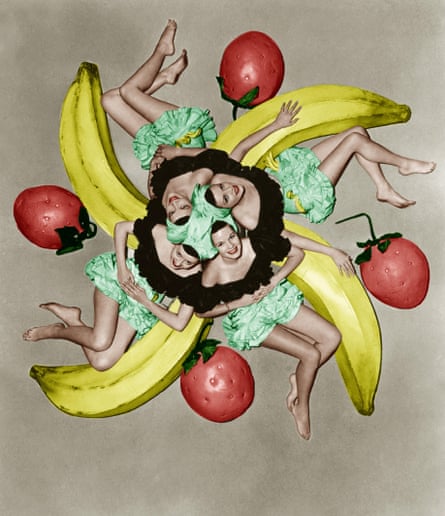
Berkeley’s first colour film as both director and choreographer stars “Brazilian Bombshell” Carmen Miranda in her signature fruit-laden headdress. The fruity motif continues in a musical number set on a fake tropical island where chorus girls wield giant bananas. Nothing salacious to see here, move along.
16. Young and Healthy from 42nd Street (1933)
This quintessential backstage musical was a huge hit and established Berkeley’s approach to choreography. An initially stagebound song with innuendo-laden lyrics, belted out by lecherous Dick Powell, blossoms into revolving geometric formations of young women shot from every conceivable angle, culminating in a travelling shot through their spread legs. This is cinema!
15. Spin a Little Web of Dreams from Fashions of 1934 (1934)
“Mr Berkeley, I’m not raising my daughter to be a human harp!” was one critic’s reaction to a vision of chorus girls plucking at harps fashioned from other chorus girls. Just before the Hays Code banished navels from Hollywood, blond-wigged beauties flaunt their belly buttons while performing the ultimate ostrich feather fan dance.
14. Honeymoon Hotel from Footlight Parade (1933)
Before Dick Powell went all film noir as Philip Marlowe in Farewell, My Lovely (1944), he and Keeler regularly played sweethearts in Berkeley’s musicals. The camera glides around what is essentially a sex hotel, as attempts to consummate their hasty marriage are hampered by other guests, interfering relatives and an unnaturally precocious child.
13. Oh, Lady Be Good! from Lady Be Good (1941)
Once again, Berkeley the choreographer stands back and lets Eleanor Powell work her magic. MGM failed to come up with a suitable dog to partner her for this number, so Powell bought a terrier mix called Buttons and trained it herself.
12. Dames from Dames (1934)
“What do you go for, go see a show for?” The answer is dames (male gaze, sorry) and here they are, not as scantily clad as in pre-code days, but forming a wide range of pleasing kaleidoscopic configurations and Bridget Riley-esque patterns until Dick Powell’s head bursts through their tableaux.
11. Shuffle Off to Buffalo from 42nd Street (1933)
Keeler once again tries to consummate a marriage (to Clarence Nordstrom), this time on a sleeper train to Niagara Falls. Other passengers leer salaciously out of their curtained compartments, while worldly Una Merkel and Ginger Rogers predict the ingenue will soon be on a train to Reno for a quickie divorce.
10. Shadow Waltz from Gold Diggers of 1933 (1933)
Chorus girls, wired up to neon-tubed violins, twirl around on vertiginous walkways. Then the lights go out so all you can see are the violins, which rearrange themselves into the shape of one massive violin. So many ways this could have gone horribly wrong – and indeed, a 6.4 earthquake hit Los Angeles during filming, and some of the violins short-circuited.
9. The Polka Dot Polka from The Gang’s All Here (1943)
One minute Alice Faye is singing as normal, surrounded by dancing children who are only marginally weird. The next, we are plunged into a Technicolor hallucination of neon hoops, more dots than DC’s Polka-Dot Man could dream of, and psychedelic effects that will have you wondering if you accidentally ingested LSD.
8. We’re in the Money from Gold Diggers of 1933 (1933)
Before teaming up with Fred Astaire in the first of their 10 musical collaborations, Ginger Rogers played a golden-hearted broad in Berkeley’s first two backstage musicals. Heading a chorus line draped in silver dollars, she belts out an upbeat ode to capitalism, including one verse in Pig Latin.
7. 42nd Street from 42nd Street (1933)
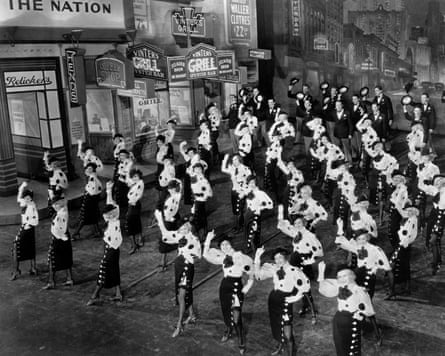
Once again, a musical number opens out into an entire panorama that could not possibly be physically contained in a theatre. Keeler’s effortful hoofing (she’s no Eleanor Powell, but we love her anyway) gives way to rhythmic travelling shots of New Yorkers going about their business: traffic, newspaper sellers, hairdressers and, adding a touch of dirty realism, a murder.
6. Pettin’ in the Park from Gold Diggers of 1933 (1933)
Dick Powell is trying to get into Keeler’s knickers in an outrageously nudge-nudge number featuring snowball fights, erotic silhouettes, roller-skating cops and stocking tops galore, before she finally stymies her beau with a onesie made of metal. Enter leering child actor Billy Barty, with a can opener.
5. I Only Have Eyes for You from Dames (1934)
Powell loves Keeler so much he keeps seeing her everywhere. And so do we, thanks to lookalike chorus girls in Keeler masks, holding up cut-outs of her face, or pulling their skirts over their heads to form one gigantic Keeler tifo, all set to a Harry Warren-Al Dubin earworm that quickly became a standard.
4. Shanghai Lil from Footlight Parade (1933)
After The Public Enemy, James Cagney was keen to avoid being typecast as a gangster and draws on his vaudeville roots to give us a tap dance that almost makes up for Keeler in yellowface. Get an eyeful of Hollywood orientalism in all its pre-code horror, complete with sex workers, opium smokers and half the US Navy on manoeuvres.
3. Remember My Forgotten Man from Gold Diggers of 1933 (1933)
Audiences of the 1930s went to the cinema to escape the Great Depression, but numbers like this assured them that their pain wasn’t being ignored. Joan Blondell, with a sort of sprechgesang, and contralto Etta Moten lament the treatment of poverty-stricken veterans of the first world war. As the chorus swells, the number segues from a theatrical street into montages of men marching to war and limping home to the breadline and a treadmill of silhouettes. Lump in throat time.
2. By a Waterfall from Footlight Parade (1933)
Dick Powell and Keeler celebrate “love in a natural setting”. Berkeley illustrates this early 1930s ode to dogging with an astonishing aquatic ballet of 100 synchronised swimmers forming flowers, snake shapes and a human fountain, shot from all angles in a glass-walled pool that filled an entire soundstage. None of this, of course, would be visible to the theatre audience glimpsed at the start of the number.
1. Lullaby of Broadway from Gold Diggers of 1935 (1935)
You ain’t heard nothing until you’ve heard 200 feet stomping out a time step in unison. Of all the musical numbers he directed, Berkeley’s personal favourite was this 13-minute expressionist nightmare in which a young woman’s nightclubbing gets out of hand. From Wini Shaw’s disembodied head turning into the Manhattan skyline, to the most sinister phalanx of tap-dancers this side of Leni Riefenstahl, to the frankly rather shocking ending, it’s an intoxicating masterpiece. “Come and dance!”
KioskNews shows a cleaned-up reading view extracted from the publisher’s page — the original always lives on their site, not ours.