Opinion: EU-Canada summit a historic opportunity to promote transparent AI
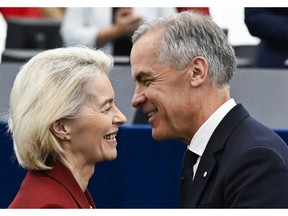
In the face of threats to territorial, economic, cultural and digital sovereignty, as well as the fracturing of the international rules-based system and the geopolitical rupture, thousands of trusted news and magazine titles on both sides of the Atlantic believe the 21st EU-Canada Summit is a critically important opportunity for two key international partners to build resilience via concrete shared commitments to hold platforms to account.
Sign In or Create an Account
Based on a leaked draft “EU-Canada Joint Summit Statement,” much progress is expected to be made at the summit in areas such as defence and security, critical resources and digital research and communications technologies.

Columnist Jesse Kline keeps you up to date with what’s happening in Israel and the effects of antisemitism on life here in Canada. Friday mornings.
By signing up you consent to receive the above newsletter from Postmedia Network Inc.
A welcome email is on its way. If you don't see it, please check your junk folder.
The next issue of Channel Israel will soon be in your inbox.
We encountered an issue signing you up. Please try again
In her 2026 state of the union address, European Commission President Ursula von der Leyen stated, “I am an optimist that AI has the potential to benefit humanity — if we get it right. But, as with any powerful new technology, AI comes with a balance of possibilities and risks. Without addressing these risks, we will never be able to unlock AI’s possibilities.” She also underscored the need to safeguard “our democratic fabric and free media.”
Speaking to the European Parliament in September, Prime Minister Mark Carney adroitly warned, “Technology platforms increasingly seek to act as sovereign powers. They want to dictate the rules of regulation — and even circumvent them. They want to control our data, spread misinformation and steal our children’s childhoods.”
He noted that, “Together, Canada and the European Union can anchor our ground to hold our values while forming a protective canopy under which our citizens can thrive.”
The question is: what should that protective canopy for our combined population of nearly 500-million people look like?
The bolstering of democratic resilience and sovereignty requires a firm, shared commitment by Canada and the EU to free, independent, pluralistic and sustainable media and reliable professional journalism, underpinned by enabling frameworks. Said commitment ought to be fully reflected in the summit’s final joint statement, as the independence and robustness of our democratic information environments hinges on this.
Furthermore, the summit should be an opportunity to underscore both the important opportunities and the key challenges AI presents to creative and cultural industries, including the longstanding lack of transparency over the use of content and enforceability gaps. Deceptive and unidentified automated bots, web crawlers and AI agents are operating at increasing scale and with impunity across the digital environment.
Canada and the EU must work together to promote a transparent AI ecosystem that respects intellectual property rights, supports licensing and appropriate remuneration, and enables creators, publishers and other cultural and creative businesses to control and realize the value of their works.
Transparency requirements should also extend to downstream data usage rights. Among the initiatives advanced by the industry, the Content Telemetry Standard developed by the SPUR Coalition defines a common language to help navigate this new information economy — laying down a critical foundation upon which a fairer market can be built.
The development and deployment of AI needs to strengthen, rather than undermine, cultural diversity and sovereignty, human creativity and the economic sustainability of the creative sectors. Those investing in and creating original content must be able to participate fairly and fully in the value generated from its use, so they can reinvest in and strengthen independent professionally produced journalism to ensure institutional accountability.
Thanks to the Comprehensive Economic and Trade Agreement, trade in goods between Canada and the European Union has increased by more than 75 per cent since 2017, and trade in services by 97 per cent. Both the European Union and Canada have introduced frameworks to protect the free press, including the neighbouring right for press publishers, as well as Canada’s Online News Act. The EU’s AI Act also constitutes a recognition of the need for lawfulness, accountability and transparency in the age of AI.
The Montreal summit presents an opportunity for Canada and the EU to build on that success, to strengthen our ties, to work together in partnership and to lead in defending the democratic pillars and values we share in common and the rules-based system. Independent journalism is critical democratic, economic and security infrastructure.
Canada and Europe can no longer count on U.S. regulatory resolve, nor can we surrender our cultural and information sovereignty to hegemons and hyperscalers who prioritize profit over public interest. By working together with steely resolve, we can manage and mitigate systemic risks responsibly. As Prime Minister Carney stated, “Canada and Europe should secure our strategic autonomy through deep co-operation.” Strengthening the resilience and independence of our democratic information environments should be a top priority for EU-Canada co-operation.
National Post
Paul Deegan is president and CEO of News Media Canada. José Guimarães is executive director of the European Newspaper Publishers’ Association and the European Magazine Media Association. Angela Mills Wade is executive director of the European Publishers Council. Chris Radley is executive director of Magazines Canada. Wout van Wijk is executive director of News Media Europe.
Join the Conversation
This website uses cookies to personalize your content (including ads), and allows us to analyze our traffic. Read more about cookies here. By continuing to use our site, you agree to our Terms of Use and Privacy Policy.
KioskNews shows a cleaned-up reading view extracted from the publisher’s page — the original always lives on their site, not ours.