Army plans to carry out detonation at Iowa plant despite indefinite pause
The U.S. Army says it plans to move forward with the detonation of several tons of unstable explosives at a munitions plant in Iowa on or by Tuesday, according to a new court filing. It will do so despite a federal court order that paused the detonation plans indefinitely, which the Army said it does not need to follow because of the public safety risks associated with the possibility of the explosives detonating on their own.
In federal court records filed late Saturday, the Department of the Army said it plans to use an emergency munitions and explosives exclusion to the Environmental Protection Agency's permit. The government argues it needs to perform a controlled detonation to protect the public from the more significant threat from an uncontrolled explosion.
On Friday, a federal court suspended the U.S. Army's plan to detonate the explosives containing lead azide at a munitions plant in Middletown, Iowa, after community outcry about the risk of toxic lead particles spreading in a dust plume across parts of Iowa and Illinois.
The Army originally scheduled two controlled explosions for Friday. The Army then delayed the them until Monday before the court stepped in.
The 8th U.S. Circuit Court of Appeals granted an emergency motion to pause the demolition after environmental groups filed a lawsuit.
The military said on Friday it was working closely with the Department of Health and Human Services and the EPA to ensure the controlled explosion would be conducted in the safest manner possible.
"Officials have been meticulously planning for this event since March, and all agencies involved are prepared to take the most extreme mitigation measures available to ensure there is no risk to the public and any disruptions are minimized," the statement said.
In its filing on Saturday, the government warned that it must conduct the controlled explosion by Tuesday because the temperature is expected to drop below 30 degrees in the next several days. It says the lead azide has deteriorated and that crystals in the waste could break as temperatures drop.
"A controlled detonation allows the Army to implement measures to minimize the risk to the public, including the risk from the ejection of partial unexploded ordnances that can explode later from the Facility," the court filing says. "The Army intends to act consistent with the terms of the Emergency Permit and its mitigation measures even if not in effect. That includes mitigation measures to minimize the risk of the dispersal of lead dust. In short, a controlled detonation is by far safer than an uncontrolled explosion."
In response to the Army's filing, the Iowa Environmental Council and Sierra Club filed a motion Sunday seeking to supplement their emergency request to block the planned detonation.
The filing includes three expert and local government declarations challenging the Army's assessment of the risk of delaying the detonation, as well as concerns about public notice and potential health and environmental impacts.
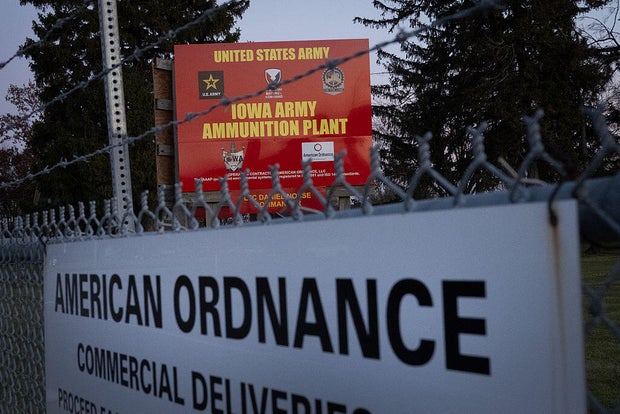
In March of this year, the Army said it discovered that 68 drums of lead azide at the site had started "recrystallization." The lead was stored in bunkers at the Iowa Army Ammunition Plant, a munitions plant built in 1941, which produces quality medium- and large-caliber munitions.
Lana Zak and Cara Tabachnick contributed to this report.
In:
Federal court indefinitely pauses military's plans for detonation of unstable explosives in Iowa
KioskNews shows a cleaned-up reading view extracted from the publisher’s page — the original always lives on their site, not ours.