France looks to give Rafale anti-radar punch with new Hammer variant
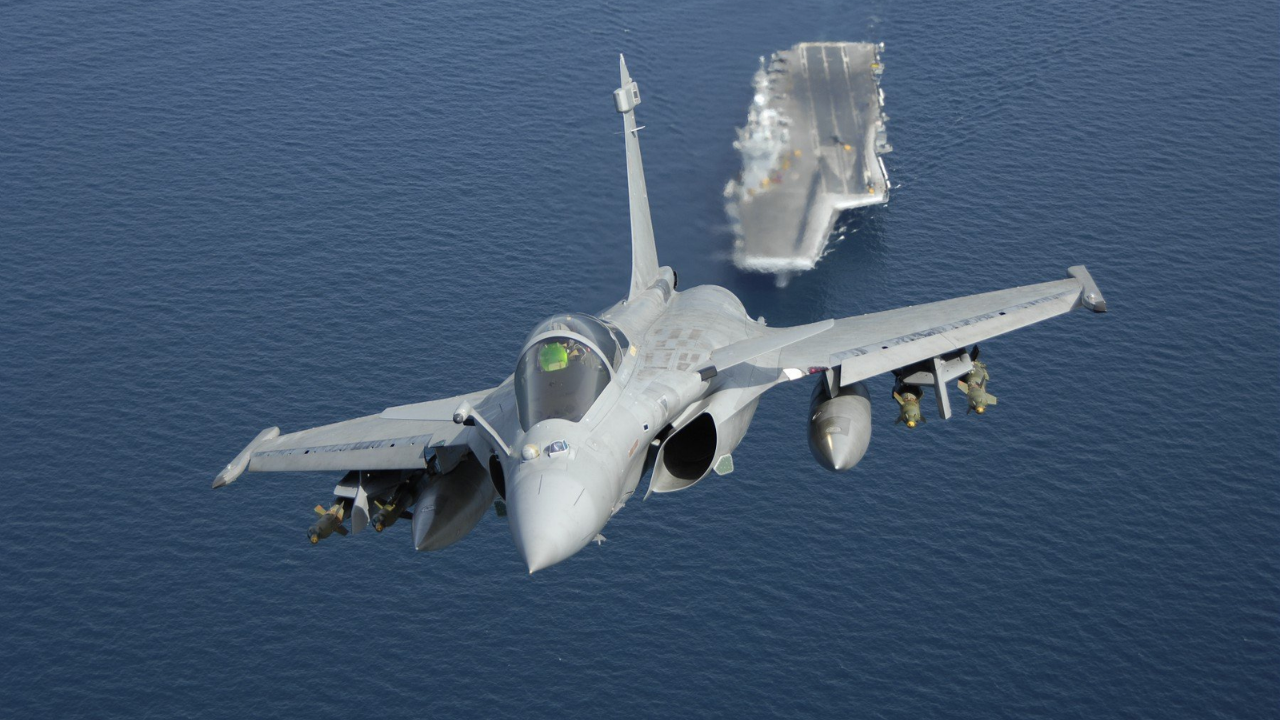
A Marine Nationale Rafale-M armed with 4 Hammer bombs takes off from aircraft carrier Charles de Gaulle. (Image credit: Safran)
France is looking to equip its Rafale fighters with a new variant of the AASM Hammer precision-guided weapon, to fill a long-standing gap in its ability to suppress and destroy enemy air defences, according to reports.
The proposed Hammer XLR uses a miniature turbojet engine instead of the solid-fuel rocket motor on existing variants, which could give French aircraft an extended-range option for striking targets in heavily defended airspace. General Jérôme Bellanger, chief of staff of the French Air and Space Force, highlighted the weapon's potential while testifying to the National Assembly on October 14, according to the French defence website Opex360.
The report said it could restore a capability France lost when it retired the AS-37 Martel anti-radiation missile in the 1990s, and that the variant is expected to become operational by 2028.The development matters to India because the Indian Air Force already flies the standard Hammer on its Rafales. The weapon, whose name stands for Armement Air-Sol Modulaire (AASM), or Highly Agile Modular Munition Extended Range (HAMMER), is a modular air-to-ground weapon developed by Safran.
It combines a guidance system, a warhead and a range-extension kit, which lets conventional bombs be turned into precision-guided munitions, and its propulsion allows release from a distance instead of overflying the target.India chose the Hammer in 2020, when it was trying to get its Rafale fleet operational quickly amid tensions with China along the Line of Actual Control. It was not part of the original 2016 weapons package, and reports said the IAF had first considered integrating Israel's SPICE 2000.
The Hammer was picked because it was already compatible with the French fighter and could be integrated faster. The IAF's inventory also includes the SCALP air-launched cruise missile and the SPICE family of guided munitions.The XLR would add a different mission, Suppression of Enemy Air Defences (SEAD) involves disrupting or neutralising radar systems and surface-to-air missile batteries, while Destruction of Enemy Air Defences (DEAD) focuses on physically destroying them, and both help create safer corridors for other aircraft.
The Rafale already carries the SPECTRA electronic warfare suite, which detects, identifies and responds to threats, but electronic self-protection does not replace a dedicated weapon that can home in on hostile radar emissions.
In February 2026, Bharat Electronics Limited and Safran signed a joint venture agreement and a master production agreement to make, supply and maintain the Hammer in India, subject to approvals, to meet the needs of the IAF and the Navy, with localisation rising in phases.The XLR remains a reported French development and not an Indian procurement. Any Indian acquisition would need separate confirmation, and the immediate benefit for India lies in the existing Hammer and its planned domestic production line.India already operates anti-radiation weapons, including the Russian Kh-31 family, and has been developing its own through the Defence Research and Development Organisation. Rudram-I, the first indigenous anti-radiation missile, was flight-tested from a Su-30MKI in October 2020. It uses inertial navigation aided by satellite navigation and a passive homing head that can detect, classify and engage radar emissions, so aircraft need not approach defended areas. The programme has since moved to the Rudram-II air-to-surface missile. The DRDO and the IAF conducted flight tests in June 2026, and the Defence Ministry said the missiles were guided to predefined targets and all test objectives were met.
Rudram-II is meant to engage a wider range of targets, including radar-related installations and other military assets.
KioskNews shows a cleaned-up reading view extracted from the publisher’s page — the original always lives on their site, not ours.