At 37, Delhi man suffered a heart attack. After 11 years, a stranger’s heart saved his life
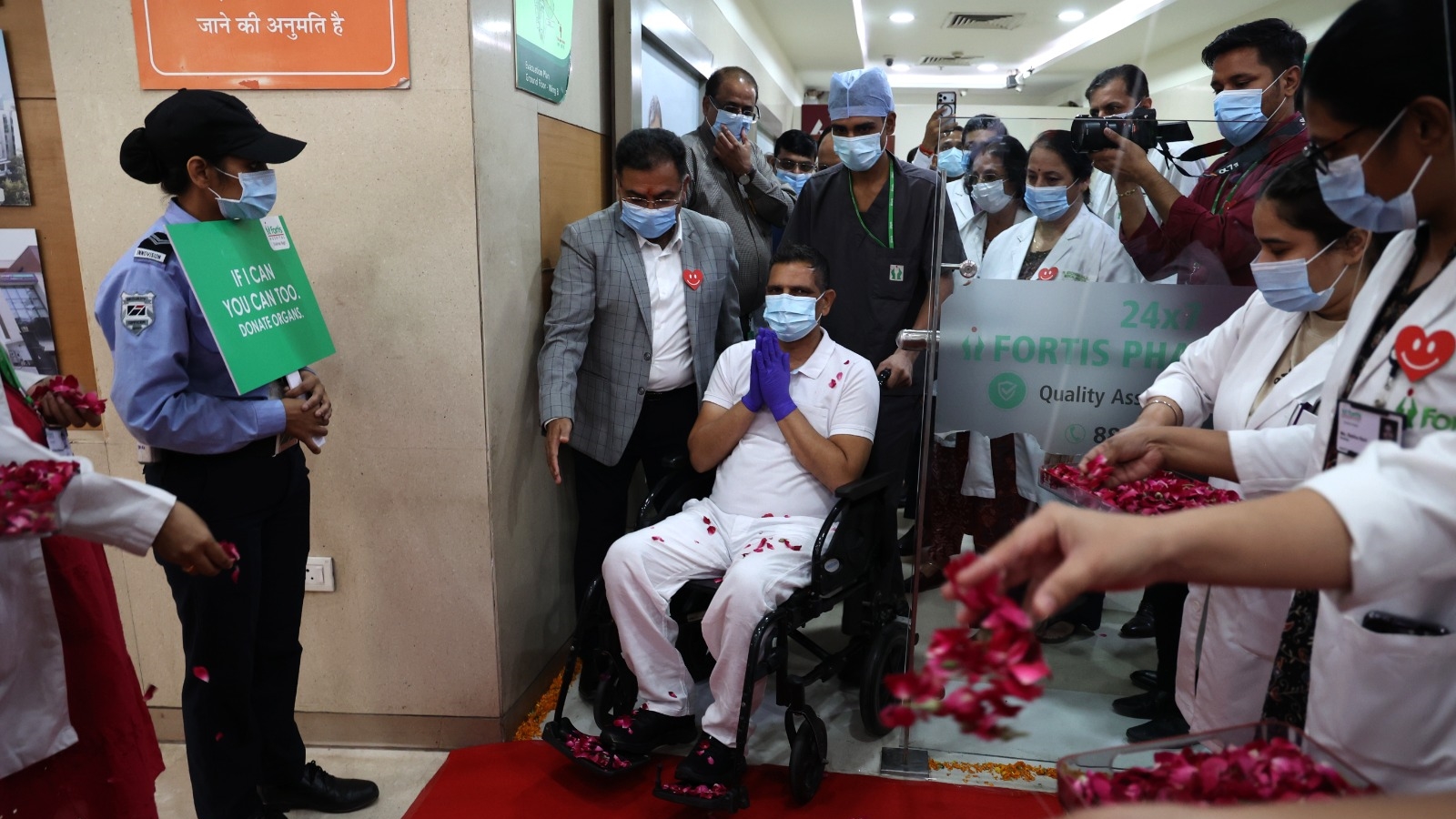
On September 17, a stranger’s heart began beating inside Chanchal Yadav, transported nearly 100 km from Rohtak in Haryana to Delhi.
It belonged to a 41-year-old man who had died in a road accident a day earlier. His family agreed to donate his organs, giving Yadav, a 47-year-old business owner from Delhi’s Vikaspuri, a chance at a new life.
For patients like him, finding a donor heart is a long and difficult process. India performs roughly 225 heart transplants a year — against an estimated annual demand of nearly 50,000 — while Delhi recorded 14 transplants in 2024, as per sources in the State Organ and Tissue Transplant Organisation (SOTTO).
11 years of waiting
For Yadav, the surgery followed 11 years of living with a damaged heart that began with a minor attack in 2015. “I didn’t even realise it had happened,” he said. “We found out three months later, by which time heart damage was already done.”
He watched as his world slowly shrank. First, he had to give up playing sports. It was his passion — volleyball, badminton, running, whatever kept him on his feet. “Iss beemari ne mujhe 11 saal sports se dur kar diya (This ailment distanced me from sports for 11 years),” said Yadav.
Then he struggled to even walk.
“Every movement started getting curtailed. There were restrictions on everything,” he said. “Gradually, I had trouble even walking. I used to feel exhausted doing the smallest things.”
In 2023, Yadav was placed on the transplant waiting list.
By the time he reached Fortis Hospital, Shalimar Bagh, in June 2026, doctors found his heart functioning at a fraction of what it should.
Story continues below this ad
Dr Dinesh Kumar Mittal, the senior cardiologist who would go on to lead Yadav’s transplant, said, “A heart transplant becomes necessary when the left ventricle — the heart’s main pumping chamber — stops functioning properly, falling below 20% of its total capacity.”
In patients who need a transplant, this can fall to as low as 10-15%, he said, adding, “At that stage, even walking becomes difficult.”
In July this year, doctors implanted an automated implantable cardioverter-defibrillator — a small device fitted under the skin that delivers an electric shock, jolting a dangerously irregular heart back into rhythm and buying extra time as he waited for a donor.
Soon after the procedure, Fortis called to ask whether he could undergo a transplant immediately. “But I told them I need to rest my body first,” Yadav recalled.
Story continues below this ad
A donor heart, 95 km away — and a race against time
The wait finally ended on September 17.
At 8.50 am that day, the transplant coordinator at Fortis Hospital, Shalimar Bagh, received a message from the National Organ and Tissue Transplant Organisation (NOTTO). A heart was available, matched to a B-positive recipient.
But the donor, a road accident victim, was at PGIMS Rohtak, 95 km away. His family had verbally consented to organ donation a day earlier.
By 2.49 pm, working on a tight schedule, a team of six doctors from Fortis was on the road to Rohtak, arriving at PGIMS at 4.34 pm.
Story continues below this ad
A careful verification process followed. Doctors ran an echocardiogram — an ultrasound of the heart — on the dead patient to confirm it was healthy enough to transplant.
After written consent from the family, the retrieval process began.
At 7.20 pm, the donor heart was stopped using a chemical solution called cardioplegia — a controlled, deliberate way of arresting the heart safely, rather than gradually failing on its own.
Within 15 minutes, the heart was packed in an ice-cooled preservation bag and left PGIMS at 7.40 pm.
Story continues below this ad
A green corridor — a route cleared in advance with traffic signals synced and police stationed at junctions — had already been arranged, allowing the vehicle carrying it an unbroken run between the two cities.
The heart reached Fortis at 8.43 pm, covering the distance in 1 hour and three minutes.
By then, Yadav was already on the operating table, connected to a cardiopulmonary bypass machine that temporarily takes over the work of both the heart and lungs during surgery.
Dr Mittal said, “After death, the heart is viable for transplant for 4-6 hours, depending on the health of the heart. In this case, the heart was quite healthy.”
Story continues below this ad
Explaining the surgery, he said: “The diseased heart is removed, and the donor heart is placed in its position and connected — the aorta, the pulmonary artery, the atria. The entire transplant procedure typically takes around 90 minutes from that point.”
By around 2 am, Yadav was off the ventilator and breathing on his own. “It was a miracle for us when the heart started beating in his chest,” added Dr Mittal.
He said the biggest constraint in transplantation isn’t surgical skill, but the availability of organs. Dr Mittal also pointed to a North-South divide in organ donation, with Southern states accounting for a much larger share of transplants. “In the North, misconceptions and superstitions around organ donation continue to hold families back.”
Yadav, meanwhile, was discharged after 25 days. As he recovered at home, his mind kept wandering to the playground and the badminton court. “I can’t wait to play badminton, swim and run again,” he said.
Story continues below this ad
He has given himself two months before he picks up a racquet.
In the meantime, Yadav plans to go back to simpler things in life: eating “desi ghar ka khana (home-cooked food)” and listening to “Hai apna dil toh awara”. “That’s the one I like to listen to most.”
How a donor heart is retrieved
- Under the Transplantation of Human Organs and Tissues Act (THOTA) Act, a heart can be retrieved for transplant only after a person has been declared brain-stem dead.
- The declaration is made by a four-doctor team comprising a neurosurgeon, the treating doctor, the doctor in charge of the hospital, and an independent doctor authorised by the National Organ and Tissue Transplant Organisation (NOTTO).
- As part of the assessment, doctors conduct an apnea test. It involves temporarily disconnecting the patient from the ventilator and watching for any spontaneous breathing effort. If the patient makes no effort to breathe despite a rise in blood carbon dioxide levels — which normally triggers breathing — it indicates that the brainstem is no longer functioning.
KioskNews shows a cleaned-up reading view extracted from the publisher’s page — the original always lives on their site, not ours.