England can take vital lessons from worst defeats into Rugby World Cup, says Johnson

Martin Johnson believes England’s most painful defeats under Steve Borthwick can benefit them at the Rugby World Cup in Australia next year.
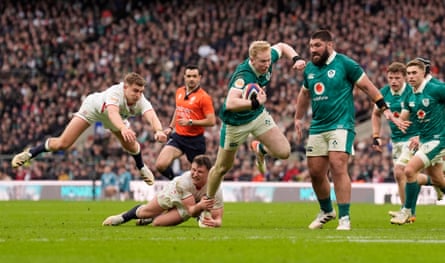
England endured some disastrous moments during the Six Nations this year, most notably the 42-21 defeat by Ireland at Twickenham, and finished the tournament with a solitary win against Wales. Summer Nations Championship fixtures began with an away defeat by the world champions, South Africa, before victories against Fiji and Argentina.
With a year until the tournament – England’s opener is scheduled for 2 October against Tonga in Brisbane – Johnson acknowledged the Six Nations was “up and down” under Borthwick but said vital lessons must be taken from the defeats.
“The bad experiences, the losing, it’s not wasted experience,” said Johnson, who captained England to the Rugby World Cup in 2003, and was head coach from 2008 to 2011. “You always want to win and they’re horrible at the time, but it shouldn’t be a wasted experience. All experience, good or bad, should go into your memory bank as a player.
“The emotional side: ‘We can’t let this happen again because it’s too painful,’ and the technical side: ‘This is why it happened … We now have that as a memory, as something to use.’ All your experiences go in that memory bank. You try to delete the emotional hurt of them, but sometimes that’s quite good to have there.”
Speaking as patron of the Joe Humphries Memorial Trust, which is calling for everyone in sport to get free, life-saving sudden cardiac arrest training during SADS week, Johnson said England’s concluding Six Nations defeat by France in March was “one of the best games of rugby I’ve ever watched”.
Regarding England’s prospects of matching the fearsome French and South African forward packs in Australia next year, he said: “I think we’re starting to develop some guys, front row, back row. The back five has probably been our strongest area in the last couple of years.
“If everyone’s fit you’ve got some pretty good depth there. It would be great to go to the tournament with all those guys firing. You’re going to need them at some point, the way the game is now, guys coming off benches is vitally important.”
after newsletter promotion
Asked if he sees parts of himself in the powerful Saracens lock, George Martin, Johnson said: “I think he’d give me a good kicking. He is a presence, isn’t he, when he’s there? I remember watching him ramming an All-Black through the ruck and into the No 9. That was a beautiful piece of rugby.”
On whether Henry Pollock’s ability justifies the considerable hype, meanwhile, Johnson said of the Northampton and England back-rower: “I don’t get involved in the Henry Pollock chats that go on. I always say for any young player, if you just keep improving and getting yourself to be a world-class player, that’s always a good thing. That’s what you need to do. Get yourself into the position where you’re a top-drawer player, and when they talk about the best in the world, your name gets mentioned. That’s never a bad place to be.”
Regarding the buildup to the tournament next year and increasing interest in the media, the former Leicester second-row said: “You always get asked about it as a player, and it used to annoy me a bit … most things annoyed me a bit, really. But it does start to loom and these [Nations Championship and Six Nations] games are all part of your collective memory, as a team and a player.”
KioskNews shows a cleaned-up reading view extracted from the publisher’s page — the original always lives on their site, not ours.