SWS: Awareness of ASEAN high among Filipino adults; net trust rating 'moderate'
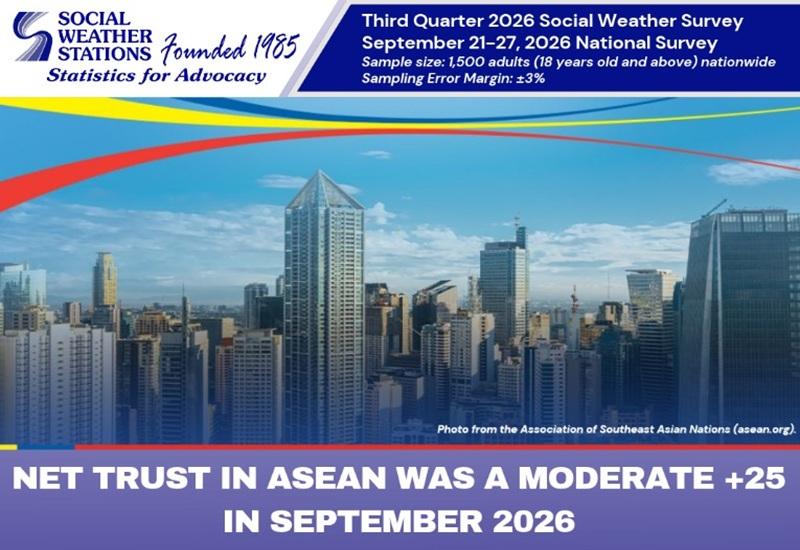
At least 91% of Filipino adults are aware of the regional organization of countries, the Association of Southeast Asian Nations (ASEAN), but the net trust is moderate at +25, according to the Third Quarter 2026 Social Weather Survey released on Wednesday.
The Survey, conducted on September 21-27, 2026, found that among those aware of ASEAN, 46% (correctly rounded) had much trust in it, while 21% (correctly rounded) had little trust, for a net trust rating (% much trust minus % little trust) of +25, classified by SWS as moderate..
At least 13% had very much trust, and 32% had somewhat much trust. Another 16% had somewhat little trust, and 4% had very little trust. Another 31% were undecided, and 3% did not know or refused to answer.
The Third Quarter 2026 Social Weather Survey was conducted from September 21 to 27, 2026, and the First Quarter 2026 Social Weather Survey from March 24 to 31, 2026.
Each used face-to-face interviews of 1,500 adults (18 years old and above) nationwide: 600 in Balance Luzon (or Luzon outside Metro Manila) and 300 each in Metro Manila, the Visayas, and Mindanao. The sampling error margins are ±3% for national percentages, ±4% for Balance Luzon, and ±6% each for Metro Manila, the Visayas, and Mindanao.
Higher net trust in ASEAN in 2013 and 2017
The net trust in ASEAN was a good +30 (50% much, 20% little) in September 2013 and a good +41 (56% much, 14% little, correctly rounded) in June 2017, higher than the moderate +25 in September 2026.
Meanwhile, the awareness of ASEAN was 94% in September 2013 and 98% in June 2017, compared with 91% in September 2026.
The net trust in ASEAN was a moderate +29 in Metro Manila, a moderate +28 in Balance Luzon, a moderate +24 (correctly rounded) in the Visayas, and a moderate +18 (correctly rounded) in Mindanao.
Net trust in ASEAN rose with education: it was a neutral +8 among non-elementary graduates, a moderate +12 among elementary graduates, a moderate +26 among junior high school graduates, a good +35 among those with some senior high school up to some college, and a good +45 among college graduates.
For the question on prior awareness of the hosting, the highest percentage was in Metro Manila at 42%, followed by 28% in the Visayas, 27% in Balance Luzon, and 20% in Mindanao.
Prior awareness rose with education, with 12% among non-elementary graduates, 21% among elementary graduates, 29% among junior high school graduates, 32% among those with some senior high school up to some college, and 55% among college graduates.
Awareness of the Philippines’ hosting of the 2026 ASEAN
The First Quarter 2026 Social Weather Survey, conducted on March 24-31, 2026, found 28% of adult Filipinos previously aware that the Philippines was hosting the 2026 ASEAN leaders’ meetings. The remaining 72% heard about it only during the interview.
Most adult Filipinos, at 91% are expecting that the Philippines will benefit from hosting the regional meetings.
At least 21% expected the country will benefit very much, 52% who expected it to benefit much, and 17% who expected it to benefit a little. The remaining 9% did not expect the Philippines to benefit.
In contrast, when the Philippines last hosted the ASEAN leaders’ meetings in 2017, 95% in September 2016 and 94% in June 2017 expected the country to benefit.
Those who did not expect the Philippines to benefit were 5% in September 2016 and 5% in June 2017, compared with 9% in March 2026.
Meanwhile, those who expected the Philippines to benefit from hosting were 92% in Metro Manila, 91% in Balance Luzon, 90% in Mindanao, and 89% in the Visayas.
The highest was in Metro Manila at 28%, followed by the Visayas at 26%, Balance Luzon at 20%, and Mindanao at 18%.
By education, those who expected the Philippines to benefit ranged from 87% among non-elementary graduates to 93% each among those with some senior high school up to some college and among college graduates.
Among those previously aware of the hosting, 94% expected the Philippines to benefit, compared with 89% of those who heard about it only during the interview.
The share who expected it to benefit very much was significantly higher among those previously aware (34%) than among those who heard about it only during the interview (17%).
Issues to prioritize in ASEAN meetings
The First Quarter 2026 survey also asked adult Filipinos, in an open-ended question allowing up to three responses, what issues the Philippines should prioritize as the ASEAN host this year.
The most mentioned were the following:
- rising prices of goods and inflation at 19%
- the West Philippine Sea at 16%
- oil prices and supply at 12%
- poverty at 9%
- economic and financial crisis at 6%
They were followed by jobs and livelihood at 5%, war and conflict at 4%, crime and illegal drugs and food supply and hunger at 3% each, and security and safety at 2%. Another 19% mentioned other issues, each cited by 2% or less.
However, 12% said there was no issue to prioritize, and 13% did not know or refused to answer.
Top issue was rising prices in Balance Luzon and Mindanao, and the West Philippine Sea in Metro Manila and the Visayas
Rising prices of goods and inflation was the most mentioned issue in Mindanao at 23% and in Balance Luzon at 20%. The West Philippine Sea was the most mentioned in Metro Manila at 22% and in the Visayas at 16%.
Oil prices and supply were mentioned by 15% each in Metro Manila and Balance Luzon, 10% in Mindanao, and 4% in the Visayas.
Those who said there was no issue to prioritize, or who did not know or refused to answer, were highest in the Visayas, at 17% and 19%, respectively.
Rising prices of goods and inflation was the most mentioned issue among non-elementary graduates at 22%, elementary graduates at 20%, and junior high school graduates at 21%. The West Philippine Sea was the most mentioned among those with some senior high school up to some college at 24% and among college graduates at 21%.
Mentions of the West Philippine Sea were 3% among non-elementary graduates, 11% among elementary graduates, and 18% among junior high school graduates.
Those who said there was no issue to prioritize were 19% among non-elementary graduates and 7% among college graduates. Those who did not know or refused to answer were 16% among non-elementary graduates and 7% among college graduates. — BAP, GMA News
KioskNews shows a cleaned-up reading view extracted from the publisher’s page — the original always lives on their site, not ours.