Raheem Sterling’s bleak tale a reminder of absurd path young footballers face | Jonathan Liew

This is how a story ends. At 9.13 on a glorious May morning, by the side of the A327, sitting in the passenger seat of a wrecked Lamborghini, feverishly stashing canisters of nitrous oxide into the back, having to recite one’s name from scratch. A police officer asks him who was driving the car at the time it smashed into a metal pole on a country road in Hampshire. Sterling says nothing. There’s nobody sitting in the driver’s seat.
As it transpired in court in Basingstoke this week, Sterling had been up driving all night by the time police started getting calls from members of the public concerned that someone was bobbing and weaving up the M3 in an unpredictable, uncontrollable manner. And of course there is an acrid and tasteless irony in the fact that this was exactly what Sterling was known for on the pitch: weaving in and out of traffic, no order or reason to it, following a logic that existed only in his own head.
We can, and we should, and the district judge did, take an extremely dim view of the serious and life-threatening crime to which Sterling has admitted. We can also acknowledge that football is the one and only reason any of this remotely registered on our radar. You are not angry at the other dangerous drivers, whose names you do not know and will never look up. You are angry at this one in particular, a £50m footballer four years ago, now facing the possibility of prison and a sporting career that may just have come to a hard stop at the age of 31.
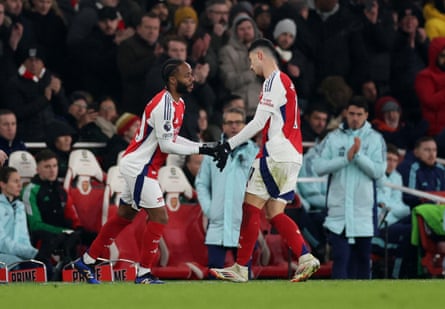
Yep: younger than Kepa Arrizabalaga, younger than Solly March, younger than Ariana Grande. And let’s be real, the end of Sterling as a going concern really happened much earlier, about the time his Arsenal loan deal ended and Enzo Maresca made clear he had no further use for him at Chelsea and he was made to train on his own after 8pm despite having young children, and Maresca said this was no big deal, because people in the fishing industry also work hard hours.
In a way, Sterling became a victim of the cycle he helped to catalyse. At the age of 15, he became one of the first big-money academy transfers when he moved from Queens Park Rangers to Liverpool for a fee of up to £2m. More than a decade on, the increasing emphasis on one‑on‑one duels, on straight-line speed and dynamic dribbling, on unpredictable and unmapped movement, has generated a kind of fetish for unscarred teenage footballers, a self-perpetuating market in child labour that nobody has ever really begun to question, much less challenge.
The Premier League’s centre of gravity has been shifting younger for years, to the point where last season half its players were 25 or younger. The three youngest Premier League debuts (Jeremy Monga, Max Dowman, Ethan Nwaneri) have taken place since 2022. Farther afield players such as Lamine Yamal (La Liga debut at 15) and Cavan Sullivan (Major League Soccer debut at 14) have begun to normalise the trope of the child footballer, the athlete propelled to global superstardom before they can legally buy a vape.
This week it has been widely reported that JJ Gabriel, a talented and highly coveted 15-year-old attacking midfielder, has demanded to leave the Manchester United academy. Let’s assume for the sake of argument that Gabriel didn’t walk into the offices of the Daily Telegraph and plant this story himself. So what we really have here, in essence, is an entire locus of gossip – briefings, counter-briefings, whispers, internet spume, back-page splashes – centred on a child.

And before we even get into the myriad safeguarding issues, it’s worth reflecting on the financial incentives involved here. As scouting networks broaden and deepen, as clubs increasingly remodel themselves as trading vehicles, the premium on exclusive young talent has become unignorable. Should Gabriel leave United he will undoubtedly have his pick of Europe’s top clubs.
after newsletter promotion
Players and their representatives have also begun to recognise their rarefied value in this market. In a previous era Michael Carrick might have had the luxury of integrating Gabriel gradually into the United first team, taking a long-term view of his development, much as Mikel Arteta has done with Dowman at Arsenal. But of course if Lamine Yamal is playing first-team football at 15, then why not JJ Gabriel? If every big club in Europe is looking for the next big star, then who ultimately holds the power in this relationship: the kid or one of the biggest football clubs in the world?
And this is absurd, and it is intentionally absurd, and it is no defence of Sterling’s subsequent actions to point out that this is basically a ridiculous path upon which to dispatch a human being: festooned with unimaginable riches as a teenager, placed at the very centre of things, cast on to the scrap heap by 29. This is an unbelievably weird life, one that starts so wildly and violently beyond the boundaries of normative society that it’s a wonder anyone manages to stay remotely sane within it.
The life-changing money, the scrutiny, the lack of privacy, the intermediaries and handlers, the winnowing of trust, the noise beyond the windows, the strangers demanding a piece of you, at a time when – remember – you are still a child and this entire lifestyle has been sold to you as the ultimate aspiration. Remember, you’re supporting the whole family now. Gabriel’s original surname, taken from his father and agent, was reportedly changed from O’Cearuill to Gabriel because it was easier to pronounce and therefore more marketable.
I guess the point here is that nobody has as much agency over their career as they might like. The young modern footballer exists at the mercy of forces barely within their control. Their job is contingent on so many others: the coaches who train their skills, the medical staff who manage their workload, the teammates who pass to them, the support network that might just dissuade them from getting into a car with a load of nitrous oxide balloons in the early hours of the morning.
And by any measure, Sterling is one of the lucky ones. The teenager who made it, who scaled the peaks, won 82 international caps, four league titles, worked under one of the greatest managers of all time, who tasted the manna even if it eventually choked him. How many other thousands of lives you will never see have been fruitlessly and callously bent and twisted towards this world: skills you will never witness, names you will never hear? How much humanity are we prepared to fling into this machine in order for it to provide us with entertainment?
Perhaps in the post-Ronaldo/Messi era we are beginning to shake the idea that great individual players can bend the arc of history to their will, a fallacy we may as well call the Ballon d’Or Industrial Complex. Injuries, circumstance, tactical trends, physical shifts, the inevitability of time and tide: these are the handmaidens of talent, its trade winds, its lucky charms. Gaze at any footballing prodigy from afar and you’ll see a seductive blur of gift and privilege. But look closely enough and you’ll notice that the driver’s seat is empty.
-
Do you have an opinion on the issues raised in this article? If you would like to submit a response of up to 300 words by email to be considered for publication in our letters section, please click here.
KioskNews shows a cleaned-up reading view extracted from the publisher’s page — the original always lives on their site, not ours.