The Standard of Living review – Rory Kinnear has bags of charm as Bloomsbury economist Keynes
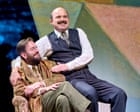
Not everyone will know that the Bloomsbury group had a jobbing economist among them. One with superstar status and a firm belief in capitalism. John Maynard Keynes (Rory Kinnear) may not have cut a very bohemian picture in his three-piece suit but the foremost thinker of economic policy in 20th century Britain was also a card-carrying art lover, avant-gardist and bisexual who had affairs with Lytton Strachey and Duncan Grant, hanging out with the gang at their nerve-centre in Charleston.
He played with equal amounts of old-school reserve, and charm, by Kinnear, as state-of-the-nation writer, James Graham, audaciously brings economic theory to the West End. The high-wire act of the subject matter is leavened by Graham’s remarkable facility to balance British social history and complex political ideas with speed, sparkle and a humorous lightness of touch.
He does just that in this polished and handsome production, directed by Nicholas Hytner. We are taken through two world wars, the Wall Street Crash and economic wrangles in Whitehall against a backdrop of Keynes’s involvement with Virginia Woolf (Naomi Frederick, intellectual confidante and sparring partner), Strachey (Pip Carter, wonderfully acerbic), Grant (Thomas Flynn, spry) and the rest of the Bloomsbury set.
“What is a good life?” Keynes asks numerously, and what might have been dusty or esoteric subject matter, better left to textbook history, is made human. It is clear that economics is not about mathematical equations but about the choices we are afford to make in relation to freedom, happiness and culture.
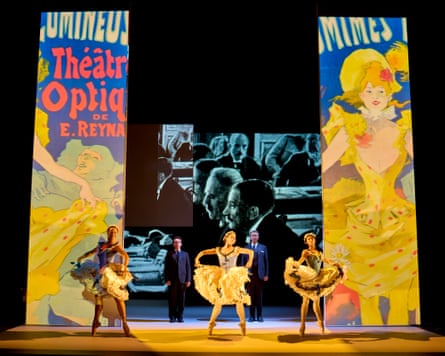
There is typically for Graham, dextrous storytelling and accessibility of ideas. Bob Crowley’s set design is little short of ravishing with its moving screens of art and archival footage.
Keynes explains his theories in lectures but also cleverly crafted dialogue so it does not feel leaden or expository. We learn how Keynes espoused government intervention and a culture of state spending after the war to bring the bombed economy back on track. Written off as socialist by some, he is the one who secured credit from America to rebuild Britain. He was also a fierce advocate of the arts and helped to create the Arts Council (he was its first chair). Alongside the serious stuff is rigorously researched and amusing detail, with Keynes keeping an inventory of past lovers in a little black book and talking of flirtations with Albert Einstein.
And yet, it is all so polished that the serrated edges of his life are lost, so accomplished that the mess of human conflict does not quite manage to fire its centre.
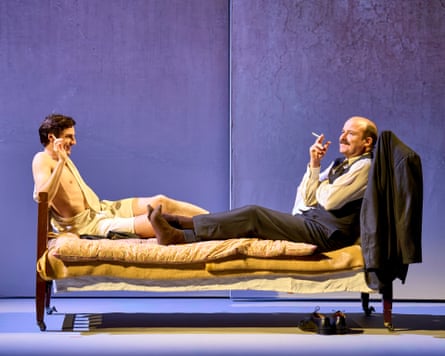
Keynes’s marriage to Russian ballet dancer Lydia Lopokova, played by ballerina Natalia Osipova in her acting debut, was a surprise turn to heterosexuality for his Bloomsbury friends, and is straightforwardly sweet here. His arguments with the non-interventionist, Austrian-born LSE economist, Friedrich Hayek (Laurie Kynaston), seem rather polite too offer anything truly combative. At least his relationship with ex-lover Strachey is scratchier.
The drama has a slightly static quality despite the twirling red-and-white feathered dancers of the Ballets Russes and its slick movements through time. It seems essentially like a biographical trot through Keynes’s life, made with fondness and admiration for the man – but perhaps not enough of what lies beneath the surface. There is a flag-waving moment for the Arts Council at its birth. It is euphoric, but there is no nod to its current state. But there is a knowing moment when, talking about the dangerous effects of economic downturn, Keynes speaks of the draw to populism and political extremism – a nod to today, and a justification of this play’s continued relevance.
Kinnear is never any less than lovable in the role, yet you never quite get beyond the three-piece suited exterior. Despite his presence in almost every scene, his emotional life remains sealed off. Maybe that is as it should be: a free, rebellious spirit who infused economics with imagination but looked like a “tax man”, in the snide words of Strachey. So Graham’s bohemianism, hiding inside the carapace of capitalism.
-
The Standard of Living is at Theatre Royal Haymarket, London, until 12 December.
KioskNews shows a cleaned-up reading view extracted from the publisher’s page — the original always lives on their site, not ours.