Jantar Mantar Tells The Time. Clock Is Now Ticking On Its Future As Protest Site
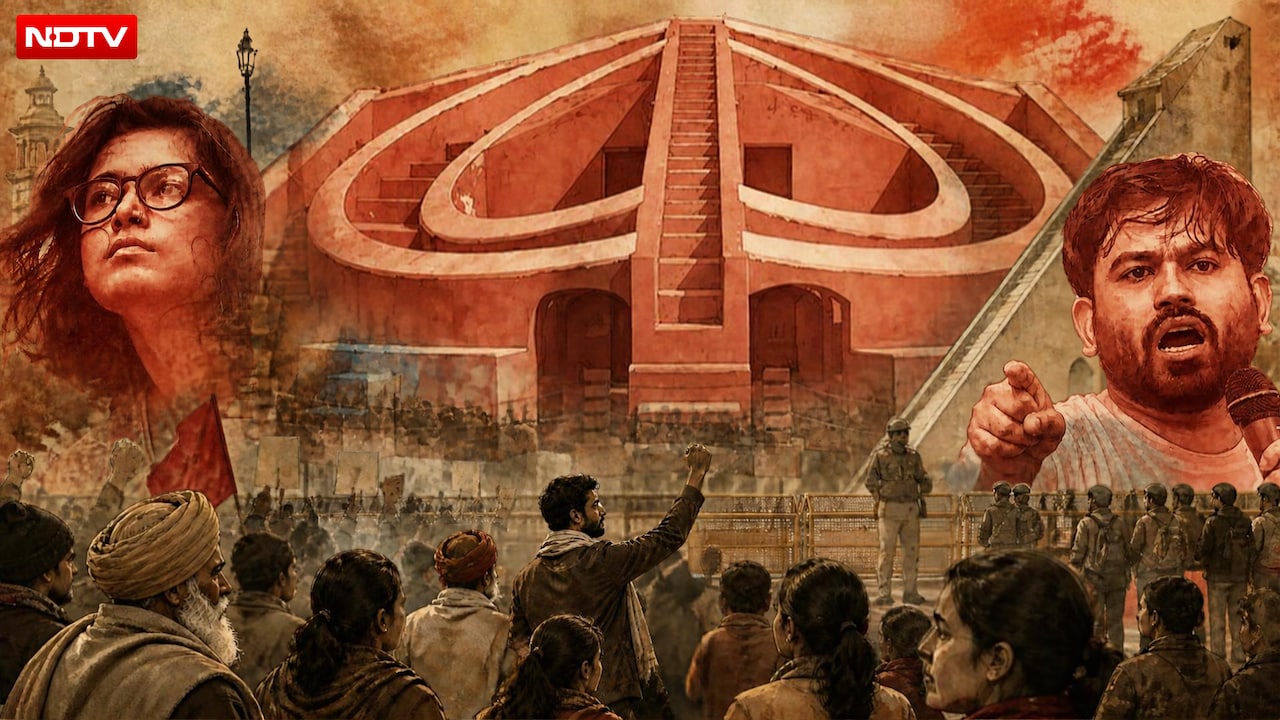
It's an 18th-century observatory that tracks the movement of the sun and the moon, reads celestial signs and, essentially, tells the time. In India's modern political culture, though, Jantar Mantar has held a new role for decades, telling whether times are indeed changing. Its own time as a protest site may soon be over.
On Saturday, police did not allow protesters raising the issue of alleged electoral fraud to come close to the site on the road right outside the main compound. The previous day, the Supreme Court had said something that raised a more existential question about the site where history and politics meet on the street.
Advertisement - Scroll to continue
"It is high time basic amenities were provided to those engaged in peaceful and lawful protest," the court first said in its order, hearing petitions against transport curbs ahead of the Cockroach Janta Party's (CJP) protest call over alleged electoral irregularities.
The next line in the order read, “To that end, suitable alternative sites capable of housing such infrastructure need to be identified and designated.”
CJP Agitation At Centre Of It Now
The bench of Chief Justice Surya Kant and Justices Joymalya Bagchi and V Mohana made a similar observation on August 3, on a separate petition, days after the CJP's first agitation forced the resignation of education minister Dharmendra Pradhan. The court sought responses from authorities, including the Centre, the Delhi government, and the police.
Advertisement - Scroll to continue
Delhi has other designated protest sites, farther from the seat of power, but Jantar Mantar sits at the heart of India's nerve centre, opening onto Parliament Street.
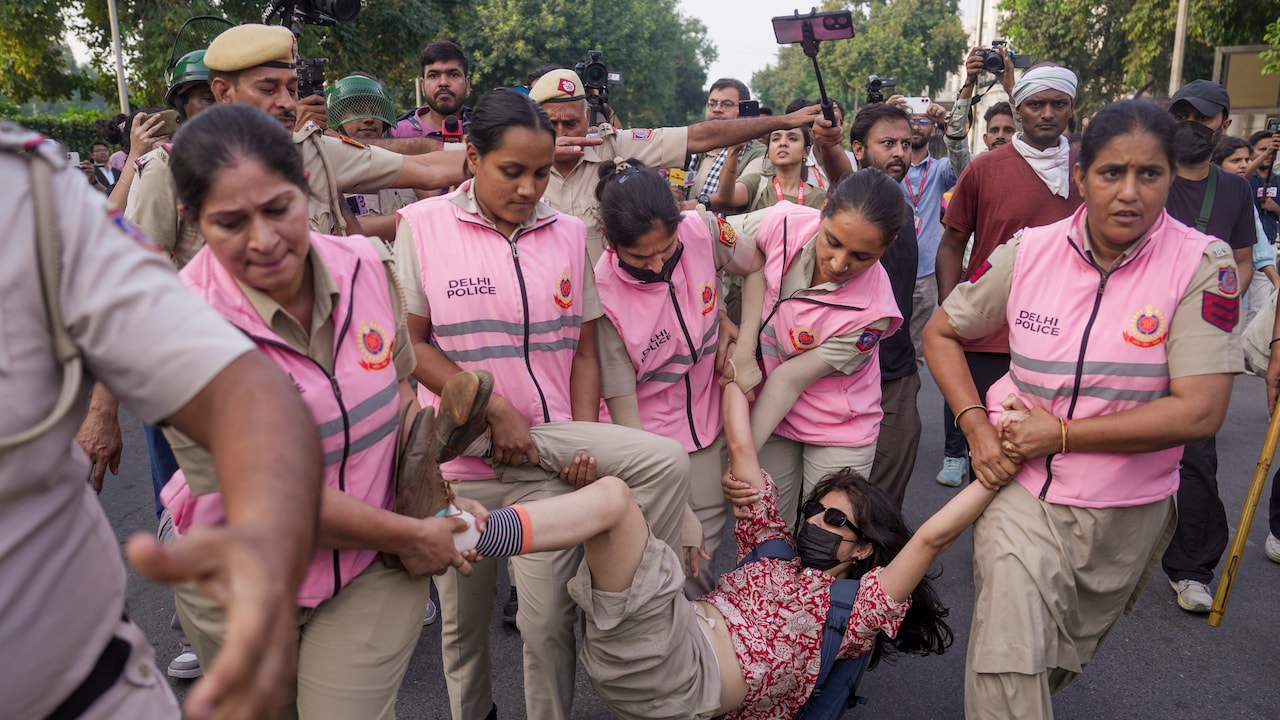
Police detain an activist demanding the resignation of Chief Election Commissioner (CEC) Gyanesh Kumar, in New Delhi on Saturday, October 10.
Photo: PTI
CJP founder Abhijeet Dipke meant to go to Jantar Mantar, as did hundreds of others, for the Saturday protest. He could not move from the plane to the aerobridge before cops appeared. Delhi Police entered the plane as soon as his flight landed on Saturday morning and took him away. Saurav Das and Ashutosh Ranka, two other main faces of the meme-page-turned-pressure group, were detained with him. All three had flown in from Mumbai to lead the protest demanding the resignation of Chief Election Commissioner Gyanesh Kumar.
At least 3,000 people, including four former chief ministers, were detained across the national capital and released by nightfall.
Delhi Police's letter denying permission to the CJP on Friday cited the organisation's agitation of June-July. It said a gathering was permitted for one day but had continued for about a month.
It also noted that Jantar Mantar is a relatively small venue that can safely hold only about 1,000 people at a time.
How Times Change, As Do Sites And Meanings
The site at the centre of the standoff is not the ticketed compound of the 300-year-old monument as seen in tourism ads. It's a small road next to it. But the monument lends a historical backdrop.
Maharaja Sawai Jai Singh II of Amber built the observatory in 1724 with giant instruments of brick and stone, back when New Delhi was not yet built, and Delhi was a seat of Mughal power even as the British or the East India Company were yet to conquer it.
The Rajput king was patronised by Emperor Muhammad Shah, who gave him prestigious imperial titles, including Saramad-e-Rajaha-e-Hind ("Chief of the Rajas of India") and Raj Rajeshwar. Muhammad Shah, who was Aurangzeb's great-grandson, was a lover of the arts and science, and is often remembered with the word ‘Rangila' (the colourful one) suffixed to his name.
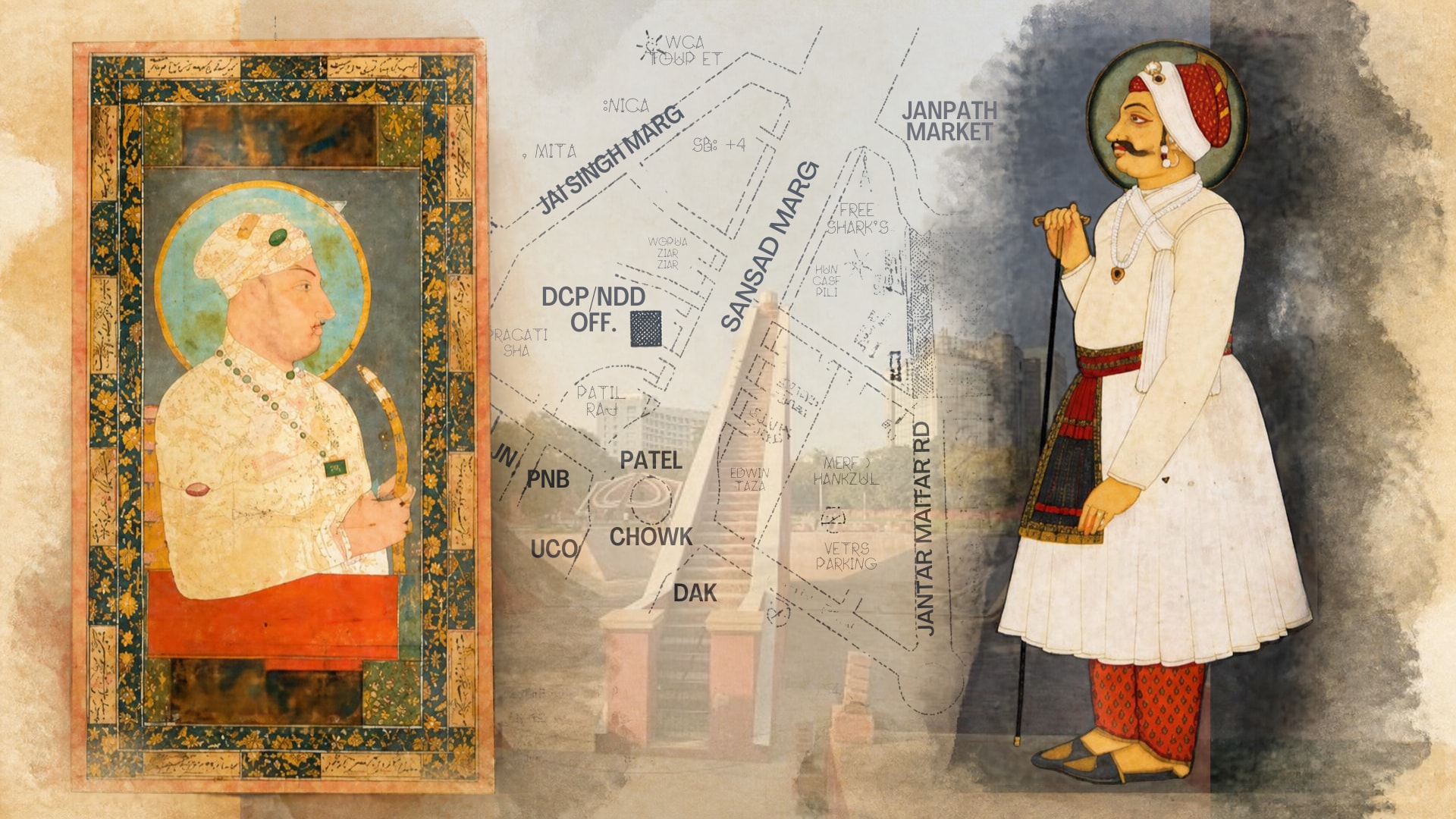
Muhammad Shah 'Rangila' wanted a more precise method of tracking auspicious dates and festivals, and Jai Singh delivered that with the Jantar Mantar, which now sits close to the seat of power in modern India. (AI-assisted illustration: Photos by National Archives, Wiki Commons, ANI)
Delhi's Jantar Mantar grew out of Muahammad Shah 'Rangila' and Jai Singh's conversation about calculating the days of festivals and auspicious dates more precisely than was possible with smaller instruments made of brass, conservation architect Anisha Shekhar Mukherji said in her book about it. The giant observatory lay a little away from the walled city of Shahjahanabad, which we now know as Old Delhi, historian Rana Safvi has noted.
Now in the middle of an ever-expanding Delhi, it was the first of five such observatories, the others at Jaipur, Ujjain, Varanasi, and Mathura, all cities where Jai Singh was posted as governor. The name is a colloquial corruption of the Sanskrit ‘yantra' (instrument) and ‘mantra' (calculation), Safvi has explained.
As technology moved, these became markers of a time gone by with varying fates, such as the Mathura one demolished by 1857 and the Jaipur one designated as a UNESCO World Heritage Site in 2010. In Delhi, the surrounding urban landscape has compromised its precision.
READ | Protesters Take Shelter At Delhi Gurdwara, Then A Viral Cop Video Sparks Row
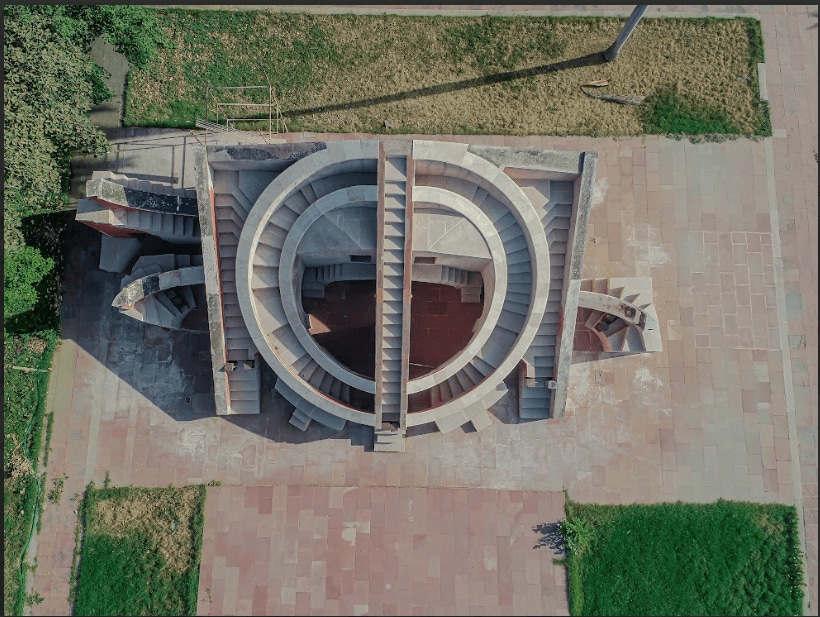
Photo: Ministry of Culture, GoI
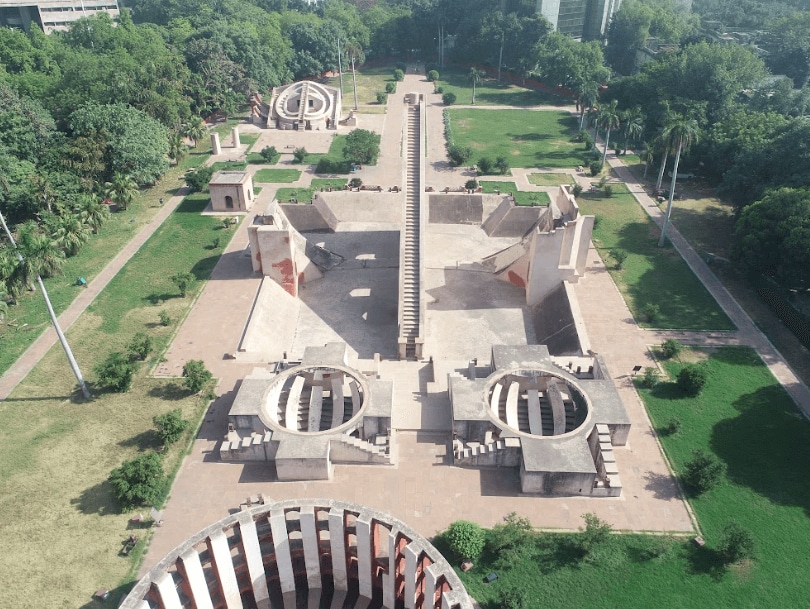
Photo: Ministry of Culture, GoI
Boat Club To Here, Elsewhere
Modern-day protests moved to Delhi's Jantar Mantar Road after authorities relocated them from the Boat Club lawns over 30 years ago. For decades after Independence, Delhi's biggest rallies were held on the lawns near India Gate, within sight of North Block and South Block, which house the ministries.
Things changed after 1988, when Mahendra Singh Tikait camped there for about a week with an estimated 5 lakh farmers. As president of the Bharatiya Kisan Union (BKU), Tikait forced the then Rajiv Gandhi government to accept key demands such as electricity bill waivers and higher sugarcane prices. (His son Rakesh was a main face of the 2020-21 farmers' movement on Delhi's borders that forced a rare reversal by Prime Minister Narendra Modi, leading to the repeal of three contentious laws.)

India Gate sees some protests now too, such as a recent one over winter smog and pollution, but police crack down quickly. Photo: NDTV
By 1993, demonstrations were no longer permitted on the lawns, with some reports linking the decision to security concerns after the Babri Masjid demolition. The protests then moved about 2 km to Jantar Mantar Road, by administrative practice, with Ramlila Maidan and grounds in Burari set aside for larger rallies.
‘Marketplace Of Grievances'
The Jantar Mantar site is a heavily regulated, half-kilometre stretch of road. It is about 1.5 km from Parliament House, so protesters marching to the legislature are typically halted by multi-layer police barricades if a march is allowed at all. The Prime Minister's official residence is also in the same Lutyens' Delhi zone, as are major offices and the Connaught Place market.
The site has seen most of India's issues and contradictions pass through: Opposition leaders protesting inflation and later curbing similar protests when in power, military veterans seeking higher pensions, and groups seeking new laws or repeals, among others. For at least one protester, the road became a postal address for some years. Time magazine once described it as a "marketplace of grievances". In more recent years, India's top wrestlers protested here, as did those sick of the seasonal onslaught of pollution in the National Capital Region (NCR).
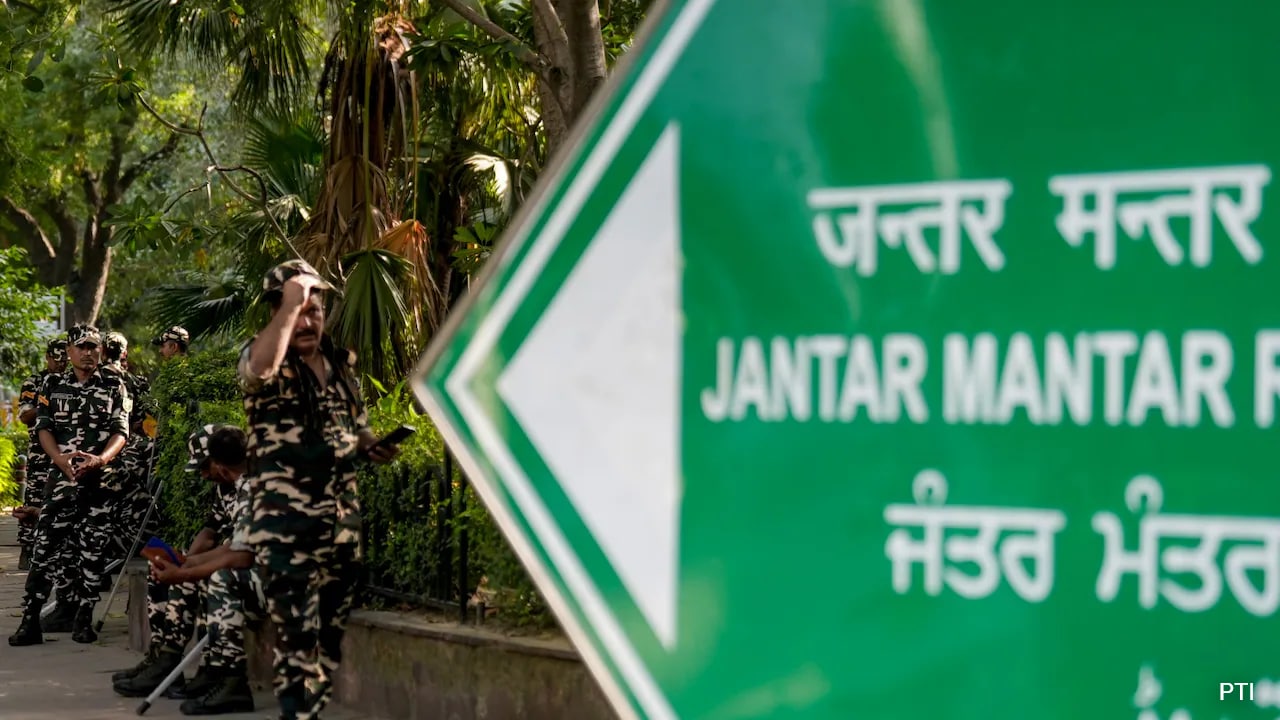
In April 2011, veteran activist Anna Hazare began a hunger strike there for a Jan Lokpal law to appoint an autonomous ombudsman in corruption cases. When he fasted again that August, the crowds had outgrown the road, and the venue was Ramlila Maidan.
That maidan has its own history: On June 25, 1975, it was the site of a rally against Indira Gandhi, just before the declaration of the Emergency, where Jayaprakash Narayan recited Ramdhari Singh Dinkar's famous poem 'Sinhasan Khali Karo Ki Janta Aati Hai' ['Vacate the throne, for the people are coming'].
The Anna movement of 2011 birthed Arvind Kejriwal's AAP and played a part in the undoing of Manmohan Singh's Congress-led UPA government. Narendra Modi-led BJP romped to power in 2014, with some from the Anna movement, such as former Army chief VK Singh, on his team. Kejriwal was among those detained on Saturday as he echoed the allegation that the Election Commission helps PM Modi and the BJP through its Special Intensive Revision (SIR) of voter rolls.
In one of the more striking sights here, in March 2017, more than 80 farmers from Tamil Nadu arrived for what became a 41-day protest. They wanted a drought relief package and a loan waiver. The visuals were stark: half-shaved moustaches, mice and snakes in their mouths, mock funerals, and skulls they said belonged to farmers who had died by suicide. Six years later, when this group applied to protest at Jantar Mantar again, they were refused.
The Delhi Police's refusal letter cited a Standing Order of 2022-23 that is cited in most such rejections now. Guidelines under that order limit protests to between 10 am and 5 pm, with no continuous programme exceeding a day.
READ | "Unwarranted Interference": India Slams UN's Remarks On Delhi Detentions
What Only Time Can Tell
The question of picking an alternative site, which the Supreme Court raised on Friday, took an existential tone almost a decade ago. In October 2017, the National Green Tribunal banned protests on Jantar Mantar Road altogether. It acted on a plea by some area residents who said the agitations made the stretch a major source of noise pollution and garbage. The NGT ordered protesters to be shifted to Ramlila Maidan, near Old Delhi.
That ban lasted nine months. On July 23, 2018, the Supreme Court set it aside in a judgment that held that peaceful demonstrations could be regulated but not prohibited altogether.
New police regulations followed, capping the Jantar Mantar site at 1,000, down from an earlier limit of 5,000. Ramlila Maidan was designated for gatherings of up to 50,000, and Burari, on the city's margins, for larger crowds. Organisers must seek permission 10 days in advance.
This year, days after the CJP's weeks-long protest, the CJI-led bench on August 3 issued notice on a petition asking that Jantar Mantar be discontinued as the “ordinary designated venue for public protests and demonstrations”.
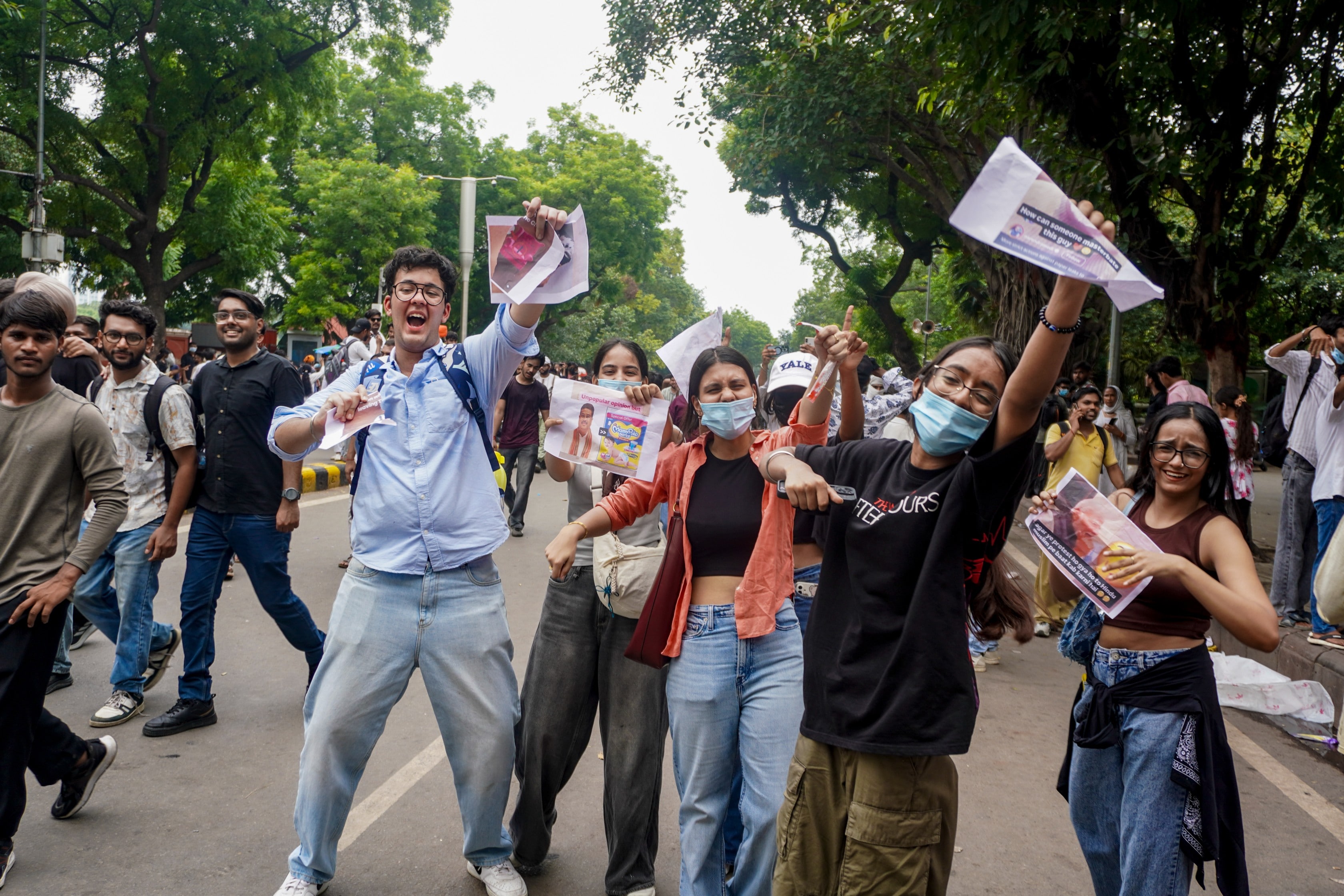
CJP supporters celebrating after their protest forced the resignation of the education minister on July 25, 2026.
Photo: PTI
“It has been stated in the plea that Jantar Mantar is not a proper site anymore for such protests due to ingress and egress issues. Supply of medical essentials etc. I think this is important... Please take instructions,” Chief Justice Surya Kant told the Solicitor General of India.
Four days later, the Cockroach Janta Party, which had started as a satirical online movement after some remarks by the CJI in court in May, responded.
“HANDS OFF our Jantar Mantar!” CJP chief spokesperson Saurav Das wrote on X. “Before trying to take away our protest site, tell us if you will designate the India Gate where we can exercise our fundamental right to peacefully protest,” he added.
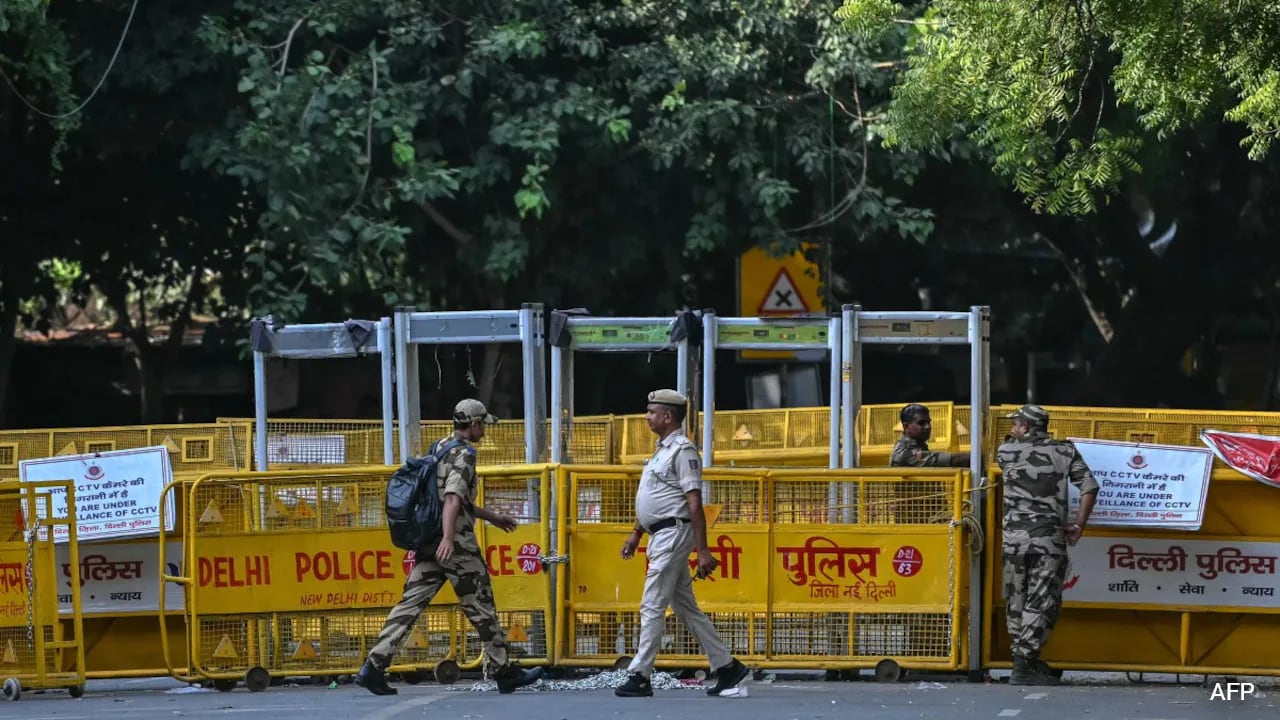
On October 10, Das was detained at the airport before he could reach Jantar Mantar, which remained deserted. The protest then spiralled across Delhi, finding echoes also in Mumbai, Chennai, Ahmedabad, Chandigarh, among other places
The CJP and Opposition leaders later vowed to continue trying to march to the historic site, and asked people to gather wherever they could: “Let the whole country be Jantar Mantar.”
KioskNews shows a cleaned-up reading view extracted from the publisher’s page — the original always lives on their site, not ours.