World’s climate action falling far short: UN report
Global commitments to cut planet-heating emissions are falling far short of the Paris Agreement and put the world on course for 2.6°C warming this century, the UN said yesterday.
Even if countries deliver their latest climate pledges in full, global temperatures could still rise 2.6°C above pre-industrial levels by 2100, the UN Environment Programme’s (UNEP) annual Emissions Gap Report showed.
That would blow past the historic goal agreed in Paris in 2015: keeping warming well below 2°C while striving for a safer 1.5°C.
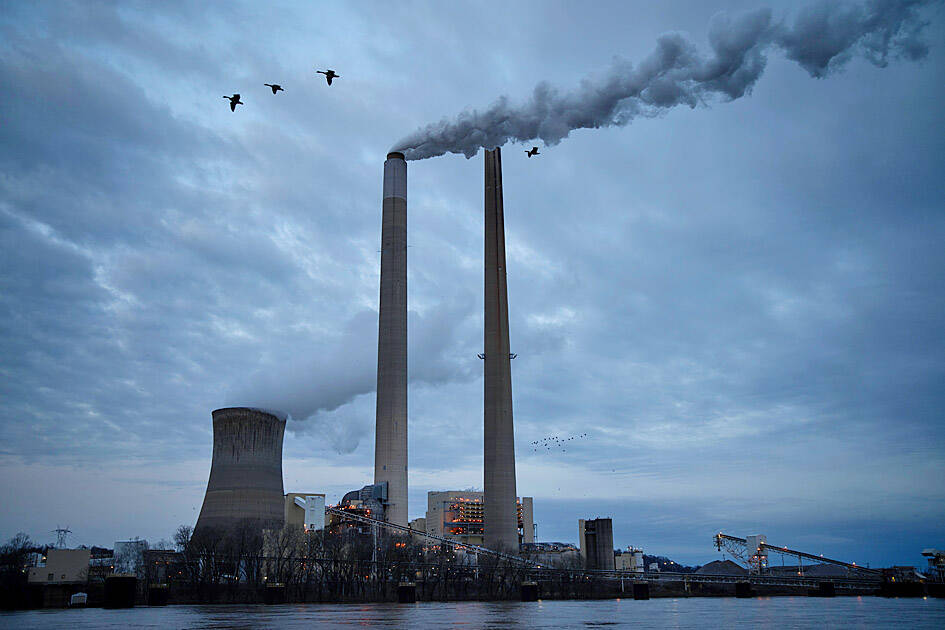
Smoke rises from the coal-fired Mountaineer Power Plant near New Haven, West Virginia, on March 13.
Photo: AP
Any chance of keeping to 1.5°C had been “lost” due to decades of insufficient climate action, the report said.
“The world can no longer avoid overshooting the 1.5°C limit, and the consequences are already devastating,” UN Secretary-General Antonio Guterres said in a statement to launch the closely watched report.
“Deadly floods, brutal heat waves, raging wildfires, lost lives, crippled economies, deepening inequalities, and those least responsible are suffering first and worst,” he said.
Overall, global greenhouse gas emissions last year were broadly on par with record levels in 2024, with the difference between the two years too small to call, the report said.
Carbon emissions just from burning coal, oil and gas — the main driver of climate change — rose slightly last year compared with the previous year.
Drastically cutting global carbon emissions — by 18 percent by 2030 and 69 percent by 2040 — “is the only way that we can get back to a semblance of a reality that is still largely manageable without major impacts and therefore that makes every sense,” UNEP Executive Director Inger Andersen said.
“The report’s message is clear,” said climate scientist Adelle Thomas, vice chair of a UN scientific assessment on climate impacts.
“We know what needs to be done. We have the tools to do it. And delay only makes the challenge more dangerous and more expensive for all,” said Thomas, who was not part of the study.
The G20 accounts for three-quarters of global emissions, but Guterres said that “all countries, especially the big emitters, must do more” to stop heating the planet.
This latest UNEP outlook is worse than last year’s due to the formal withdrawal of the US from the Paris Agreement and upward revisions of historical emissions, report coauthor Anne Olhoff said.
Emissions growth slowed down among the G20, but the US was a “major exception,” the report said.
In terms of magnitude, the US increase of 133 megatonnes of carbon dioxide equivalent “far exceeded” that of any other country, it said.
KioskNews shows a cleaned-up reading view extracted from the publisher’s page — the original always lives on their site, not ours.