The 2026 BirdLife Australia photography awards – in pictures
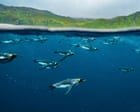
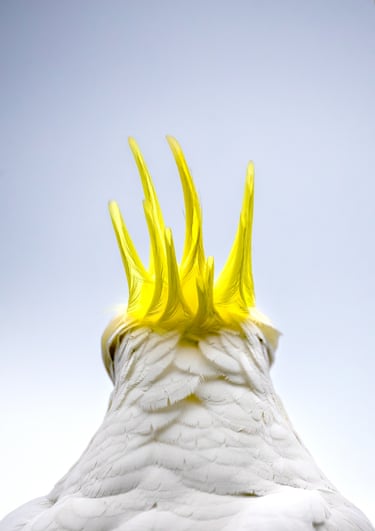
The Crown – bird portrait, winner
We live in a wooden house so we try to keep the wild cockatoos at bay (or else they eat it!) but occasionally one or two polite fellas will perch on our balcony to watch the world unfurl below. On this day it had been showering on and off (hence the soft grey light). I snapped from the doorway to my house just as the cockie was straightening up after a head shake, so for a moment his comb was standing up like a crown.Photograph: Rachelle Mackintosh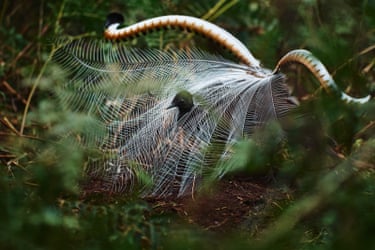
It takes two to tango – bird behaviour, winner and overall runner-up
While superb lyrebirds are famous for their mating displays, which can be observed in winter months throughout the wet forests of south-eastern Australia, the actual copulation was captured only a handful of times and to my knowledge the majority of those captures were done on video. I feel that I was very lucky to document this very special scene in photographs and wanted to share the experience with a wider audience. This shot is of the part of the ritual dance preluding the copulation. The female arrived at the mound, and the male covered her with his tail and is dancing around her, singing and trying to win her over.Photograph: Elmar Akhmetov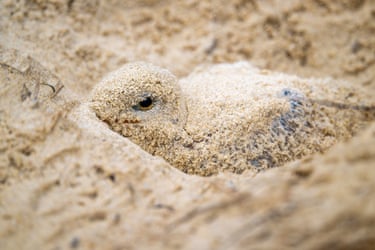
Crumbed Sausage – bird behaviour, runner-up
As part of my volunteer work for BirdLife Australia, I have monitored this caspian tern colony over several years. Often they nest in a very exposed area on a sand spit and the nests and chicks are destroyed by weather events in conjunction with tidal surges. After such an event this is what I found in the area of the colony. This mature chick was hiding and totally camouflaged by a covering of sand. To be clear this is not a nest as caspian tern chicks are semi-precocial, being active and mobile after hatching but still being fed by their parents.Photograph: Mark Lethlean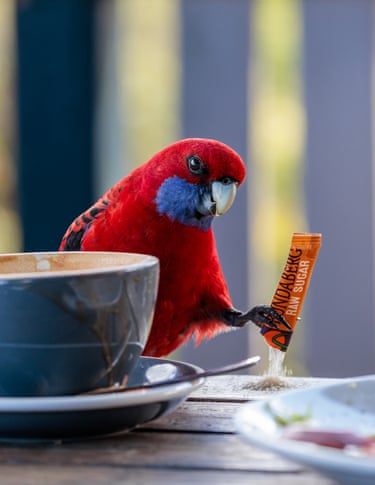
The sugar thief – human impact, winner
After a nature walk around O’Reilly’s with my camera, I was sitting at the cafe when a crimson rosella landed on a nearby table. To my surprise, it grabbed a sugar packet, tore it open and started emptying it while making direct eye contact with me. The moment was both funny and unsettling. While the scene is comical, it’s a reminder of the harm caused by feeding wildlife. Birds like this can become too comfortable around people and reliant on food that isn’t good for them. Thankfully, the bird was quickly interrupted in its sugar heist by the waitstaff clearing the table.Photograph: Kylie Facey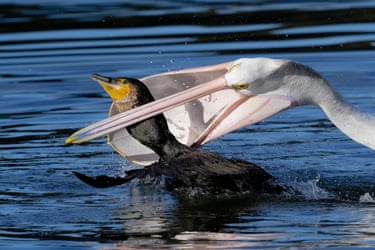
Cormorant refuses to give up catch to pelican mafia – bird behaviour, commended
I have often seen cormorants and pelicans “fishing together”. I’d always thought there was something cooperative about it. Recently, after some closer observation, I saw that it was a bit darker than that. The pelicans were shadowing the cormorants, ready to pounce the moment a cormorant came up with a fish, grabbing the cormorant by the throat in an attempt to stop it swallowing the fish, having to instead cough it up into the waiting mouth of the pelican … I like this particular shot because it shows the precise moment the pelican latches on to the cormorant’s throat with mouth inflated, too late in this instance, as the cormorant had already got the fish far enough down to get away with it. From a technical aspect, one of the things I like is that I’d had the foresight to set my aperture at f11 to give myself some depth of field for action involving multiple birds.Photograph: Greg Wyncoll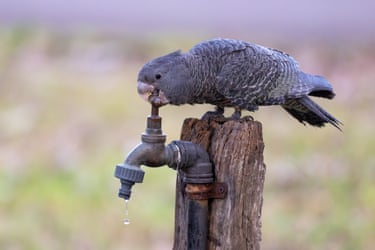
Gang tackle – backyard birds, winner
A female gang gang cockatoo playing with a park tap trying to get more water flowing. Cockatoos are very smart birds that also like to play and explore. This photo encapsulates why many people are drawn to cockatoos, showing off their adaptation to urban life as well as their cheeky and inquisitive nature.Photograph: Mark Doro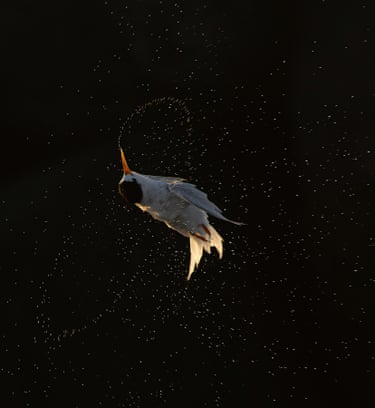
Mid Flight Glisten – birds in flight, commended
Arriving for a sunset shoot to capture the fairy terns was my goal. As with all shoots, one is not sure what to expect at any given time. There was a colony on the beach and I decided to wait and observe their behaviour first, waiting for an opportunity that appealed to me. I noticed that the fairy terns were flying near the groyne, dipping in and then emerging, twisting and turning in the golden light and I decided that these were to be the shots I was looking for. The groyne provided a fantastic backdrop as it was in shade and dark. When the fairy terns twisted and turned in flight they sprayed water from their beaks and wings in a “shake off” and as the sun was setting it illuminated the water droplets giving them a golden glisten, while backlighting the bird. I love how the water droplets in this image emote the feeling of the water and bird seemingly frozen in the air for just a second.Photograph: Louie Owen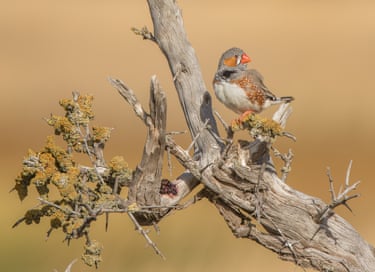
Bold – special theme: Australian finches, winner
I was at the Western Treatment Plant, south-west of Melbourne, and I was wandering back to my car after photographing some waders when I took this opportunistic shot of a male zebra finch. I like the image because the bird and perch are in sharp focus and the background colour is complementary.Photograph: Stephen Garth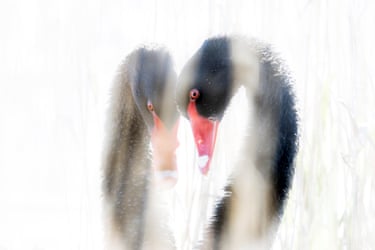
Impasse – bird portrait, runner-up
Taken in Tasmania on the final (late) afternoon of a bird photography workshop. Here I captured two Australian black swans in some sort of graceful song and dance of disagreement. It seemed like a gentle warning to not approach too close to a partner and cygnets nearby. I’m not sure what was said between them, but a peaceful resolution was the result and the visitor retreated. The fabulous instructor was encouraging us to play and overexpose the images and this was the result. In post-processing I enhanced the blacks a little to have the birds stand out as they were the stars of the image, I also increased the vibrance a touch just to bring those reds to life. I like the shape of the swans, that heart they make with their long necks, and the eye contact with the camera from the bird on the right.Photograph: Reeni Martinez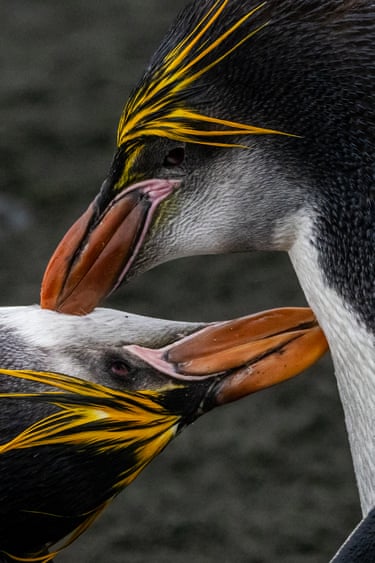
Bonding – youth, highly commended
At Sandy Bay, Macquarie Island, a royal penguin pair share a quiet moment of connection through mutual preening. This gentle behaviour is the penguin equivalent of a kiss, a display of affection and bonding between partners. Their tender interaction offers a glimpse of the social bonds that these remarkable birds have.Photograph: Arlo Wallace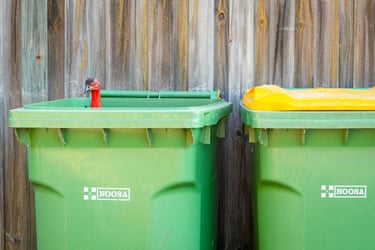
Bin Turkey – human impact, highly commended
While camping in Queensland, I noticed an opportunistic brush turkey foraging for food in the rubbish bin.Photograph: Emma Perry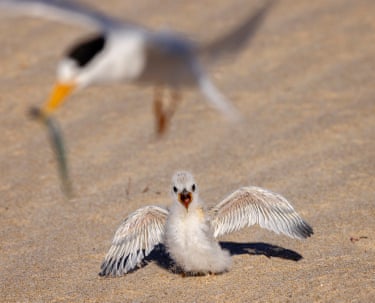
Is that for me? – bird behaviour, commended
Endangered fairy terns return each summer to breed on a popular Mandurah beach, surviving in an unlikely location between a car park and a rock groyne. Amid the ruckus of the busy colony, fairy tern chicks can identify their parents by their calls although that doesn’t stop them from begging food from any adult that flies by with a tasty morsel. In this instance this hungry chick had to wait a bit longer, as that fish was destined for another.Photograph: Sharon Jones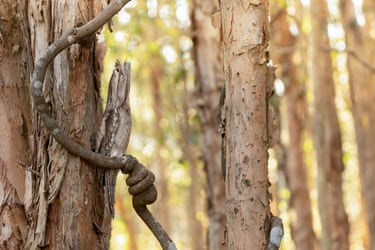
Master of Disguise – youth, winner
I love this shot of a tawny frogmouth because firstly they’re such cool and unique birds with a funky personality. I also love how the perch it’s sitting on almost frames the bird and has an interesting spiral shape. And I love how the shot shows the habitat around the bird, reminding me what it was like in the area. Also tawny frogmouths are usually perched rather high up so it was super cool finding this one perched at eye level, allowing me to have a cleaner background and better view angle to the shot.Photograph: Micah Boyce
‘Every moth is precious’: why are there so many bogong moths, and how can you safely remove them from your home?

After a dead whale washed up at a Perth beach, some took selfies. Others held their nose from the stench

‘Thrilled’: huge swarms of bogong moths surprise NSW residents and may point to species’ recovery
Whale carcass washes up on popular Perth beach, drawing hundreds of onlookers – video
KioskNews shows a cleaned-up reading view extracted from the publisher’s page — the original always lives on their site, not ours.