Gyanesh Kumar Could Now Be Part Of Delimitation Commission Amid Voter Roll Controversy

Chief Election Commissioner Gyanesh Kumar, whom the Opposition has twice tried to remove from office, could have a role in redrawing India's electoral map if the government's delimitation bill passes in its current form when Parliament reconvenes next week.
The original Delimitation Bill 2026 -- as introduced in the Lok Sabha in April when the government could not put together the required Special Majority of two-thirds -- has reportedly been edited this time to address the concerns of states' proportional share in the Lok Sabha. That means there'll be a flat 50 per cent increase across all states, thus no change in how the pie is divided and a freeze for the next 25 years. That's the numbers bit.
Though a copy of the revised draft is not yet available, the Opposition fears that the redrawing of boundaries of each constituency would lead to gerrymandering, or the division of populations in such a way that benefits one party.
Poll Body Chief At Centre Of Row
The Delimitation Commission that'll carry out the whole process would be chaired by a serving or former Supreme Court judge.
Its other members would include the Chief Election Commissioner (CEC), on account of holding that post -- that's officially called an ex-officio membership -- or an Election Commissioner nominated by the CEC. Plus, the State Election Commissioner concerned.
Gyanesh Kumar's term as CEC runs until January 26, 2029. That is the period in which a nationwide delimitation would have to be completed if the 2029 Lok Sabha elections are to be held as per new boundaries.
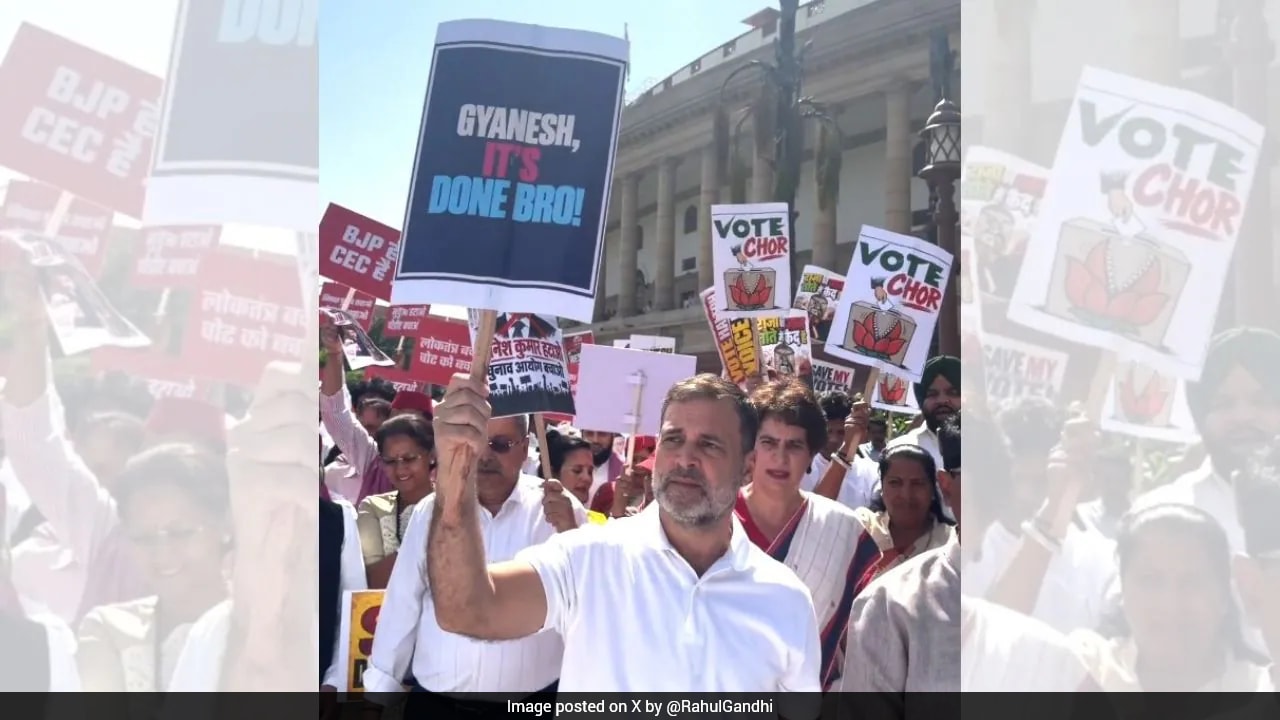
Ex-IAS officer Gyanesh Kumar, formerly a secretary in Amit Shah-led Home Ministry, has been a target of the Opposition's "vote chori" campaign over the Special Intensive Revision (SIR) of electoral rolls, facing allegations that he colluded with Prime Minister Narendra Modi's BJP to "steal the people's mandate" in multiple elections.
In March this year, 193 Opposition MPs, 130 from the Lok Sabha and 63 from the Rajya Sabha, submitted notices seeking Gyanesh Kumar's removal as CEC. But Rajya Sabha Chairman CP Radhakrishnan and Lok Sabha Speaker Om Birla rejected those notices. There was another attempt made in April.
After the Constitution (131st Amendment) Bill, 2026, about the delimitation linked to implementing the women's quota, was defeated in the Lok Sabha on April 17, Congress-led Opposition leaders were buoyed and planned a fresh removal notice. They claimed a dip in the government's popularity after protests led by the youth group Cockroach Janta Party (CJP) forced the resignation of the education minister over paper leaks, and then October saw protests more pointedly against Gyanesh Kumar. In between, a news report by The Indian Express noted that there had been disagreements between CEC Gyanesh Kumar and the two other commissioners, Sukhbir Singh Sandhu and Vivek Joshi, over the SIR.
Mock Removal
The Opposition eventually took a route more suited to optics, claiming they aren't allowed to speak in Parliament. About 250 Opposition MPs took part in a symbolic "public impeachment" of Gyanesh Kumar at Congress president Mallikarjun Kharge's residence in Delhi. Petitions remain pending in the Supreme Court against the SIR.
The Election Commission has rejected the Opposition's allegations of vote theft as "incorrect and baseless", and underlined that all decisions on SIR and other matters had been unanimous, and that internal disagreements were part of a democratic process.
Gyanesh Kumar, from the 1988 batch of the IAS in the Kerala cadre, became an Election Commissioner on March 15, 2024, and Chief Election Commissioner on February 19, 2025.
He was the first CEC appointed under the contentious 2023 law that replaced the Chief Justice of India with a Union Minister nominated by the PM on the three-member selection committee. Rahul Gandhi, the Leader of the Opposition, submitted a dissent note on his appointment as he saw the PM-plus-his-minister as leaving the process biased from the start.
READ | Asked Why Not Boycott Polls If 'Rigged', Rahul Gandhi Offers "Some Nuance" And A 2014 Claim
Before joining the Election Commission, when Gyanesh Kumar served in the Union Home Ministry as additional secretary in charge of Jammu and Kashmir and Ladakh in 2019, he worked on the Jammu and Kashmir Reorganisation Bill, which split the state into two Union Territories and provided for the delimitation of the J&K UT's constituencies. He later headed the ministry's desk on matters related to the Ayodhya case, including the formation of the temple trust, another high-profile assignment as a senior bureaucrat.
Delimitation Commission's Powers
On the Delimitation Commission, the original bill and precedents do not require the CEC to serve himself. When a Delimitation Commission was set up for Jammu and Kashmir UT in 2020, the then CEC Sunil Arora nominated commissioner Sushil Chandra to it. Chandra later became CEC and remained an ex-officio member of the Delimitation Commission for the UT of J&K.
Gyanesh Kumar could take the seat himself or nominate one of the two election commissioners, Sandhu or Joshi.
His term ends in January 2029; the Lok Sabha elections that year are due in April-May.
READ | Gyanesh Kumar Has An Immunity Pin. Why A Petition Says He Can't Use It
The Delimitation Commission's orders would have the force of law once published and would be immune from challenge in court, as per the bill. However, the Supreme Court has held in at least one recent matter that Article 329 of the Constitution does not completely bar judicial review of delimitation orders, and that courts can step in where an order is manifestly arbitrary.
The Opposition's objection to the bill goes beyond the Commission's membership. It has accused the government of using the women's quota to redraw constituencies to its advantage. It cites recent exercises in Assam and Jammu and Kashmir, where boundaries were redrawn without changing the total number of Lok Sabha seats, and where Opposition parties said the new maps worked against them. The government has denied the charge.
Parliament reconvenes on November 30, with the government confident it'll get enough votes from among Opposition parties too to cross the two-thirds threshold this time, avenging its defeat of April and changing India's electoral map for at least the next quarter of a century.
KioskNews shows a cleaned-up reading view extracted from the publisher’s page — the original always lives on their site, not ours.