Chinese math tutor sparks debate for downgrading English in public schools
Debate over English's place in China's education system has resurfaced online after a popular math tutor called for the subject to be given less prominence in schools, arguing that most students rarely use the language after graduation and that learning it consumes too much of their time.
Tang Jiafeng, a math teacher widely known for preparing students for China's national postgraduate entrance examination, argued on social media last month that Chinese schools, parents, and children devote excessive time and money to English.
He noted this occurs despite the subject having limited relevance to the careers most people eventually pursue.
"I publicly call for English to be stripped of its status as a core subject," he wrote, as cited by the South China Morning Post. "No country in the world places English in such a supreme position as we do."
 |
|
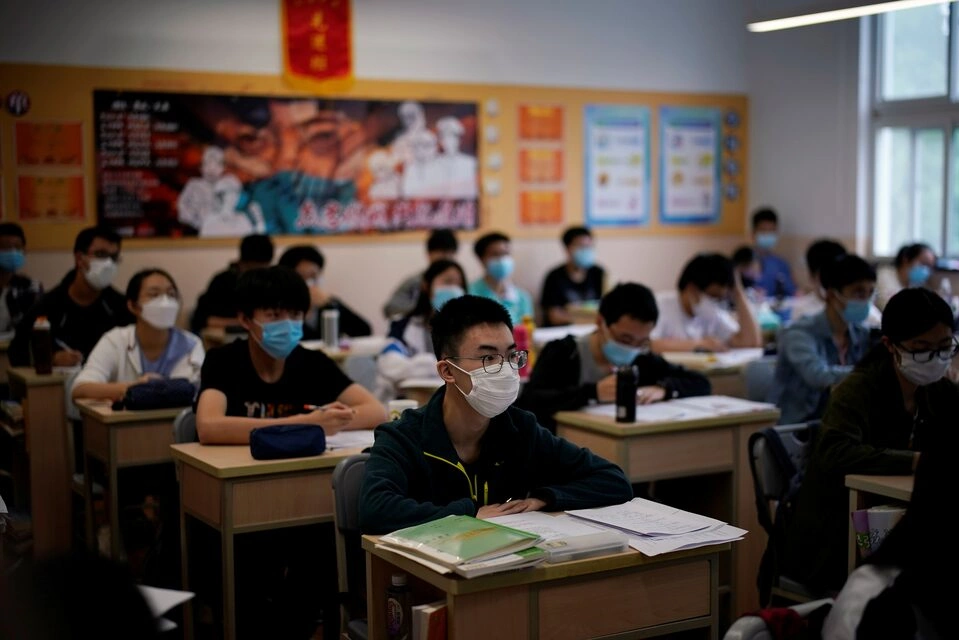
Students wearing face masks inside a classroom at a high school following the coronavirus disease outbreak, in Shanghai, China, May 7, 2020. |
Tang argued that from primary school through university, immense resources are wasted on a subject that will remain irrelevant to most people's futures. He lamented that Chinese children frantically study English before they have even mastered their mother tongue.
Emphasizing that China is an ancient civilization of thousands of years, Tang stated that English should be treated merely as a practical tool where basic proficiency is enough. He concluded his post by declaring that the history of Chinese people "worshipping foreign things" must end.
His comments followed local examination reforms that reduced the weighting of history, a change Tang said had "disappointed" him.
He argued that history education helps students understand the struggles of previous generations and develop sound values. If a subject’s importance had to be reduced, he said, English should be given less weight rather than history.
English currently ranks alongside Chinese and mathematics as one of the three core subjects in China’s basic education system. Under the traditional 750-point structure of the national college entrance examination, known as the gaokao, each subject carries 150 points.
Although recent reforms have changed the weighting and assessment of other subjects in both the gaokao and the zhongkao, China’s national high school entrance examination, Chinese, mathematics, and English remain central to the country’s exam-driven education system.
History has lost some prominence under local reforms, with fewer students selecting it as an elective in the gaokao.
English teaching efficiency
Tang’s proposal has drawn criticism from those who believe English remains crucial for education and career development.
Hu Xijin, former editor-in-chief of the Global Times, described calls to remove English from the core curriculum as extreme and narrow-minded. He argued that proponents use nationalist rhetoric to present their position as patriotic.
In a social media post on Oct. 10, Hu defended English as an essential subject that gives students access to international knowledge and opportunities across various fields.
Hu emphasized that foreign language skills are of great importance for every global citizen, "because we live primarily in the present," alluding to the debate over the ungraded history exam.
"This present is shaped by globalization. China's opening up is not only state policy but also expands people's scope of action as well as the range of their diverse material and immaterial interests in life," Hu said, as cited by DW.
He also warned that reducing English instruction in public schools could widen educational inequality. Affluent families would still be able to afford private English lessons, while children from less privileged households could lose access to opportunities readily available to their wealthier peers.
Hu said basic education should allow every student to develop their potential, arguing that maintaining English as a core subject is a matter of equal opportunity rather than an admiration for foreign cultures.
He linked English’s global dominance to the West’s historical advantage in modernization, noting that Chinese will naturally gain greater international influence as China continues to develop economically and technologically.
Proposals to reduce the importance of English in the gaokao are not new, and the debate has gained momentum alongside China’s growing economic and technological influence.
Supporters of reducing English’s role often point to rising cultural confidence and the expanding international use of Chinese. They also argue that advances in artificial intelligence-powered translation tools have reduced the need for intensive foreign-language study.
Others question the effectiveness of China’s exam-focused English teaching methods. Students often spend years memorizing vocabulary and grammar to prepare for tests without becoming confident communicators in everyday situations.
The 2025 EF English Proficiency Index, based on test results collected in 2024 from more than 2.2 million people worldwide, ranked China 86th among 123 countries and regions, placing it in the "low proficiency" category.
Criticism has also extended to the content of English lessons. Some observers note that textbooks and classroom instruction increasingly emphasize Chinese history, culture, and domestic achievements, while devoting less attention to Western societies and international cultures.
They argue that this shift risks undermining one of the traditional purposes of foreign-language education: helping students understand the wider world and engage with different cultures.
KioskNews shows a cleaned-up reading view extracted from the publisher’s page — the original always lives on their site, not ours.