Is it true that … we only use 10% of our brains?
The idea that we access a fraction of our cognitive potential goes back decades, but does medical science agree?
By Kate Lloyd / The Guardian


This idea really bugs Mary Spiller, senior lecturer in the University of East London’s Department of Psychology and Human Development, who’s shocked by how prevalent it remains, despite being untrue.
Spiller says the myth’s origins can partly be traced to the work of William James, one of the founders of modern psychology, working in the late 19th and early 20th centuries. He wrote: “We are making use of only a small part of our possible mental and physical resources.”
Misunderstandings about brain scans may also have helped the myth spread, she says. Images of brain activity often show some areas lighting up while others appear dark, which can give the impression that only certain parts of the brain are working.
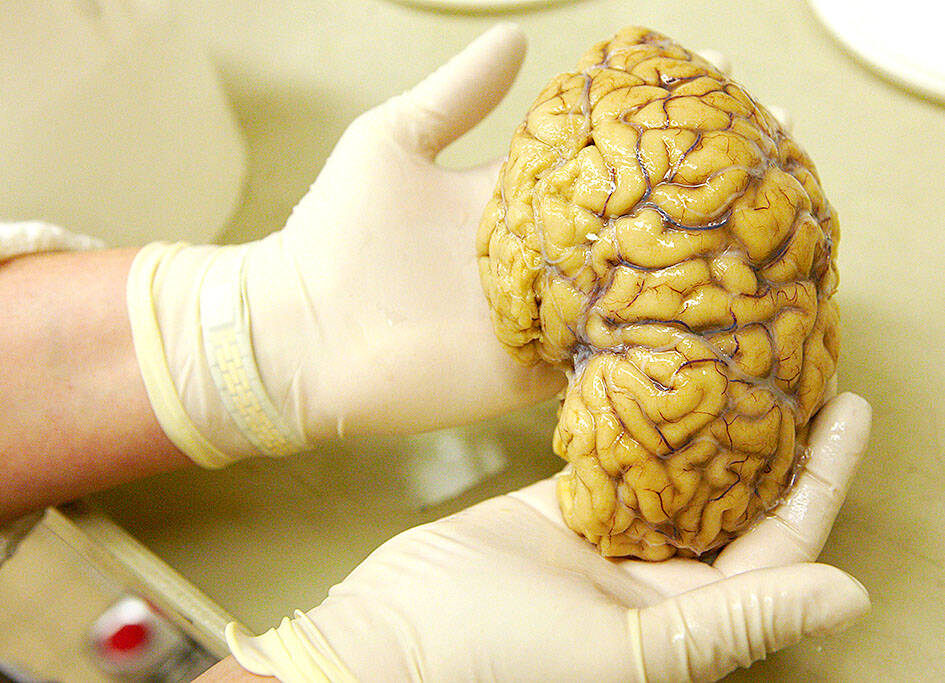
A laboratory assistant in March 2011 holds one hemisphere of a healthy human brain in the Morphological unit of psychopathology in the Neuropsychiatry division of the Belle Idee University Hospital in Chene-Bourg near Geneva.
Photo: Reuters
“The sections that aren’t lit up aren’t inactive,” she says. “When we’re comparing the brain in two different conditions, the areas highlighted are simply the ones that are more active in one condition than the other.”
Cases where people have had large parts of their brain removed and can still function afterwards aren’t evidence that we don’t use all of our brains, either, even if it might seem as if they are.
“What that’s showing is the amazing potential of our brain’s neuroplasticity,” she says.
If someone has half of their brain removed, the remaining half can reorganize itself so that people can continue to function.
“Different regions of the brain have specialized roles, such as movement, language and vision, but there’s also a degree of neuroplasticity within those regions. Things can change.”
So, how much of our brains do we use?
“We use all of our brains,” she says. “We use all of our brains pretty much all of the time. Even when we’re sleeping.”
KioskNews shows a cleaned-up reading view extracted from the publisher’s page — the original always lives on their site, not ours.