S’pore and Japan deepen ties on environment issues, including coastal protection and climate science
SINGAPORE - Singapore and Japan will work together more closely on various environmental initiatives, such as managing contaminants, climate science and coastal protection, under two new agreements inked by leaders of both countries on Sept 24 and 25.
Both agreements advance existing pacts between Singapore and Japan on such issues.
The first agreement is the upgraded Memorandum of Cooperation on Environmental Matters. It was signed between Minister for Sustainability and the Environment Grace Fu and Japan’s Minister of the Environment Hiroyoshi Sasagawa on Sept 24.
Under it, both countries will establish partnerships, such as those between firms and government agencies, on new areas such as managing emerging contaminants and removing pollution from the ground.
Existing areas of collaboration include decarbonisation, air quality, waste, and managing noise pollution and water quality.
Deliverables could include sharing relevant information, planning exchanges and training, and organising environmental events and seminars, said the Ministry of Sustainability and the Environment (MSE) in a statement issued on Sept 25.
Fu said: “The (agreement) will advance cooperation between our countries as we navigate geopolitical uncertainty and our respective transitions to low-carbon, climate-resilient and resource-efficient economies.”
She added that Japan and Singapore hope to work closely together during the Republic’s ASEAN chairmanship in 2027. This year also marks Japan and Singapore’s 60th anniversary of diplomatic relations.
The other agreement Fu inked on Sept 25 was the renewed Memorandum of Cooperation on Climate Science and Climate Adaptation, with Japan’s Minister of Land, Infrastructure, Transport and Tourism Tatsunori Ibayashi.
MSE said this will focus on coastal protection, flood resilience, stormwater management and weather services.
The partnership will also pave the way for trials of new technologies between the nations.
Fu said: “I look forward to working closely with Japan to support each other’s efforts to enhance resilience in our societies, as well as the wider region, in areas such as early warning systems and meteorology, as well as cooperation on water, food, and climate-resilient infrastructure.”
Separately, the Singapore Water Association’s coastal protection chapter will be leading close to 40 senior representatives from the public and private sector on an overseas study trip to Japan from Sept 25 to Oct 2.
The trip will include visits to Tokyo Bay’s high-tide defence infrastructure, the Minamisanriku coastal town’s tidal and floodgate systems, and Sendai’s multi-layered coastal defences and post-tsunami reconstruction areas.
They will also visit the International Research Institute of Disaster Science at Tohoku University, among other research institutions.
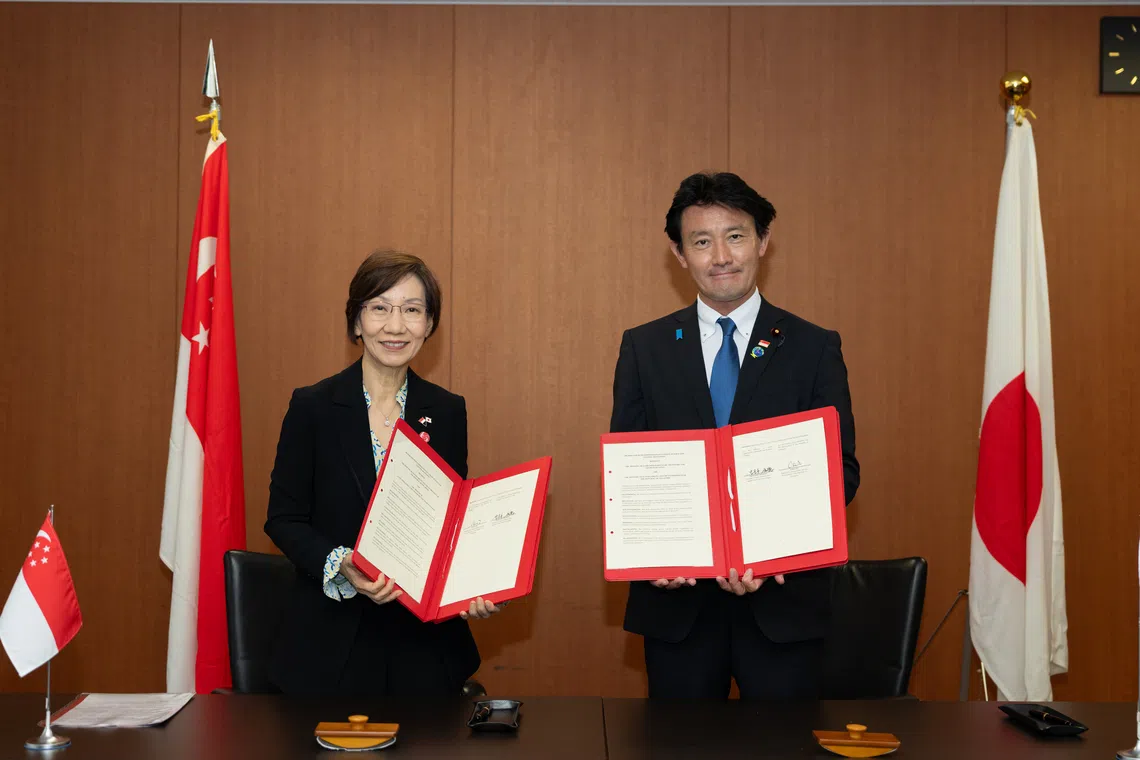
Minister for Sustainability and the Environment Grace Fu (left) and Japan’s Minister of Land, Infrastructure, Transport and Tourism Ibayashi Tatsunori signed the Memorandum of Cooperation on Climate Science and Climate Adaptation.
PHOTO: MINISTRY OF SUSTAINABILITY AND THE ENVIRONMENT
The participants are from government agencies, the built-environment sector, engineering and consultancy firms, contractors, technology providers and research organisations, said the association in a statement on Sept 25.
The eight-day visit will also include business-matching sessions and engagements with Japanese engineering, technology, research and industry partners, it added.
They will also explore collaborations in engineering solutions, innovation, smart systems and digital applications.
This trip follows a study visit the association organised to low-lying Netherlands in late 2025, to help local players find out more about the country’s coastal solutions and forge business links with the more mature Dutch coastal protection sector.
Shabana Begum is a correspondent, with a focus on environment and science, at The Straits Times.
KioskNews shows a cleaned-up reading view extracted from the publisher’s page — the original always lives on their site, not ours.