Health promotion agency urges caution on overeating at Mid-Autumn Festival
By Lo Pi and Fion Khan / Staff reporter, with staff writer


With the Mid-Autumn Festival falling on Friday next week, the Health Promotion Administration (HPA) cautioned that festive gatherings featuring mooncakes, barbecues, drinks and snacks can easily lead to excessive calorie intake.
People should adjust portion sizes and food choices, while incorporating vegetables, fruits and whole grains into meals to maintain a balanced diet and healthy weight, HPA Director-General Shen Ching-fen (沈靜芬) said.
A traditional 180g lotus seed paste mooncake with pine nuts contains about 720 calories, equivalent to approximately 2.5 bowls of white rice, the agency said.
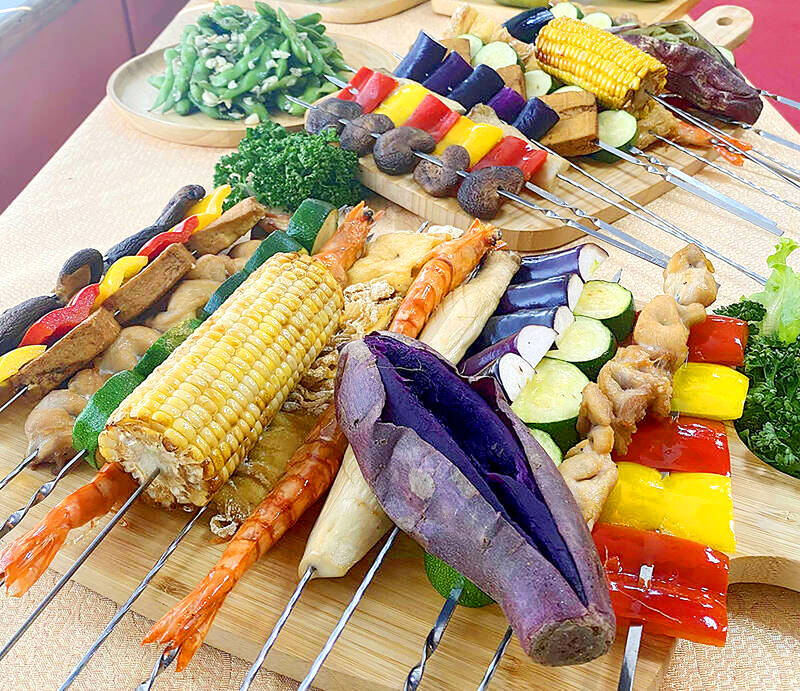
Vegetables, corn and shrimp are pictured on a grill in an undated photograph.
Photo: Tsai Shu-yuan, Taipei Times
People are advised to check nutrition labels and compare calorie, sugar and fat content before purchasing mooncakes, it said.
Mooncakes can also be cut into smaller portions and shared with family and friends to regulate calorie intake, while unsweetened tea or water is recommended over sugary drinks, it said.
For holiday barbecues, the agency advised following three main principles: lower calories, avoiding charred food and minimizing smoke exposure.
The primary hazard when grilling is charred food, as high-temperature cooking can generate heterocyclic amines, while meat juices, fat or sauces dripping onto open flames produce polycyclic aromatic hydrocarbons, it said.
Avoid direct contact between food and open flames, limit exposure to high heat and turn food regularly during cooking, it said, adding that burnt portions should be discarded before eating.
People are also encouraged to adopt a “more vegetables, less meat” approach, choosing moderate amounts of fish and chicken while increasing servings of vegetables such as green or bell peppers and other food like mushrooms and baby corn, it said.
Processed foods including sausages, bacon and meatballs should be limited, it added.
Barbecue sauce should be applied sparingly to reduce sugar and sodium intake, while natural seasonings such as scallions, garlic and pepper can be used to enhance flavor, it said.
Another commonly overlooked hazard is smoke, the agency said.
Barbecue fumes can increase concentrations of air pollutants such as PM2.5, potentially irritating the eyes and respiratory system, it said.
The HPA recommended choosing well-ventilated outdoor locations and avoiding indoor spaces or poorly ventilated balconies.
Barbecue and seating areas should be separated when possible, and people should avoid remaining downwind of smoke for extended periods, it said.
Those tending the grill should also take regular breaks, while vulnerable groups should exercise additional caution, it added.
Separately, a doctor at Lian An Wellness Center said that people with gallstones should be especially careful during the holiday.
High-fat foods can stimulate gallbladder contractions, potentially causing gallstones to shift and block bile ducts, triggering pain, said Yang Jian-hua (楊建華), director of the center’s ultrasound room.
People with gallstones should avoid consuming large quantities of high-fat foods, such as mooncakes, salted egg yolk pastries and barbecue dishes within a short period of time, he said.
While people should avoid overeating, skipping meals can also increase the risk of gallstones, he said.
Prolonged fasting reduces gallbladder contractions and bile release, allowing bile to remain in the gallbladder for extended periods and increasing the likelihood of sludge, sediment and gallstone formation, he said.
About one in every 13 people was found to have gallstones, according to the center’s analysis of more than 35,000 health examination records last year.
As gallstones often produce no obvious symptoms, many cases are discovered only during routine health examinations or abdominal ultrasound scans, it said.
People with a family history of gallstones, middle-aged or older women, women who have given birth multiple times, people who are overweight or those undergoing rapid weight loss, as well as those with chronic diseases such as diabetes or liver disease, face a higher risk, Yang said.
Maintaining gallbladder health does not require eliminating dietary fats entirely, but rather maintaining regular meals, controlling overall fat intake and avoiding prolonged fasting or rapid weight loss, he said.
KioskNews shows a cleaned-up reading view extracted from the publisher’s page — the original always lives on their site, not ours.