6 War Miniseries That Are 10/10 With No Weak Episodes, Ranked

Sign in to your Collider account
For those who don't already know, a miniseries is a form of television serial in which there is only one season. To clarify, this doesn't mean a TV show gets canceled after one season — it means there were only plans for one season in the first place, with the creators having no intention of carrying on the story beyond that. This makes it easy to binge and is effective for wrapping up a narrative without leaving the audience hanging.
Miniseries are not restricted to any one particular genre, but have been a pretty common choice for war shows. Over the years, a ton of war TV shows have opted to be short-lived miniseries rather than long, multi-billion dollar TV stints, to ensure they say what they need to say and don't overstay their welcome. Since the format has been pretty popular lately, it's worth checking out these war miniseries that are absolutely perfect in every way.
6 'Catch-22' (2019)

Catch-22 is an underrated dark comedy miniseries based on the novel of the same name by Joseph Heller. The story is set during World War II, following Captain John Yossarian (Christopher Abbott). John works for the United States Army Air Forces (USAAF), serving as a bombardier on a large, slow-moving aircraft. As the war escalates, John finds himself sent on missions that get more and more dangerous, endangering his own life and the lives of his crew. In fact, he muses that it feels like his own superiors are trying to kill him. Desperate for a way out, John searches for a loophole in his contract that will allow him to go home.
His strategy is hindered by the military clause of Catch-22, which states that any individual requesting to be relieved of duty by reason of insanity must be denied, because this actually shows that they are of sound mind. War is, after all, insanity. Put simply, the question is, "Are you concerned for your safety?" If "yes," then it shows you are a rational person and cannot be exempt from duty on grounds of insanity. If "no," you still have to perform your duty anyway, since you have nothing to worry about. The comedy comes from military bureaucracy, and the ridiculous hoops John has to jump through just to go home and see his family again. He is just as much fighting his own bosses as much as Axis forces, constantly trapped between politics and live combat. This show is not only full of gallows humor, but it's also a realistic critique of how military politics work and how there are few ways out, if any, for those who no longer wish to be there.
5 'Masters of the Air' (2024)

Masters of the Air is the third miniseries in the Band of Brothers universe, which began back in 2001. While the previous miniseries in the universe all centered on ground units, this show, true to its name, decided to take viewers high above the clouds. The show follows the 100th Bombing Group of the USAAF, which conducted a series of dangerous and high-intensity raids on German positions in 1943. Many of the characters in this show (much like its predecessors) feature a mix of both real historical figures and fictitious characters.
One might think that being in the air, miles above German ground positions, would be much safer than being infantry, but they'd be sorely mistaken. Being in a plane presents a whole slew of new dangers, especially when the characters pilot slow-moving bombers and are assailed by fast-moving Luftwaffe fighter planes. It's a great story, a grand adventure, and a fantastic entry into an already-beloved franchise.
4 'War & Peace' (2016)

War & Peace is based on the novel of the same name by the famous writer Leon Tolstoy. This enormous novel is both a fictitious story and a mix of letters and essays addressing themes of politics, history, and philosophy. The show only really touches on the narrative parts, with the philosophical and historical subtext cleverly hidden between the lines. Like the book, the story is set during the Napoleonic Wars, when Napoleon Bonaparte began rapidly conquering a significant portion of the globe, making it all the way to the doorstep of the Russian Empire, where this tale begins.
The miniseries takes place across a span of seven long years of war, featuring a fictional Russian family in the midst of Napoleon's conquest. The six-part miniseries really examines how war, even a war that took place over 200 years ago, can tear families apart, cause immense trauma, and damage empires, if not topple them entirely. It's beautifully done, and features some major names in the leading roles, making the performances of the cast feel much more real.
Collider Exclusive · Oscar Best Picture Quiz
Which Oscar Best Picture
Is Your Perfect Movie?
Parasite · Everything Everywhere · Oppenheimer · Birdman · No Country
Five Oscar Best Picture winners. Five completely different visions of what cinema can be — and what it can do to you. One of them is the film that was made for the way your mind works. Ten questions will figure out which one.
🪜Parasite
🌀Everything Everywhere
☢️Oppenheimer
🐦Birdman
🪙No Country for Old Men
01
What kind of film experience do you actually want? The best movies don't just entertain — they leave something behind.
02
Which idea grabs you most in a film? Great films are driven by a central obsession. What's yours?
03
How do you like your story told? Form is content. The way a story is shaped changes what it means.
04
What makes a truly great antagonist? The opposition defines the protagonist. What kind of opposition fascinates you?
05
What do you want from a film's ending? The final note is the one that lingers. What do you want it to sound like?
06
Which setting pulls you in most? Where a film takes place shapes everything — mood, stakes, what's even possible.
07
What cinematic craft impresses you most? Every great film has a signature — a technical or artistic element that makes it unmistakable.
08
What kind of main character do you root for? The protagonist is the lens. Who you choose to follow says something about you.
09
How do you feel about a film that takes its time? Pace is a choice. Some films sprint; others let tension accumulate slowly, deliberately.
10
What do you want to feel walking out of the cinema? The best films leave a mark. What kind of mark do you want?
The Academy Has Decided Your Perfect Film Is…
Your answers have pointed to one Oscar Best Picture winner above all others. This is the film that was made for the way your mind works.
Parasite
You are drawn to films that operate on multiple levels simultaneously — that begin in one genre and quietly, brilliantly migrate into another. Bong Joon-ho's Parasite is a film about class, desire, and the architecture of inequality that manages to be darkly funny, deeply suspenseful, and genuinely shocking across a single extraordinary running time. Your instinct is for cinema that hides its true intentions until the moment it's ready to reveal them. Parasite is exactly that — a film that rewards close attention and punishes assumptions, right up to its devastating final image.
Everything Everywhere All at Once
You want it all — and this film gives you all of it. The Daniels' Everything Everywhere All at Once is one of the most maximalist films ever made: action comedy, multiverse sci-fi, family drama, existential crisis, and a genuinely earned emotional core that sneaks up on you amid the chaos. You are someone who responds to ambition, who doesn't want cinema to choose between being entertaining and being meaningful. This film refuses that choice entirely. It is overwhelming by design, and its overwhelming nature is precisely the point — because the feeling of being crushed by infinite possibility is exactly what it's about.
Oppenheimer
You are drawn to cinema on a grand scale — films that understand history not as a backdrop but as a force, and that place their characters inside that force and watch what happens. Christopher Nolan's Oppenheimer is a film about the terrifying gap between what we can do and what we should do, told with the full weight of one of the most consequential moments in human history behind it. You want your films to feel important without feeling self-important — to earn their ambition through sheer craft and the gravity of their subject. Oppenheimer does exactly that. It is enormous, complicated, and refuses easy comfort.
Birdman
You are drawn to films that foreground their own construction — that make the how of the filmmaking part of the what it's about. Alejandro González Iñárritu's Birdman, shot to appear as a single continuous take, is cinema examining itself through the cracked mirror of a fading actor's ego. You respond to formal daring, to the feeling that a film is doing something that probably shouldn't be possible. Michael Keaton's performance and Emmanuel Lubezki's restless camera create something genuinely unlike anything else — a film that is simultaneously about creativity, relevance, self-destruction, and the impossibility of ever truly knowing if your work means anything at all.
No Country for Old Men
You are drawn to cinema that trusts silence, that refuses to explain itself, and that treats dread as a form of meaning. The Coen Brothers' No Country for Old Men is a film about the arrival of a new kind of evil — implacable, arbitrary, and utterly indifferent to the moral frameworks we use to make sense of the world. It is one of the most formally controlled films ever made, and its controlled restraint is what makes it so terrifying. You want your films to haunt you, not comfort you. You are not interested in resolution if resolution would be dishonest. No Country for Old Men is honest in a way that most cinema never dares to be.
3 'Generation Kill' (2008)

Generation Kill is a brutally realistic miniseries set at the beginning of the Iraq War, in the opening stages of the United States' military invasion, in search of Iraqi dictator Saddam Hussein. The series is based on a memoir of the same name by Evan Wright, an American war correspondent who spent a considerable length of time embedded in Iraq with an American military unit. Basically, if the show seems real, that's because much of it is — it is a dramatization of actual events, depicting actual firefights and casualties, recreated right in front of the audience. Wright himself even makes an appearance in the show, played by Lee Tergesen. However, he is only a small part of the series and isn't mentioned by name. The focus is mostly on the soldiers here.
What's cool is that one of the soldiers, Sergeant Rudy Reyes, is actually played by Reyes himself, adding even more authenticity to the situation. The show was a bold move, as the Iraq War was a bit of a sore subject in American media at the time due to public opposition, and it was still ongoing at the time of the show's release. Despite this, it was a massive success, because it allowed American audiences to see a gruesome, unsanitized version of the conflict that most media outlets were too afraid of showing. It's a masterpiece of television, and one of the finest war miniseries ever made.
2 'The Pacific' (2010)

The second miniseries in the Band of Brothers universe, The Pacific follows an American ground infantry unit during the Second World War. The soldiers at the heart of the show are assigned to the Pacific Theater, where the enemy isn't Nazi Germany, but Imperial Japan. Following the Attack on Pearl Harbor in 1941, the US began a bloody island-hopping campaign in the Pacific Islands, intent on putting a halt to the rapid expansion of Japan. Like the other miniseries in the same universe, The Pacific puts viewers right in the heart of the action through some of the bloodiest and most famous battles of the war.
Audiences will begin with the Guadalcanal Campaign in the Solomon Islands, followed by the Battle of Peleliu in present-day Palau, before concluding with the Battles of Iwo Jima and Okinawa, the southernmost isles of Japan itself. The difference here is that the Japanese are in their element in the thick jungles and swamps of the Pacific. Guerrilla warfare reigns supreme, often taking American forces by surprise and wreaking havoc on organized units. As with the others of its ilk, HBO's The Pacific makes sure not to pull any punches in its portrayal of combat. Expect a lot of blood and gore, true to the nature of war itself. It's not for the faint of heart, but for those who love seeing realistic portrayals of warfare, this is a superb pick.
1 'Band of Brothers' (2001)

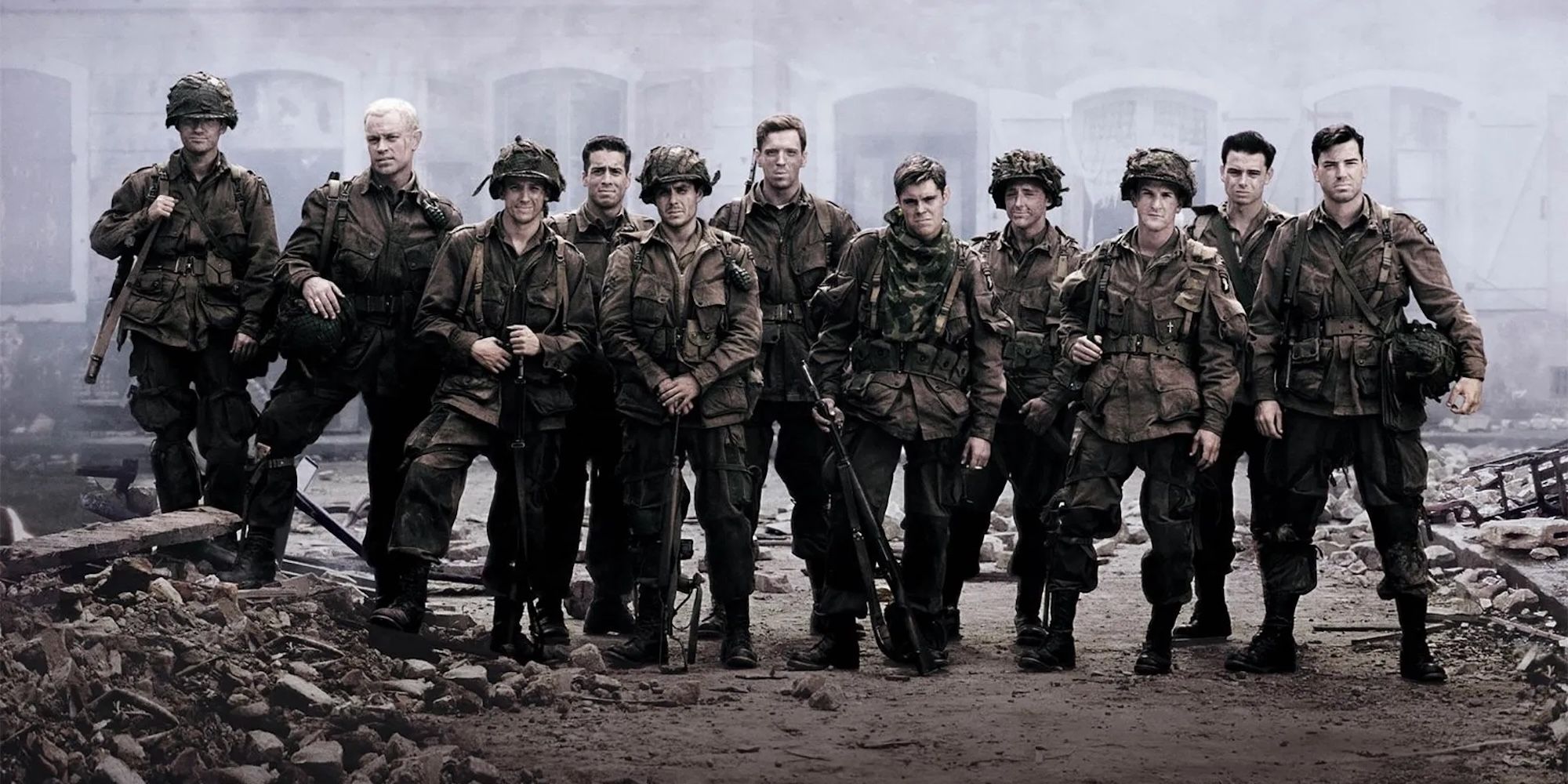
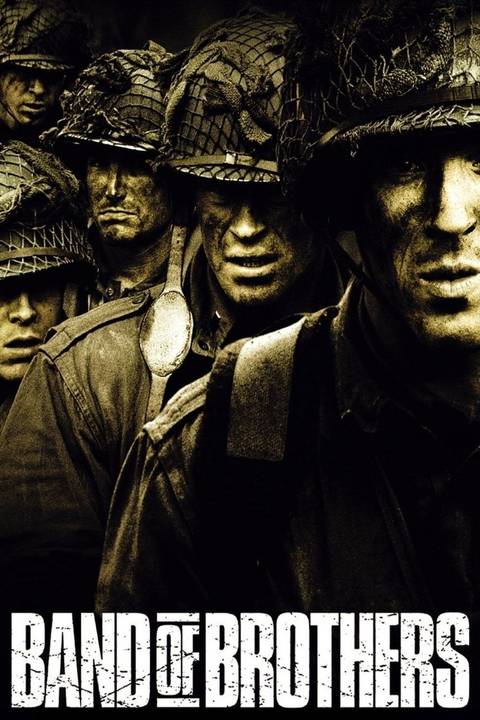
Following the success of their 1998 feature film Saving Private Ryan, Tom Hanks and Steven Spielberg came up with Band of Brothers, a miniseries that went on to make history. The show is very much in the spirit of Saving Private Ryan, being an unflinching, honest depiction of what World War II really looked like from the front lines. The show follows an American Airborne unit as they parachute behind enemy lines in some of the most dangerous engagements of the war's Western Front.
The show opens up with a training episode, followed by the squad's first operation, parachuting into Normandy in the wee hours of the morning on D-Day. Considering Saving Private Ryan is also set on D-Day, but is about the amphibious beach landings, Band of Brothers provided a much different perspective on things. The series continues through the Battle of Carentan before finishing off at the Battle of the Bulge, the final offensive that the Nazis made against the Allies on the Western Front, beginning in the chilly winter of December 1944. This show is just phenomenal, defining genre rules and depicting some of the greatest, most heroic moments of the war. It just doesn't get any better than this.
- Release Date
- 2001 - 2001
- Network
- HBO
- Showrunner
- Steven Spielberg, Tom Hanks
- Directors
- David Frankel, David Nutter, Mikael Salomon, Phil Alden Robinson, Richard Loncraine, Tom Hanks
- Writers
- Bruce C. McKenna, Graham Yost, John Orloff
-

Richard D. Winters
-

C. Carwood Lipton
The story of Easy Company of the U.S. Army 101st Airborne Division and their mission in World War II Europe, from Operation Overlord to V-J Day.
KioskNews shows a cleaned-up reading view extracted from the publisher’s page — the original always lives on their site, not ours.