After America's midterms, the clock is ticking for Israel to bridge its political divides

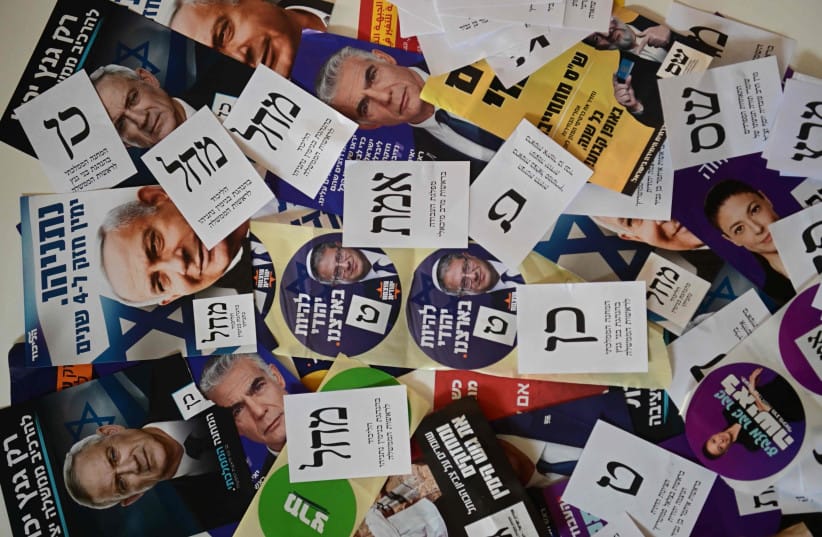
A week ago Tuesday night, when it became clear that the Israeli elections had produced an inconclusive result, one scenario discussed was that a national crisis could spur Israel’s politicians to form some kind of unity government.
The national crisis on most people’s minds was, of course, renewed fighting with Iran. Perhaps that could prod Naftali Bennett and Gadi Eisenkot, if not Yair Lapid and Avigdor Liberman, to put aside their enmity toward Prime Minister Benjamin Netanyahu and form a centrist Zionist government.
On broad security issues, the difference between the parties those leaders represent is about the same as the difference, in an ice cream shop, between ordering chocolate, chocolate fudge, or Swiss chocolate fudge. In short, not much.
Following Tuesday’s midterms in America, however, a different kind of national crisis emerged: the changing state of Israel-US relations.
Michael Oren warns US midterms signal the end of an era in US-Israel relations
The US elections can be interpreted in many different ways. But former ambassador to the US Michael Oren put the implications for Israel starkly, in a piece he penned on Wednesday: “So ends half a century of the US-Israel relationship as we have known it.”
That half century of support rested broadly on a shared American feeling that in the Israel-Arab conflict, Israel was the good guys: the side worth supporting because of its history, because of the values it represents, because supporting it meant being on the right side of history.
Now, because of numerous variables – generational and demographic changes in the US, the weakening memory of Israel as the vulnerable underdog, the impact of social media, Qatar’s well-funded efforts to shape opinion about Israel, and some of Israel’s own obtuse policies – that equation is being flipped.
The midterms made the shift particularly clear in the Democratic Party, where anti-Israel positions that lean on antisemitic tropes – something that in the past might have made a candidate unelectable – can now be an electoral asset.
Politicians used to flock to Israel in election years to demonstrate support, believing it would give them a boost back home.
Now, as recent visits of California Rep. Ro Khanna and Jewish congressman-elect Brad Lander illustrate, there is political mileage to be gained from coming to Israel and confronting IDF soldiers or settlers.
The audience is still back home. What has changed is what that audience rewards.
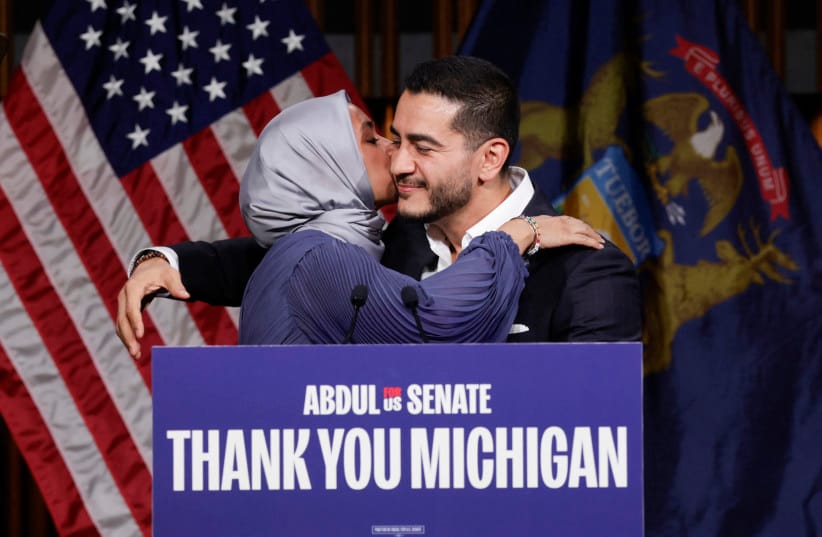
A blatantly antisemitic ad that ran in support of Michigan’s newly elected senator, Abdul El-Sayed, blamed Israel – the state of the Jews – for the high price of eggs and bananas in Michigan. A campaign running on that type of antisemitic fuel would, in the past, have been expected to run out of gas.
Not anymore. And that should be as sobering to American Jews as it is to Israel.
Batya Ungar-Sargon examines Henry Ford's history of antisemitic scapegoating
In her new book, The Jews and the Left, Batya Ungar-Sargon discussed Henry Ford’s antisemitic scapegoating in Michigan a century ago.
But, she wrote, “Ford had to apologize for his antisemitic publication, The Dearborn Independent, when he wanted to run for office, because it was well known that you couldn’t go full antisemite and expect to succeed politically in America.”
When Ford’s candidacy failed, she added, “he went right back to publishing it.”
The point is not that antisemitism was absent from American life. Far from it. It is that openly trafficking in it carried a political price.
By 1962, Ungar-Sargon wrote, three-quarters of Americans said they would not vote for a candidate they discovered was antisemitic, while just one in 25 said they would vote for an antisemitic candidate.
Tuesday’s midterm elections and their immediate aftermath leave one wondering how much of that inhibition remains.
Now, of course, there will come the howls that being anti-Israel or anti-Zionist is not the same as being antisemitic, and that “some of my best anti-Zionists” are Jews.
And the distinction is real. Not every critic of Israel is an antisemite, nor are all anti-Zionists. But many of them are, like those blaming the Jewish state for high grocery prices in America’s heartland.
The election of El-Sayed and a cohort of outspoken Israel critics – New York’s Lander, Claire Valdez and Darializa Avila Chevalier, New Jersey’s Adam Hamawy, Illinois’s Daniel Biss, Pennsylvania’s Chris Rabb, California’s Angela Gonzales-Torres, and Colorado’s Melat Kiros – gives American and Israeli Jews reason to examine where the Democratic Party is heading.
JD Vance's midterm response raises concerns over Republican support for Israel
But the concern does not stop at the Democratic Party’s door.
There is also JD Vance’s postmortem take on the election – and what the vice president’s reading of the results signals about the direction of the Republican Party.
Less than 24 hours after the Republican thumping, Vance already had his explanation: the Iran war, the resulting economic pain, and America’s relationship with Israel.
Vance’s comments are telling not only because of who made them, but because of when he made them: a day after the midterms, which essentially marks the first day of his 2028 presidential campaign.
It is legitimate to debate the wisdom of the Iran war, its economic costs, and America’s foreign commitments. But against the backdrop of Vance’s previous insinuations about Israeli influence over American policy, his decision to single out the relationship with Israel carries a message of its own.
That message is all the more troubling coming from a vice president who, as The Wall Street Journal editorialized, promotes the “Jews-on-the-mind podcast ecosystem” that is “led by his friend and ally Tucker Carlson.”
With these words, Vance is laying the groundwork for a presidential campaign whose theme essentially is: blame the Jews. Maybe not all the Jews, but those in Israel and the American ones who support them – the suggestion being that they drove US policy, and ordinary Americans paid the price.
For Israeli and American Jews, that prospect should be as frightening as El-Sayed’s election.
Prolonged coalition talks risk another election amid shifting US-Israel relations
Which brings us back to Israel and the coalition negotiations.
Prolonged negotiations that produce no government and send the country back to the polls – as happened in 2019 and 2020 – are bad for innumerable reasons.
They add an overriding electoral calculation to every decision, including life-and-death ones, such as whether to go to war, which need to be as free of that consideration as possible.
They project disunity to Israel’s enemies. And the nonstop campaigning magnifies what divides Israelis, while giving politicians every incentive to keep those divisions alive.
Now there is another cost: time lost in dealing with a rapidly changing America.
Israel needs a government that can do two things simultaneously: take full advantage of the remaining two years of the Trump presidency and prepare for a Washington in which support for Israel can no longer be assumed.
Taking advantage of those two years requires an agenda.
Jerusalem needs to decide what it wants to achieve in Gaza, Lebanon, and Syria, and set the wheels in motion while there is still a president in the White House positively disposed toward its positions.
The same holds true for the future of US military assistance. Trump’s bombshell announcement about ending that aid leaves basic questions unanswered, including how it would square with the current agreement providing $3.8 billion annually through 2028. Israel needs to work out what comes next. Better to do that with a strongly pro-Israel president than leave it for a potentially less sympathetic successor.
Beyond aid, Israel needs to deepen its security, intelligence, and technological cooperation with the US. The aim should be to ensure that when forces in Washington seek to downgrade the relationship significantly, American officials and businesses will have compelling reasons of their own to push back.
Former strategic affairs minister Ron Dermer made that point in a clip that went viral this week. Israel could deal with a president who dislikes it, he argued, if the CIA director could walk into the Oval Office and say: “I know you don’t like those Israelis, but if we rupture our relations with the Mossad, that’s going to endanger a lot of Americans.”
The same logic, Dermer said, applies to artificial intelligence: cooperation should be valuable enough that American leaders would see severing it as ceding ground to China.
The objective is a relationship so deeply embedded in practical cooperation that weakening it would carry a clear cost for America. The stronger that case, the harder it becomes to portray support for Israel as a favor to the Jews. These next two years must be used wisely to even further strengthen the ties that make that argument credible.
Israel must rebuild American public support beyond Washington
At the same time, Israel needs to repair its standing beyond Washington.
A broader government, including voices from parties beyond the Likud and the hard Right, could reach audiences that have stopped listening. There are those who want to define Israel by Itamar Ben-Gvir. A government whose survival depends on him makes their job easier. One that gives greater expression to Israel’s other voices and priorities could make it harder.
Have no illusions: that will not sway an El-Sayed or a Carlson. But the effort needs to target Americans who remain open to persuasion, even if their support has weakened. Israel cannot afford to treat them all as a lost cause.
None of this erases the reasons Bennett, Eisenkot, Lapid, and Liberman oppose Netanyahu. Nor does it relieve Netanyahu of responsibility for finding a way out of the deadlock. But all of them need to weigh their disputes against the cost of allowing endless coalition negotiations – and perhaps another election in seven months – to consume the time ahead.
“Israeli politicians must realize that we are facing a warlike situation that demands national unity,” wrote Oren. “Israel has faced similarly daunting situations before – when the Soviet bloc abandoned us in 1952, and France in 1967 – and we can overcome this one as well, but only through national solidarity.”
A week ago, the assumption was that it might take renewed fighting with Iran to make Israel’s politicians reconsider their red lines. Tuesday’s midterms should be reason enough.
KioskNews shows a cleaned-up reading view extracted from the publisher’s page — the original always lives on their site, not ours.