AI spending jitters to rattle TAIEX briefly: NDC head
FIRM FOOTING: Hardware suppliers’ backlogs were expected to grow through next year, while bargain hunters helped the TAIEX recover much of its early losses
Concerns over massive spending on artificial intelligence (AI), which have triggered a global sell-off of technology stocks, are expected to have only a short-term impact on Taiwan’s stock market, as many local companies remain fundamentally sound in terms of export orders and financing, National Development Council (NDC) Minister Yeh Chun-hsien (葉俊顯) said on Sunday.
Investors in global capital markets have become concerned about the cash flows of some cloud service providers, which have invested heavily in AI infrastructure but have yet to generate sufficient revenue, Yeh said.
Such concerns have recently sent ripples through stock markets globally, including Taiwan’s, he said.
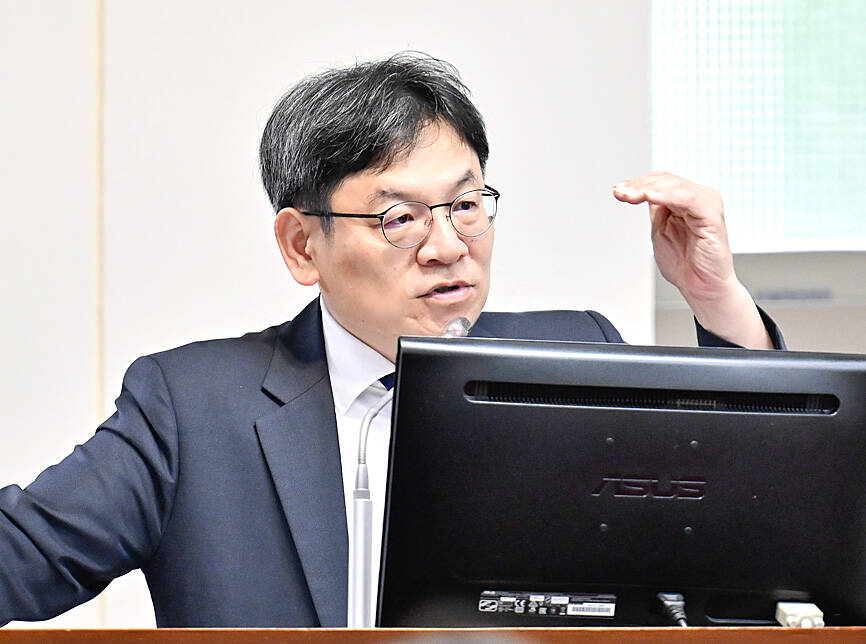
National Development Council Minister Yeh Chun-hsien speaks at a meeting of the legislature’s Economics Committee in Taipei on Oct. 15.
Photo: Chen Chih-chu, Taipei Times
The TAIEX came under heavy pressure in early trading yesterday, tumbling 812.73 points to the day’s low, largely due to a 2.86 percent fall in the tech-heavy NASDAQ Composite Index and a 7.20 percent plunge in the Philadelphia Semiconductor Index on Friday.
Most of Wall Street’s heavy losses followed weaker-than-expected guidance from Intel Corp. Meanwhile, AI safety and research company Anthropic PBC reportedly could receive a “junk” credit rating after its initial public offering, which is expected later this month.
However, the TAIEX recouped most of its earlier losses as bargain hunters picked up shares in select market laggards, closing down 291.69 points, or 0.65 percent, at 44,920.14. Taiwan Semiconductor Manufacturing Co (TSMC, 台積電) dropped 1.69 percent to NT$2,330, after a 5.95 percent fall in its American depositary receipts on Friday.
Yeh said that although some emerging US AI-related companies were facing cash flow pressure, they could still raise funds by issuing corporate bonds.
Taiwan’s hardware manufacturers continue to receive substantial orders, and their order backlogs are expected to keep growing amid the current AI boom through the end of next year, he said.
Taiwanese technology companies generate a large proportion of their revenue from overseas markets, and there are currently no signs of deterioration in their liquidity or cash flows, he added.
The ongoing correction in AI-related stocks on global markets is unlikely to undermine the fundamentals of Taiwan’s hardware suppliers, Yeh said.
The volatility of global AI-related stocks, therefore, is expected to have only a temporary impact on their Taiwanese counterparts, he said.
Yeh noted that TSMC has advanced its automated production capabilities and has put the necessary computing capacity in place, while continuing to post record earnings.
TSMC’s net profit in the third quarter rose 68.7 percent from a year earlier to NT$763.06 billion (US$23.33 billion). Last month, the company raised its revenue growth forecast for this year to 44 percent in US dollar terms, up from its previous projection of slightly more than 40 percent.
Meanwhile, Yeh projected that Taiwan’s GDP would grow about 12 percent this year on the back of strong exports, above the 11.05 percent growth forecast issued by the Directorate-General of Budget, Accounting and Statistics in August.
KioskNews shows a cleaned-up reading view extracted from the publisher’s page — the original always lives on their site, not ours.