Myanmar committed genocide against Rohingya, U.N. top court rules
The Hague, Netherlands — In a landmark judgment, the United Nations' top court ruled Thursday that Myanmar committed genocide against the Rohingya minority in a brutal 2017 military operation.
International Court of Justice President Yuji Iwasawa said the court, in a 9-6 decision, found that Myanmar "has committed genocide against the Rohingya group in northern Rakhine state, in violation of its obligations under the Genocide Convention."
The 15-judge panel of the World Court rejected Myanmar's defense that the 2017 campaign was a legitimate operation against insurgents.
Iwasawa said that "the court finds that Myanmar's security forces killed thousands of Rohingya civilians, perpetrated widespread acts of sexual violence, as well as acts of extreme violence against children, and attacked fleeing Rohingya as they sought to flee in large numbers."
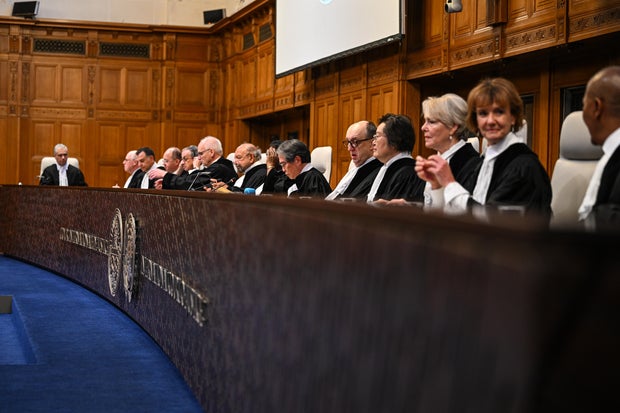
The decision marks the first time the court has ruled that a state committed genocide.
"This is a great day for the Rohingya, and it is a great day for all oppressed people, everywhere, who have been told that their suffering does not count and that no one is listening," said Yasmin Ullah, a Rohingya rights activist who sat in the court's ornate, wood-paneled Great Hall of Justice for the three-hour reading of the ruling.
The intent to destroy a group in whole or in part is a key element in establishing whether crimes amount to genocide under international law.
The court said evidence showed Myanmar forces killed about 10,000 Rohingya.
The Muslim-majority African nation of Gambia launched the proceedings at the International Court of Justice in 2019, asking it to rule that Myanmar breached the 1948 Genocide Convention, order the nation to end any illegal activities targeting the Rohingya and ensure those responsible for genocide are punished.
The judgment comes as the World Court also is handling genocide allegations linked to the Gaza conflict and the war in Ukraine.
"Genocides have similarities in how they are committed so this decision will have an impact on other cases," said Melanie O'Brien, a professor of international law at the University of Western Australia.
In August 2017, Myanmar's military launched what it called a clearance campaign in Rakhine state in response to an attack by a Rohingya insurgent group. The campaign led to accusations that security forces committed mass rapes and killings and burned thousands of homes.
Under the 1948 convention, to establish that genocide occurred, the court had to find that there was an intent to destroy the Rohingya "in whole or in part."
About 1.2 million Rohingya refugees now live in Bangladesh, primarily in crowded camps across Cox's Bazar district, where they endure harsh conditions marked by fire hazards, infectious diseases, monsoon landslides, inadequate sanitation and strict work restrictions.
Gambia has asked for reparations for the Rohingya, including ordering Myanmar to grant them full citizenship and the right to return home.
The court's rulings are final and legally binding, but it has no way to enforce them beyond reporting noncompliance to the U.N. Security Council.
In a previous judgment in 2007, the court said that Serbia "violated the obligation to prevent genocide" in the 1995 Srebrenica massacre, when Bosnian Serb forces murdered some 8,000 mostly Muslim men and boys in the Bosnian town.
Judges at The Hague-based court have also been asked to weigh in on other allegations of genocide.
South Africa has accused Israel of breaching the Genocide Convention during its offensive in Gaza, a claim Israel vehemently denies. That case is years from completion.
Ukraine also has a case pending against Russia. Shortly after Moscow's full-scale invasion in February 2022, Kyiv accused Russia of fabricating genocide claims against Ukraine to justify the attack.
Yasmin Ullah, a Rohingya human rights activist who fled Myanmar as a young child with her mother in the 1990s, said the demands in the Myanmar case are rooted in her community's desire for recognition and dignity.
"Because so far, we've just been pushed around into this limbo state," she said. "It's been almost 10 years now that Rohingya have been living in very, very precarious conditions across the Asia-Pacific."
In March 2022, then-U.S. Secretary of State Antony Blinken said Myanmar's treatment olf the Rohingya amounted to genocide, in a declaration intended to generate international pressure and lay the groundwork for potential legal action.
"The day will come when those responsible for these appalling acts will have to answer for them," Blinken said at the time.
KioskNews shows a cleaned-up reading view extracted from the publisher’s page — the original always lives on their site, not ours.