Shares down slightly but stable
ELECTION AFTERSHOCKS: The seizure of the US legislature by the Democratic Party jolted tech markets, but trading in the afternoon smoothed out the worst of the sting
Taiwanese shares closed lower yesterday, but recovered from the day’s low on bargain hunting, while investors assessed the US midterm elections, in which Democrats seized control of the Senate and the House of Representatives and dealt a blow to US President Donald Trump’s economic agenda as he heads into his final two years as president.
The TAIEX ended down 358.63 points, or 0.83 percent, at 42,948.91, with Taiwan Semiconductor Manufacturing Co (台積電) falling 1.53 percent.
Turnover on the main board was NT$1.11 trillion (US$33.82 billion), up from about NT$1 trillion on Tuesday, Taiwan Stock Exchange data showed.
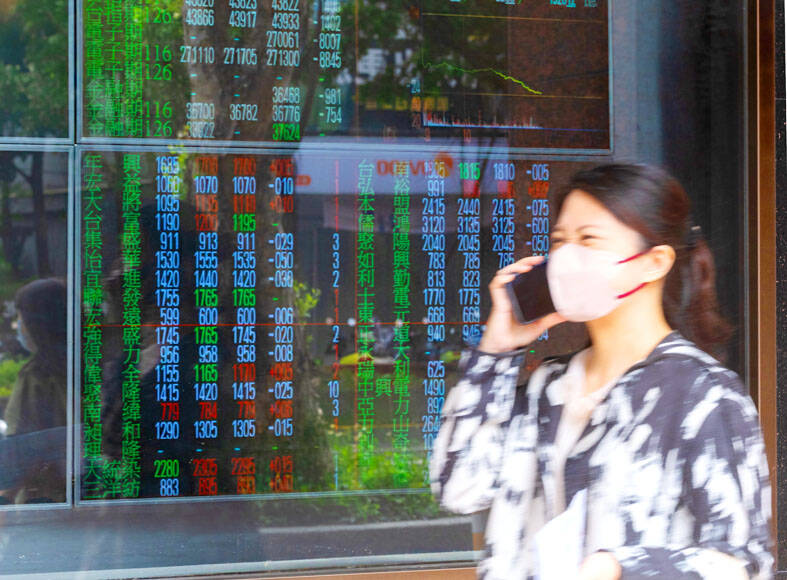
A woman talks on her mobile phone as she passes an electronic stock board in Taipei on Tuesday.
Photo: CNA
Foreign institutional investors sold NT$149.899 billion worth of shares on the main board yesterday, the fifth-highest amount on record, the data showed.
“It was a dramatic session as investors began buying around noon after Trump said he would work with the Democrats,” Mega International Investment Services Corp (兆豐國際投顧) analyst Alex Huang (黃國偉) said.
“Technically speaking, buying opportunities emerged as the TAIEX dipped below 42,000 points, so bargain hunters began buying select artificial intelligence [AI]-related semiconductor stocks after US-based AI chip designer Advanced Micro Devices Inc and AI server maker Super Micro Computer Inc delivered better-than-expected results overnight,” Huang said. “So, today’s turnover expanded.”
Among semiconductor stocks that recovered from earlier weakness, smartphone integrated circuit (IC) designer MediaTek Inc (聯發科) rose 1.09 percent, while IC packaging and testing firm ASE Technology Holding Co (日月光投控) gained 1.79 percent.
“Uncertainty remained after the US midterms,” Huang said. “Because Trump is an unpredictable person, nobody knows what he will do. Volatility could continue.”
Elsewhere in Asia, South Korea’s KOSPI erased a loss of as much as 4 percent to gain 0.6 percent, as Samsung Electronics Co and SK Hynix Inc pared their declines to less than 1 percent.
Japan’s Nikkei 225 was down 1.4 percent as Kioxia Holdings Corp plunged more than 5 percent, while Advantest Corp and Softbank Group Corp lost more than 3 percent.
Hong Kong and Shanghai reversed losses, while Mumbai, Bangkok, Wellington and Manila were up. However, Sydney and Jakarta fell.
The prospect of Congress coming to a standstill weighed on the US dollar and Treasury yields, with observers pointing out that such a scenario would restrict spending.
“Democratic control of Congress will make it harder for the White House administration to pass major partisan legislation. That could reduce the prospect of significant additional fiscal stimulus over the next two years,” Invesco Asset Management Singapore Ltd global market strategist for Asia Pacific David Chao (趙耀庭) said.
“For Asia, the implications matter,” he added. “Less fiscal stimulus could reduce upward pressure on US growth, inflation and Treasury yields, potentially easing some of the pressure that higher US rates and a stronger dollar have placed on Asian currencies and monetary policy.”
KioskNews shows a cleaned-up reading view extracted from the publisher’s page — the original always lives on their site, not ours.