Major social services overhaul to simplify help for families with complex needs
SINGAPORE – How social services are provided here will undergo a major overhaul in the coming years, making it easier for families facing multiple problems to get help that better addresses the inter-linked issues underlying their woes.
On Nov 26, the Ministry of Social and Family Development (MSF) announced that it had accepted in principle all 19 recommendations made by the Family Services Review Committee convened in June 2024, with the central reform being the establishment of a new One Family Service (OFS) model.
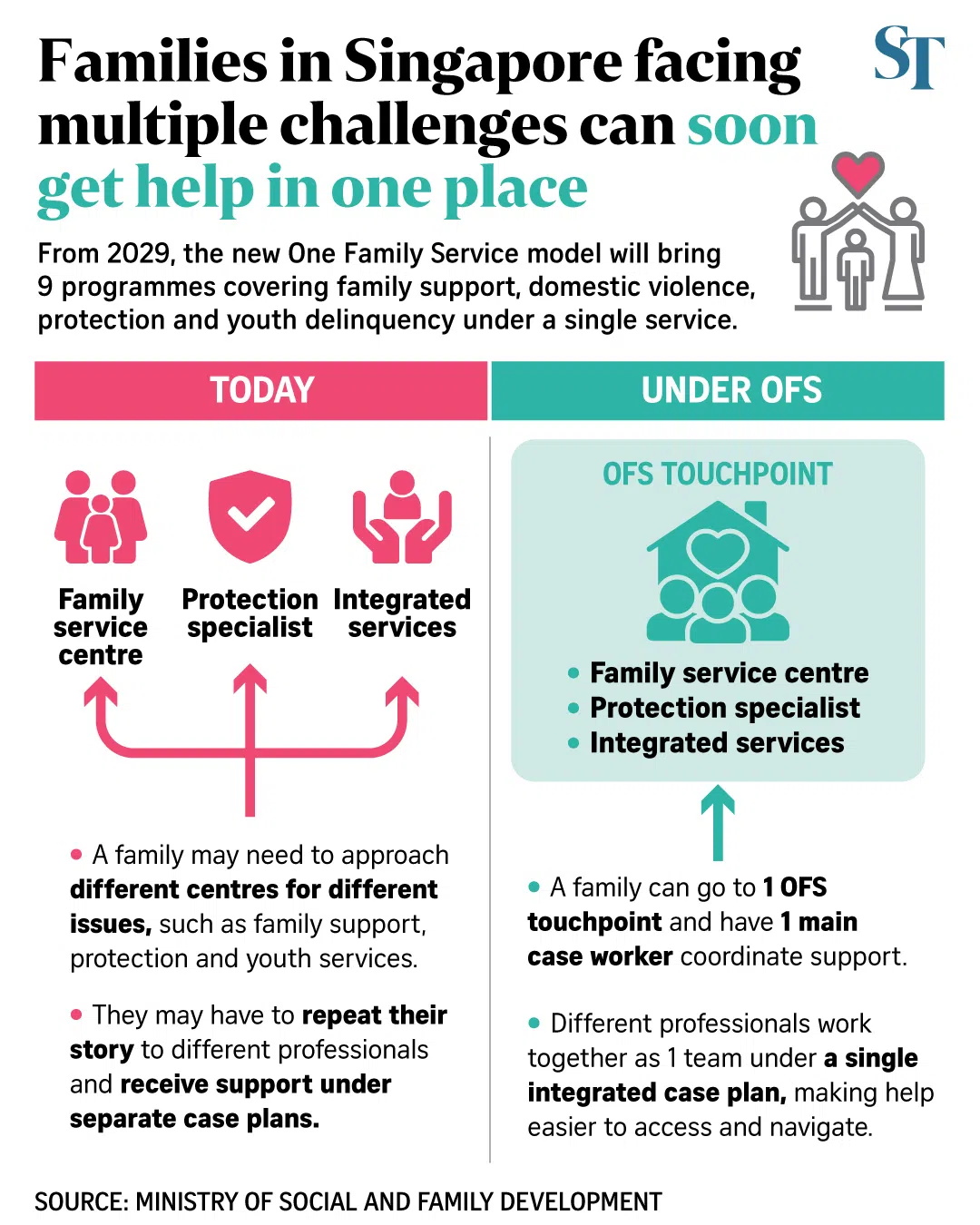
The OFS model will restructure nine MSF-funded programmes into a single integrated service, with the aim of responding to each family’s needs more holistically, so that families do not need to seek help from multiple programmes for their various problems.
The nine programmes span family support, domestic violence and protection, as well as youth delinquency. They currently serve about 35,000 individuals or families a year, and close to one in five of these families receive help from more than one programme.
Currently, families with multiple problems have to engage with different programmes and professionals, where they undergo different assessments for each programme and work with separate case plans to address the issues they face.
For instance, a family experiencing domestic violence and with a child in trouble with the law will have separate case plans for the parents and the young person. Under OFS, there will be a single integrated case plan that looks at the family’s issues and needs as a whole, supported by a team of professionals contributing relevant expertise.
Under the model, Singapore will be divided into seven regions. The initial roll-out in three regions is expected to begin in 2029, with the remaining regions to come on board over the next one to two years. An MSF spokesperson said the first three regions where the model will be introduced have not been decided.
The new model comes after the review committee found that families’ needs here are growing more complex, with Family Service Centres (FSCs) handling more complex cases, cases with higher safety risks, or both.
In 2019, such cases made up a quarter of FSCs’ caseload, but by 2025 the proportion had risen to 30%.
For example, families often face a mix of financial woes, family conflict, children’s behavioural issues and family violence.
These problems tend to reinforce one another and addressing each issue in isolation may lead to only limited or temporary improvement, said the 81-page report issued by the committee.
The report noted that while Singapore has built strong and accessible family services, demographic shifts such as an ageing population, smaller households and more diverse family structures are reshaping the types of support that families seek.
“These trends place greater demands on the need for better continuity of care, professional ability to take a holistic view of family needs, and stronger coordination across programmes and organisations,” it said.
The committee and its working groups involved over 50 representatives from 28 social service agencies and associations, and engaged more than 400 social service professionals.
Senior Parliamentary Secretary for Social and Family Development Eric Chua, who co-chairs the committee, said navigating social services should not be another challenge for families facing difficulties.
He said of the new model: “By reaching families earlier and organising support around their strengths, needs and goals, we hope to make their journey simpler and more continuous as their circumstances change.”
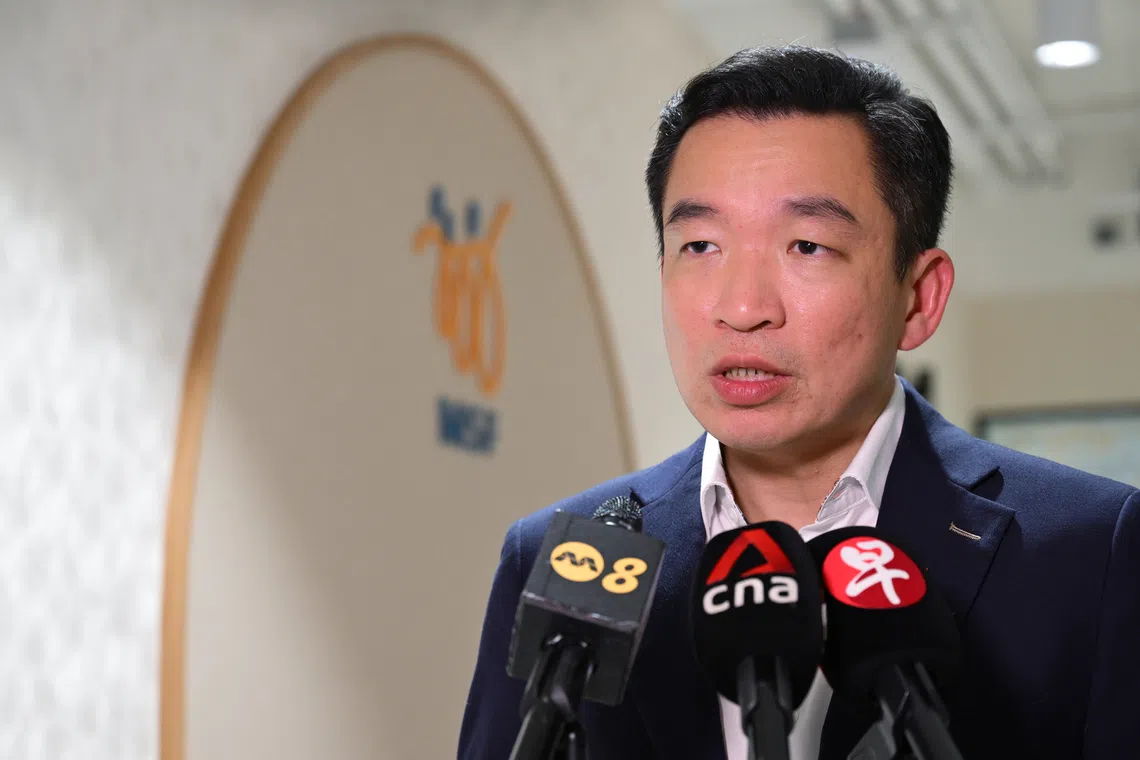
Senior Parliamentary Secretary for Social and Family Development Eric Chua said navigating social services should not be another challenge for families facing difficulties.
ST PHOTO: NG SOR LUAN
For the 26 social service agencies (SSAs) that run the nine programmes under OFS, the roll-out will mean a major change in the way they operate.
Instead of delivering a programme within their own organisation, they will have to work with other SSAs in their region to plan, coordinate and deliver the service to improve outcomes for the families they serve.
Under OFS, a family receiving help will have a primary case worker who has an overall understanding of the family’s needs. This person will lead and coordinate the team in supporting the family, and serve as the family’s main point of contact.
REACH Community Service’s cluster head of Family Service, Counselling and Mental Health Sharon Ng said the new approach can help determine which issues to tackle first, so that the family is not overwhelmed with working on multiple issues at the same time.
“Sometimes families say they feel overwhelmed by having to talk to different professionals for different programmes, and they want to speak to just one person,” she added.
The new model will require social service professionals to develop cross-cutting competencies that enable them to work in teams alongside professionals from other disciplines and organisations.
The committee recommended that MSF work with institutes of higher learning, professional bodies and other groups to align the education and training of social service professionals with the new model.
The new model also calls for shared infrastructure and common digital platforms.
For example, each region should have sufficient OFS centres where families can get the full range of support that they need at one location, instead of them having to travel to different centres for different services.
The committee also recommended setting up a common digital platform, where professionals from different SSAs can work together on planning, outcomes monitoring and delivering team-based care.
When asked if there would be any redundancies in manpower or other resources with the shift, the MSF spokesperson said: “We do not expect redundancies. Service demand is expected to grow, with an increasing proportion of families having more complex needs.”
The OFS will also expand areas of work, such as preventive support and deeper therapeutic interventions. MSF said it will make significant investments in training in the coming years so that professionals are equipped for the shift.
The ministry said it also plans to give each region a budget to carry out preventive support work, identifying families who can benefit from help before their problems – such as family conflict, mental health concerns and youth behavioural issues – get worse.
SSAs may work with community groups, schools and other partners to reach out to these families, so that their problems do not become more serious and harder to tackle, said the MSF spokesperson.
Associate professor Vincent Ng, dean of the School of Social Work at the Singapore University of Social Sciences, and a member of the committee, said the new model represents a significant shift in how social service professionals and SSAs work together.
There remain practical issues to be worked out, such as clarity of roles and accountability when professionals from different agencies work together, and how staff are supervised, he added.
Ng said social service professionals and leaders of SSAs will continue to be involved in discussions on implementation arrangements, which are being developed.
The MSF spokesperson said it will support the regional partners in progressively developing their model of working together, and a key aspect of this is determining each SSA’s respective role in the region.
The ministry will also work with the sector to define the shared family outcomes that each region is responsible for, funding and common infrastructure arrangements.
KioskNews shows a cleaned-up reading view extracted from the publisher’s page — the original always lives on their site, not ours.