ECOLOGICAL AMNESIA PART 2: Bread and Wine: A land that can forget itself
This is the second in a six-part series. The first can be accessed here.
Ask Eugene Moll whether a ruined landscape can be brought back and he answers cautiously. “It can, nothing is impossible, but a land can forget itself.”
Plough a renosterveld field year after year for a couple of human generations and the seed bank beneath it simply expires: the geophytes, the annuals, the whole buried memory of what grew there.
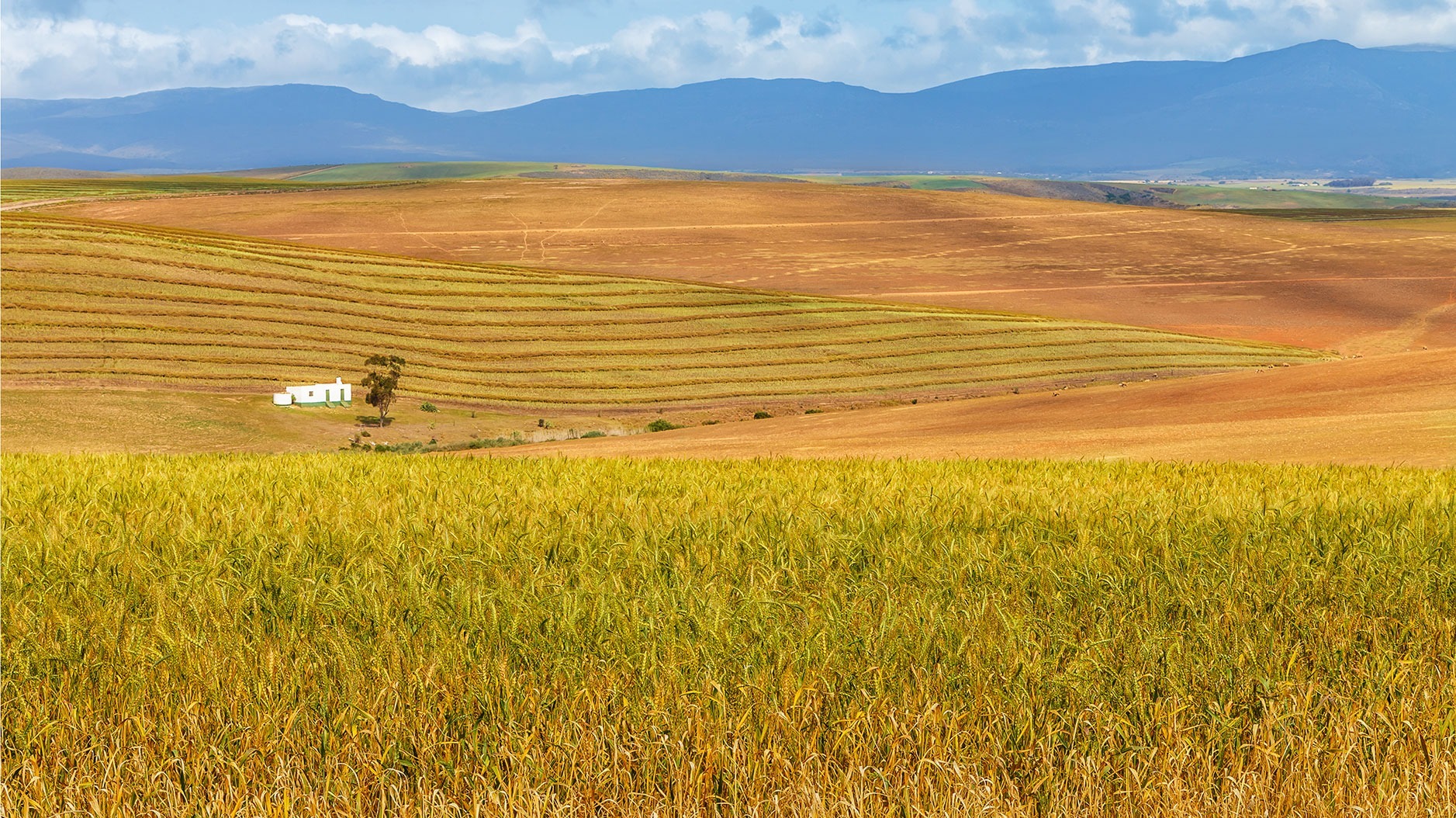
“You’d have to reintroduce the seeds,” he says, “and that’s not the easy thing.” What we have today is amnesia dressed as countryside – the vineyards, wheat and yellow canola that visitors photograph and mistake for natural scenery.
Before I trace the history of bread and wine in the Cape, or count the ecological cost of growing them, I needed Moll – a community plant ecologist who has been reading this vegetation since the 1970s – to sketch the fabric we’re standing on.
/file/attachments/orphans/BWRenosterveld3_801693.jpg "Renosterveld lost since 1900. (Graphic. DM)")
It is more complicated than most people think.
The Western Cape, he explains, is not one thing but four or five floras stitched together: strandveld on the old coastal dunes, scattered Afromontane forest patches in the wet gullies, remnants of woodland that once ran, in theory, all the way up Africa, renosterveld on the rolling shales and granites and the heathland we call fynbos.
What makes the Cape a floral kingdom (“not Africa”, as he puts it, but a pocket at the bottom of the continent where species collected like billiard balls in a corner) is that these components have been interdigitated and isolated for about 70 million years.
/file/dailymaverick/wp-content/uploads/2025/06/Only-around-5%EF%BF%BD-of-renosterveld-remains-today.-1-1.jpeg "Only around 5� of renosterveld remains today.")
Phosphorus
The key to all of it is a single element. I’d have guessed oxygen or carbon. Moll, who says the penny finally dropped reading Bill Bryson’s The Body, says its phosphorus.
Every living cell runs what’s called the Krebs cycle – chemical reactions that create energy – hundreds of times a day. But without phosphorus there is no energy and without energy no life. The Cape Fold Mountains – that great L-shape of sandstone from the Cederberg to Port Elizabeth – hold almost none.
That’s the secret of fynbos which has unusual nutrient-saving adaptations that have learned to cope with low phosphorous. It’s not driven by climate at all, but by starvation and fire. Strip the nutrients from a system, as Scotland’s medieval foresters did when they felled the Caledonian woods, and heath moves in.
Renosterveld is the opposite story and a tragic one, says Moll. It grows on the richer shales – Malmesbury to the north, Bokkeveld to the south and, in places, Cape Granite – the undulating, grain-friendly soils the first farmers cleared almost immediately.
Ninety-five percent of it, Moll reckons, is gone. What remains is a scatter of isolated islands marooned from one another.
It’s really a weed
And here’s the surprise: renosterveld may be a landscape we misinterpret.
“Renosterbos is actually a weedy or pioneer species,” he says of Elytropappus rhinocerotis, the grey shrub that gives the veld its name and its black-rhino-country reputation.
Two thousand years ago, when people arrived down the West Coast with sheep and cattle and began to settle rather than roam, they grazed out much of the grass – and where you overgraze, woody weeds begin to take over.
His evidence, in part, is a memory from 1973. From his office at UCT he used to look over the Tygerberg Hills: dark, low hills covered with tawny grass and darker heuweltjies, mounds once covered with woody scrub. Today it’s renosterbos. What was lost is rooigras, Themeda triandra, still hanging on where nobody bothers it, on a verge up Signal Hill.
/file/attachments/orphans/BWRenosterveld2_436883.jpg "The stubble land of harvested wheat fields near the banks of the Misverstand Dam on the Berg River, near Porterville, Western Cape, South Africa bake under the harsh African sun, waiting for rain. (Photo: Gallo Images / Mike Copeland)")
So what’s the ecological casualty of wheat and wine, I ask? Not the renosterbos, he replies – its the richness under and around it.
The geophytes (the Cape has some 130 species of Oxalis and eight of mole-rat species to eat them), the annuals, the wildflowers that once filled the little dorp flower shows of the 1960s – saved, in many cases, only because farmers’ wives forbade their husbands to plough this or that damp or rocky corner.
Wheat took the flats. Vineyards now climb the slopes, following sandstone scree down onto the granite until the mountainside itself is a monocrop.
“Ecological simplification,” he calls it, the same thinning out happening across Europe. It doesn’t grow back.
Shifting baseline
Two of his examples are worth flagging here. One is a cultural memory issue called shifting baseline.
The Zimbabwean river of his childhood that his father knew had deep pools with hippos and crocodiles. Moll watched it fill with sand. Today a young person would see it as ordinary woodland.
“What you see is what you think is pristine,” he points out. Each generation inherits a poorer world and calls it normal.
The other is the sheer thinness of the whole enterprise: the pedoderm, the top 10 or 15 centimetres of soil where nearly all a plant’s nutrients are taken up. Lose that to sheet erosion, as the Karoo did in the 1930s and 40s, and you’ve lost millions of years in a few decades.
Take a time check
Moll’s suggestion is that in order to understand grapes and wheat, start with time: the hunter-gatherer land of 2,000 years ago, sparse by necessity because the soil can’t feed crowds without fertiliser (a fynbos “poison”).
Then the arrival of sheep and the first semi-settlement. Then fences, boreholes and the moment people became permanently stuck to the land. From there the ecological story of grain and grape can be told properly.
/file/dailymaverick/wp-content/uploads/2025/04/ED_434251.jpg "kara-sa-wine-industry-tariffs")
A grape, he notes drily, is really just a bag of sugar – carbon, hydrogen and oxygen, all free from the air – waiting for the nitrogen, phosphorus and potassium that builds new life.
Does anything give him hope for the Western Cape? He’s honest: not much.
“I’m a real pessimist for the future.”
His post-war generation, he says, had the best of it. About his grandchildren, he is less sure. That uncertainty – a land forgetting itself while we admire the view – is the ground this series will stand on. DM
KioskNews shows a cleaned-up reading view extracted from the publisher’s page — the original always lives on their site, not ours.