Why Emirates is betting on premium economy to grow India business
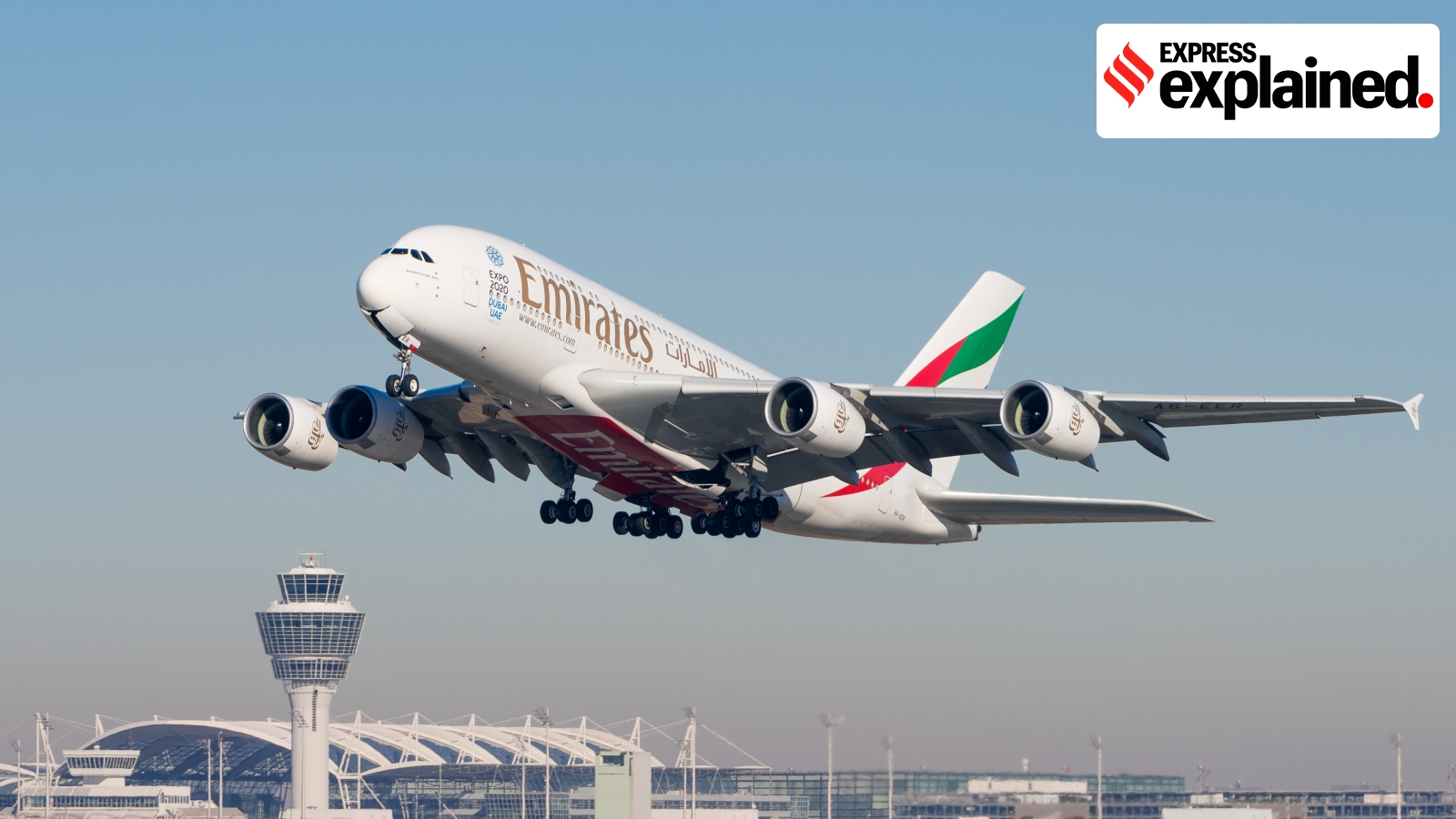
From today (Sunday, October 25), the airline is expanding its premium economy offering to all its flights to and from Delhi and Kolkata. It is also introducing for the first time its flagship Airbus A380 aircraft on one of its four daily frequencies from Delhi, making the capital the third Indian city to be serviced by its flagship super jumbo aircraft.
Even the remaining three daily flights will be upgraded to refurbished Boeing 777 aircraft, offering a four class cabin configuration — first, business, premium economy, and economy — versus the current three-class offering that features first, business, and economy classes.
In addition to Delhi, the premium economy cabin will also be available on all 12 of the airline’s weekly Kolkata-Dubai flights, up from the five a week at present. With this, the premium economy product will be available on flight to and from six of nine Indian cities that Emirates operates to, and will cover about half of its 168 weekly departures from India.
What explains this strategy?
A maturing Indian market
According to Essa Sulaiman Ahmad, Emirates’ senior vice president of commercial operations for West Asia and Indian Ocean, the Indian market — widely perceived as a price-sensitive one — has matured and there is “extremely high demand” for travel, including rising demand for premium cabin seats. Ahmad said that offering premium economy seats on a number of its India flights also works well from the perspective of passengers travelling with the airline beyond Dubai to markets like Europe and North America, where the cabin class is widely offered.
The carrier’s focus on premiumisation is evidently aimed at attracting flyers willing to pay more for better comfort and experience from a key geography for the Dubai-based mega carrier. Apart from reinforcing its premium positioning and commanding higher fares than competition, offering more premium class seats is one way for Emirates to grow the revenue from its India flights, given that it can’t expand seat capacity to and from India, according to industry watchers.
Premiumisation gives the airline a way to extract more value from this connectivity. It also enables Emirates to compete for passengers who might otherwise choose a European airline, another Gulf carrier or a direct service operated by an Indian carrier, primarily Air India.
Story continues below this ad
India is among the world’s most important outbound aviation markets, with rising international travel demand, a growing pool of affluent consumers, and increasingly ambitious domestic airlines, making it one of the key focus markets for Emirates.
A four-class aircraft configuration gives the airline more flexibility to serve different customer segments — economy seats for price-sensitive passengers, premium economy to flyers seeking additional comfort, and business and first class to travellers with much bigger budgets. In this context, premiumisation does not necessarily mean reducing economy capacity across the airline’s India network, but offering a wider range of products and improving the revenue generated by each cabin class.
The premium economy bet
The clearest expression of Emirates’ India strategy is its expansion of premium economy, a cabin positioned and priced between the economy and business class. It offers wider seats, greater legroom, deeper recline, upgraded dining and a more comfortable journey without the much higher price tag of a business class seat. Premium economy seats are usually priced higher than economy seats, but much below those in business class, which makes them a lot more attractive and accessible for passengers looking to upgrade from economy, but who simply can’t afford business class fares.
For instance, one-way fare for an Emirates flight from Delhi to Dubai in mid-December is currently priced at around Rs 38,000 for an economy class seat, and about Rs 51,000 for a premium economy seat, as per the carrier’s website. However, the gap between economy class fare and business class fare is significantly wider, with a seat in the latter being offered by the airline for around Rs 1 lakh. First class seats are on offer for Rs 2.36 lakh apiece.
Story continues below this ad
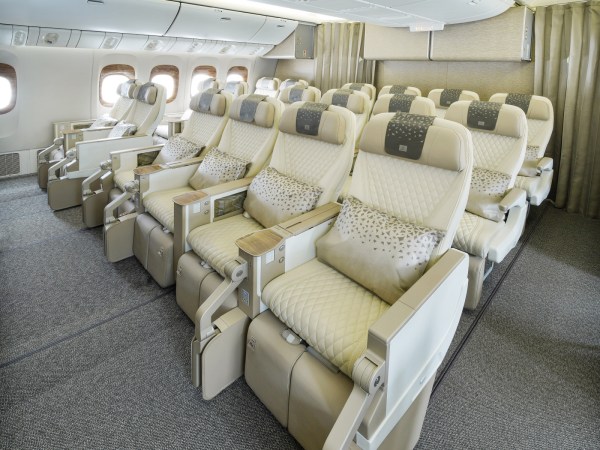 Emirates’ premium economy section. (Emirates)
The significance lies in the scale of the premium economy capacity expansion by Emirates. The airline doesn’t see this cabin class as a niche offering anymore, and the premium economy product is becoming a more prominent component of Emirates’ India network, giving the airline more opportunities to sell a higher-priced seat to passengers who might otherwise have travelled in the economy class. And not just in India, this cabin class is also gaining prominence in the airline’s global fleet and network.
An analysis of airline capacity data from aviation analytics firm Cirium shows that the number of premium economy seats being offered by Emirates on its flights from India has shot up. In November, Emirates is offering 2,537 premium economy seats per week on its flights from India, up 80.2% over November of last year. As compared to September of this year, the November premium economy seat capacity is up 73.4%, the analysis shows. In November 2023, Emirates offered just 784 premium economy seats per week, while in November of 2022, the number was nil.
The data shows that the jump in Emirates’ premium economy seats has come at the cost of economy class seats, even as the latter continues to do the heavy lifting. In November, Emirates is offering 50,264 economy class seats on its flights from India, down 2.4% year-on-year and 2.2% from September levels. Since 2022, the number of economy seats on the airline’s flights from India has declined by almost 5%. Emirates is evidently trying to make its premium proposition more accessible without abandoning its mass-market economy class business in India.
Moreover, business class seats on offer in September are higher by 2.1% year-on-year and 2% versus September at 7,345. However, the ultra-premium first class seats — which account for a minuscule share of the airline’s total seats on offer — are down 1.6% year-on-year to 1,136. As compared to September, they are down 2.2%.
Growing India business amid capacity constraints
Story continues below this ad
Emirates’ strategy in India is increasingly getting geared towards capturing a greater share of premium class passengers like business travellers, affluent leisure travellers, and high-spending families.
Add to that flyers who want a better experience and services than what the economy class offers, but can’t afford steep business class fares. Premium cabin classes offer higher yields and profit margins to airlines than the standard economy class, which means that all full-service carriers want to fill these cabins.
For Emirates, which is the largest overseas carrier operating to and from India, it is even more important, according to analysts. That is because the airline can’t offer more seats on India flights, given New Delhi’s reluctance to expand seat capacity under the India-Dubai bilateral air services agreement that has been saturated for years.
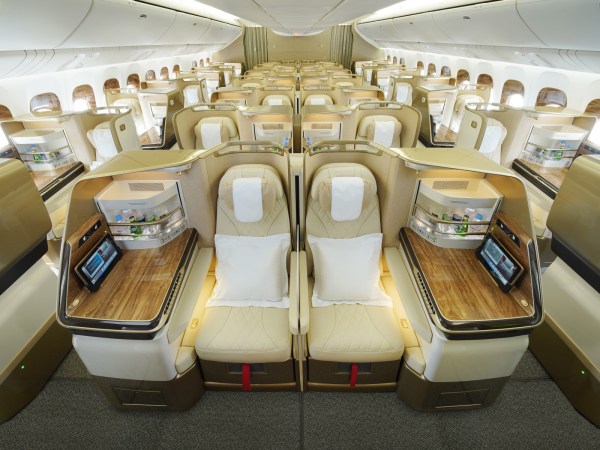 The airline’s business class seats. (Emirates)
With that key limitation, one way to expand the India business is to sell more premium class seats, and position the airline as a premium proposition that can command higher fares than peers, while still being able to fill up the much larger economy cabin on its aircraft.
Story continues below this ad
The India-Dubai air services agreement allows a total of about 66,500 seats per week per direction for the Indian as well as Dubai-based airlines. The quota, which hasn’t been increased for over a decade, was fully exhausted by both sides a few years ago. Dubai has been seeking an expansion of the bilateral flying rights, but India has been reluctant to do so. For Dubai-based airlines, the seats are divided between Emirates and flydubai, with the former accounting for 92% of the capacity.
The Indian government and major Indian carriers like Air India and IndiGo have ambitions to have more direct international connectivity from India. A significant number of passengers flying to far-off destinations from India take connecting flights through major global hubs outside the country, Dubai and Doha for instance.
India wants its carriers to ramp up wide-body operations, instead of facilitating foreign airlines, particularly Gulf-based carriers with deep pockets, in ferrying passengers to Europe and beyond through their massive hub airports.
KioskNews shows a cleaned-up reading view extracted from the publisher’s page — the original always lives on their site, not ours.