Fiona Dhawunymurruwuy will be evicted on Sunday, along with 120 other First Nations people: ‘There’s no place for me’
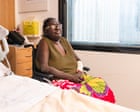
Three years after a failing kidney forced Yolngu woman Fiona Dhawunymurruwuy to move from her Arnhem Land home to Darwin, the place she felt most “protected from the outside” in the top end city is vanishing.
“It’s a community for us. These people are connected. People know each other, people communicate, it’s a nice place to live,” the 52-year-old bilingual teacher from Millingimbi says.
Dhawunymurruwuy has been living at the Yilli short-stay accommodation (YiSSA) complex since April last year. The facility, described by residents, who like Dhawunymurruwuy are predominantly from remote Aboriginal communities, is set to close on Sunday, after the Northern Territory government failed to renegotiate a five-year lease.
The NT has rejected support from the federal government to keep the facility open, turning down a $6.5m offer to purchase the demountable buildings from its owner, private company AUSCO Modular, as recently as this week. The offer was made under the condition that Yilli Rreung Housing Aboriginal Corporation would continue as the service provider for the facility.
Instead, the remaining 120 residents will be relocated 100kms away in the small town of Batchelor.
Visiting YiSSA on Thursday, the federal minister for Indigenous Australians,Malarndirri McCarthy, said it was a “deeply sad day”.
McCarthy said the offer from the federal government “still remains on the table”, and that it was a “fair and a very reasonable offer” that would get families through the wet season.
The NT chief minister, Lia Finocchiaro, last month labeled the funding offer a “waste of taxpayers’ hard-earned money”. Her office did not respond to a request for comment this week.
At its height, the facility housed almost 400 First Nations people, including women and children escaping domestic violence and people visiting from remote communities for medical treatment.
In July, when the Territory government informed Yilli Housing they had until 11 October to vacate all residents from the facility, there were 383 people living at YiSSA — including 145 children — with another 300 on a waitlist.
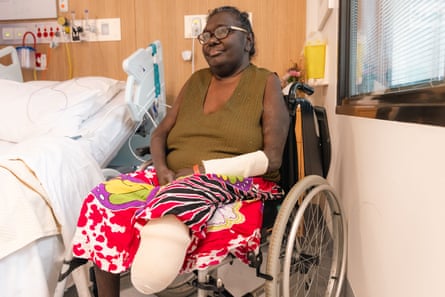
Dhawunymurruwuy, who had her left leg amputated last month due to ongoing health problems, moved into YiSSA in April 2025 to be closer to dialysis facilities, and to her work at Malak primary school in Darwin’s northern suburbs, where she helps students transition from her community of Milingimbi to schooling in Darwin, teaching in both English and Yolngu Matha.
Speaking to Guardian Australia from the Palmerston regional hospital where she is undergoing rehab from her recent major surgery, Dhawunymurruwuy says she is working hard to get healthy again, but now feels it was all for nothing.
“I had my amputation and now I’m doing my rehab, the exercise, training as much as I can,” she says. “All I need is a prosthetic leg and to train myself. I’m training to make my leg muscles and my hand strong again.
“The problem is, if I finish all of this, where will I go?
“There’s no place for me when I get out. Should I go straight to living in the long grass? I’ve never slept in long grasses ever in my life.”
after newsletter promotion
Dhawunymurruwu is referring to First Nations people experiencing homelessness in Darwin, who sleep rough in the city’s parks, open spaces and bushland, and are known locally as “long-grassers”.
An estimated 1,000 people sleep in thelong grass on any given night. More than 90% are First Nations people, many have travelled to Darwin from remote communities for medical treatment, family visits or cultural reasons, and become stuck due to poverty and a severe public housing shortage.
As the clock ticked down on the eviction of YiSSA residents, hundreds of protesters gathered outside the Darwin Convention Centre, where the Australian Housing and Urban Research Institute held its biennial Australian Homelessness Conference.
The rally, organised by grassroots movement Justice Not Jails (JNJ), called for the NT government to reconsider its position and partner with the federal government to purchase the facility.
Natalie Hunter, an organiser with JNJ and Nyikina and Jabirr Jabirr woman, says the Finocchiaro government had not considered a “range of issues” before allowing the lease to lapse, and tells Guardian Australia the decision to move people to Bachelor was rushed and ill-conceived.
“There’s no resources there, so how do you cater for even half of those 400 families,” she says. “They’ve probably got over 100 children, so how do you have a hundred children coming into your local school without even having any plan, or direction in where they’re placing people?
“The health service in Batchelor only caters for that little town. It has not been planned. There’s nothing out there. The CLP are doing this on the run.”
All Dhawunymurruwu wants is to have a house of her own, and to “get back to work because those kids miss me very much”.
“They said that they are missing me,” she says. “They called me and they was talking to me … even the teachers I work with, they miss me.”
KioskNews shows a cleaned-up reading view extracted from the publisher’s page — the original always lives on their site, not ours.