What’s on your plate?: Seven meals show what food insecurity looks like in SA
/file/attachments/2996/1HungerSeriesLogo_447660.jpg)
For some families, dinner is pap and spinach. For others, chicken and bread must feed a household of 12. At a Free State school, a plate of samp, beans and vegetables may be a child’s main meal of the day.
As part of the Hungry for Change series, Health-e News community journalists asked people to show us what is actually on their plates.
Registered dietitian and public health nutritionist Helen Donkin, from the Association for Dietetics in South Africa (Adsa,) analysed seven of the meals, using portion sizes estimated from photographs and nutritional information from the South African Food Data System (SAFoods).
When pap has feed three children and their mother
/file/attachments/orphans/Casestudy1photo-Chickenfeetsex_535520.jpg "Zinzi* and her three young children eat outside their home in Lenasia South. Zinzi* often shares a plate of food with her daughter while her two sons share another. (Photo: Lerato Kodisang)")
Zinzi*, a 32-year-old single mother of three in Lenasia South, sells chicken feet on the street to feed her children. When that income is not enough, she says she sells sex for cash or food.
The family usually eats twice a day. Pap is their staple and on difficult days it may be all they have. When food runs short, Zinzi shares a plate with her toddler while her two sons share another.
In March, Zinzi’s daughter spent a week at Chris Hani Baragwanath Hospital. Zinzi says doctors told her the child was malnourished.
Read Zinzi’s full story.
*Not her real name
/file/attachments/orphans/Plate1_233530.png)
Donkin says the photographed meal of pap and spinach provides much-needed energy, but is low in several important nutrients.
“Inexpensive food is not a problem per se, but often these foods tend to be lower dietary quality, or mostly contribute one macronutrient, like only carbohydrates or fats.”
Proper nutrition is particularly important for young children. Donkin says the period from conception to a child’s second birthday is a crucial window for nutrition.
“Poor nutrition in this crucial window, the first 1,000 days, which is from conception to a child’s second birthday, can have long-lasting negative effects on growth and development.”
R50 a day to feed six people
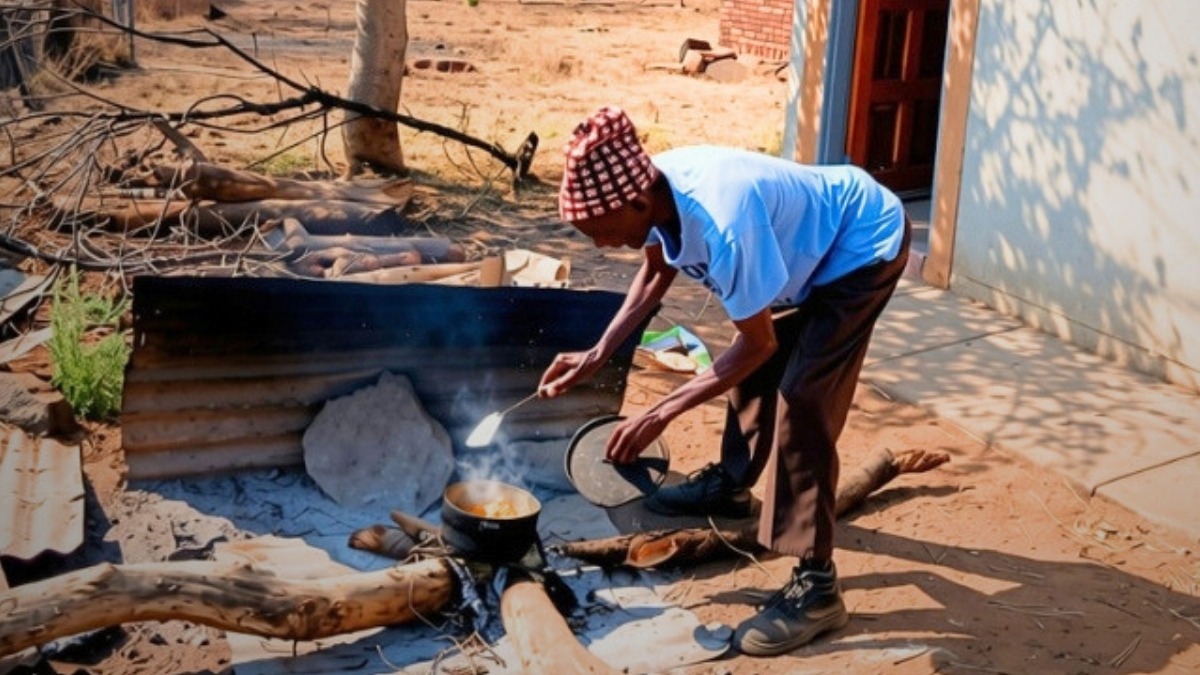
Sixty-six-year-old Sekhwele Mnisi, from Ga-Motodi village near Burgersfort in Limpopo, earns about R1,500 a month to feed himself, three adult children and two young grandchildren. That works out to around R50 a day for six people.
The family has no running water or electricity. About R400 goes towards water each month and another R400 towards paraffin and candles. They also need firewood for cooking.
When food runs out, Mnisi tells his children to drink water and have faith.
Read Sekhwele Mnisi’s full story.
/file/attachments/orphans/Plate2_944953.png)
Donkin says the photographed meal of pap and bread is high in carbohydrates, but low in several important nutrients.
“Yes, a full tummy does not equal meeting all your daily nutrient needs. Often high-carbohydrate, high-fat meals are filling, but many of these foods are low in protein and micronutrients,” Donkin says.
She says this type of meal can contribute to the triple burden of malnutrition, where undernutrition, obesity and deficiencies in vitamins and minerals can exist in the same family or community.
When older people go hungry so children can eat
/file/attachments/orphans/Casestudy3photo-GogoToti_603306.jpg "Gogo Toti watches as her granddaughter prepares noodles at her home in Emaxelegwini informal settlement near Ngcobo in the Eastern Cape. (Photo: Siyabonga Kamnqa)")
Grandmother Toti (68) shares her three-roomed home in Emaxelegwini informal settlement near Ngcobo in the Eastern Cape with five adult children and six grandchildren.
When there is not enough food, adults skip meals so younger children can eat. Toti, who has arthritis, says she tries to eat something before taking her medication.
“I have no choice but to make that daily sacrifice.”
Read Gogo Toti’s full story.
/file/attachments/orphans/Plate3_346262.png)
Donkin says the photographed meal of chicken and bread provides energy, protein and some micronutrients, but has limited dietary diversity, with no vegetables, fruit, legumes or dairy.
“This meal could well satisfy one’s hunger for a while and meet energy, protein and some micronutrient needs.”
But the food has to stretch. Donkin’s analysis found that when the meal is shared, individual family members get too little energy, protein, fibre and micronutrients.
“This leaves any one of the family members with an inadequate intake of energy, protein, dietary fibre and micronutrients.”
She says food insecurity can also be particularly difficult for older people and those living with chronic conditions.
“Inadequate nutrition over time can contribute to vitamin and mineral deficiencies and weakened immunity, while some medicines may cause side effects when taken without food.”
Recycling cans to put food on the table
/file/attachments/orphans/Casestudy4photo-reclaimers_671876.jpg "Nokulunga Nkabinde feeds her seven-year-old son a piece of bread at their home in Embo, west of Durban, after a day spent collecting and crushing aluminium cans they sell to feed the family. (Photo: Sandile Mbili)")
Nokulunga Nkabinde (31) is unemployed and collects discarded aluminium cans in Embo, west of Durban, to help feed her household.
She lives with her two sons, aged seven and five, two adult siblings, her mother and grandmother. The household has a combined monthly income of about R6,000.
Nkabinde is one of several unemployed women in Embo who collect cans to help support their families.
Read Nkabinde’s full story.
/file/attachments/orphans/Plate4_900002.png)
According to Donkin, Nkabinde’s plate of rice, scrambled eggs and fried vegetables has more dietary variety than several of the other meals analysed.
“It includes three vegetables and an animal source of protein, although there is no fruit, legumes or dairy,” Donkin says.
“Dietary diversity forms the basis of a diet that can support health, supports gut health by feeding beneficial microbiome in the gut and provides a variety of nutrients from a variety of sources.”
“A diet with little variety can mean people do not get enough vitamins, minerals, antioxidants and other nutrients needed to support health,” she says.
When saving through stokvels puts more food on the table
/file/attachments/orphans/Casestudy5photo-Stokvel_414314.jpg "Reabetswe Food Stokvel co-founders started the stokvel in 2023. It has since grown to 45 members in Tsetse Village outside Mahikeng. (Photo: Provided)")
Every month, members of the Reabetswe Food Stokvel in Tsetse Village outside Mahikeng pool their money to buy food in bulk.
For co-founder Mapiti Seleka (41), the groceries help her family through December and into the first months of the new year. The photographed meal is a special festive-season meal, not what the family eats every day.
“Before the stokvel, December was just pap and hope.”
Read Seleka’s full story.
/file/attachments/orphans/Plate5_300592.png)
Donkin says the photographed meal has good dietary diversity, with fish, couscous and four vegetables.
“Every food group contributes a small amount of calcium, which combined means this is a moderate calcium meal, showing practically how dietary diversity contributes to getting in enough of all different nutrients,” Donkin says.
But Donkin cautions that more than half of the meal’s energy comes from fat.
“This could increase the risk of non-communicable diseases if every meal follows the same pattern,” she says.
When a school meal may be the only meal of the day
/file/attachments/orphans/Casestudy6-Schoolfeedingscheme_719332.jpg "Bowls of food are prepared for children at the We Care Day Care Centre at S.A Mokhothu Primary School in Nyakallong, Free State. The centre feeds children during the school term and keeps its kitchen open during school holidays. (Photo: Thabang Thembani)")
For some children at SA Mokhothu Primary School in Nyakallong, Free State, a school meal is their main meal of the day.
During the school holidays, the We Care Day Care Centre keeps its kitchen open during the first week of the break. It also provides meals to older learners from surrounding schools when there is enough food.
Caregiver Rebecca Ndaba says high unemployment means many families in Nyakallong struggle to provide even one meal a day.
Read the full story.
/file/attachments/orphans/Plate6_275648.png)
According to Donkin, the samp and beans, pumpkin and tomato-and-onion relish is one of the most balanced of the seven meals shared during Health-e News’ Hungry For Change series.
Donkin says it provides adequate protein for a young child, is high in fibre and has a good balance of energy from carbohydrates and fats.
“Overall this is a well-balanced meal providing dietary diversity and nutrients. If combined with a fruit on occasion, the vitamin C provision would increase significantly.”
But Donkin says for children, the nutritional importance of a meal cannot be separated from how regularly they are able to eat. She says poor nutrition during childhood can also affect cognitive development.
“This makes regular access to nutritious food particularly important for children who may be relying on a school or community feeding programme for their main meal of the day.”
Growing food when families cannot afford to buy it
/file/attachments/orphans/Casestudy7-Growers_588777.jpg "Volunteers prepare spinach harvested from the community garden at the Thuthukani Centre in Lenasia South. Produce grown at the garden is shared among volunteers to help supplement food in their homes. (Photo: Lerato Kodisang)")
At the Thuthukani Centre in Lenasia South, unemployed residents grow vegetables they can take home to their families.
The garden produces spinach, tomatoes, onions, broccoli, bell peppers and cabbage.
Volunteers can use their social grants to buy staples and other food, while produce from the garden adds fresh vegetables to their meals.
Read the full story.
/file/attachments/orphans/Plate7_623701.png)
Donkin says the photographed meal of pap, spinach, carrots and onions is high in fibre and provides substantial amounts of vitamin A, calcium and iron. But it contains no animal protein, legumes, dairy or fruit.
The meal analysed by Donkin consists of pap with fried spinach, carrots and onions. She says it has good dietary diversity from three different vegetables and is particularly high in fibre.
“The vegetables also provide substantial amounts of vitamin A, calcium and iron.”
But Donkin says the meal has nutritional gaps.
“There is no animal protein, legumes, dairy or fruit.”
Donkin found it provides moderate protein for adults, while a greater proportion of its energy comes from fat than carbohydrates because of the cooking oil used to prepare the vegetables.
Donkin says growing vegetables can add nutrients to people’s diets, although it comes with costs of its own.
“If families have some water and land available that’s fenced off, a vegetable garden is a wonderful way to add nutrients to the diet,” Donkin says.
But Donkin says growing food also costs time and labour.
“It is labour intensive, both tending to the veggies and fetching water. Community initiatives like a shared food garden can help reduce input costs, and share labour and harvests.”
According to Donkin, responsibility for overcoming food insecurity cannot rest solely with families. Improving the nutritional value of a diet costs money, time or both.
“The solution is not simply to educate families about eating healthier while nutritious foods remain inaccessible to them with financial, social and economic constraints beyond their immediate control.” DM
First published by Health-e News in an eight-part series about food insecurity in South Africa.
KioskNews shows a cleaned-up reading view extracted from the publisher’s page — the original always lives on their site, not ours.