Parliament passes law banning online sales and ads for non-compliant active mobility devices
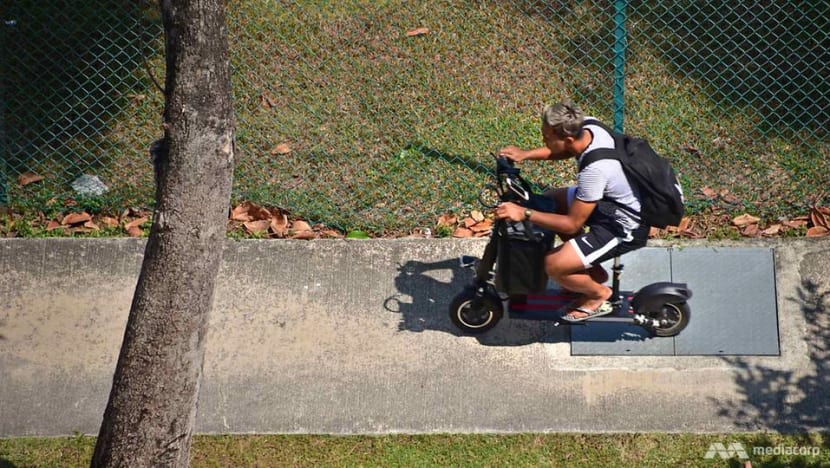
MPs also discussed how drivers' livelihoods may be affected by the future roll-out of autonomous vehicles.
New: You can now listen to articles.

This audio is generated by an AI tool.


07 Oct 2026 10:29PM
SINGAPORE: Online retailers face new restrictions on selling and advertising non-compliant active mobility devices, and must display warning notices about device and usage rules after parliament passed new measures into law on Wednesday (Oct 7).
To prevent fires caused by active mobility devices – with 49 such blazes occurring in 2025 – the Ministry of Transport also moved to ban the use of non-compatible batteries in power-assisted bicycles, motorised personal mobility devices and mobility vehicles.
The wide-ranging Land Transport and Related Matters Bill also introduced a new regulatory sandbox for autonomous vehicles (AVs) to be deployed on public paths, prompting a debate in the House about the future roll-out of AVs and how it may impact drivers’ livelihoods.
The new law also strengthens enforcement against illegal point-to-point transport services, and toughens measures to remove deregistered vehicles, which have been used in crimes like drug trafficking.
It also removes mandatory inspection of electric vehicle (EV) chargers in landed homes to reduce compliance burden, while boosting enforcement against illegal charging of EVs.
Parliament backed the Bill after close to five hours of debate, with 26 Members of Parliament (MPs) speaking.
24:12 Min
It will be an offence to sell or advertise non-compliant active mobility devices online, under proposed changes to the law. Sellers will have to display warning notices on device listings, informing buyers of device and usage rules. To reduce fire risks, new battery safety rules will be introduced, barring the fitting and use of non-compatible batteries in such devices. Penalties for illegally importing power-assisted bicycles and motorised personal mobility devices will be raised. Minister of State for Transport Baey Yam Keng announced the details in parliament on Wednesday (Oct 7). Meanwhile, action will be taken to keep deregistered vehicles off the roads, including an Authorised Exporter Scheme and a shorter grace period for disposal. Mr Baey also outlined stronger deterrence and enforcement measures against providers of illegal point-to-point ride services, adding that the government is not ruling out penalties for commuters in future. The government also aims to introduce new legislation in a year, governing the use of autonomous vehicles on the roads. It will also launch a new sandbox to facilitate deploying autonomous mobile robots on public paths on a larger scale.
NON-COMPLIANT ACTIVE MOBILITY DEVICES
The new restrictions make it an offence to sell or advertise non-compliant active mobility devices online. They extend current rules largely designed for physical retailers to the online space, Minister of State for Transport Baey Yam Keng said in his opening speech on Wednesday.
The rules take effect in the second quarter of 2027. They apply to online listings and advertisements that originate in Singapore, or are made by a Singapore-connected person and accessible in the country.
In addition, the Land Transport Authority (LTA) will be able to direct sellers to amend or remove offending online listings or advertisements.
The rules do not apply to foreign-based sellers with no Singapore presence, who are kept in check by import controls instead, said Mr Baey.
Several MPs flagged the enforcement gap around overseas online sellers.
“Online sales frequently involve sellers operating outside Singapore,” said MP Dennis Tan (WP-Hougang), adding that “practical enforcement against overseas sellers may understandably present different challenges, particularly where such sellers have no assets, operations, or personnel in Singapore”.
19:07 Min
The objectives of the proposed changes are sound and many of the provisions are sensible and necessary, said MP Dennis Tan. Speaking in parliament on Wednesday (Oct 7), he pointed out that the success of the framework will depend on how effectively the new powers are exercised in practice. He sought clarifications on the implementation of the provisions relating to overseas online sellers, battery safety and authorised exporters of electric vehicle charging infrastructure.
MPs also asked about scope for expanding responsibility to the operators of online marketplaces.
“When an overseas or anonymous seller cannot be reached, will LTA have a direct and sufficiently broad power to require the operator to disable access to the offending product listing in Singapore?” asked MP Charlene Chen (PAP-Tampines).
A few MPs made reference to directives that authorities can issue under the Online Criminal Harms Act for online platforms to disable Singapore users’ access to offending content. They asked if a similar mechanism could be put in place for errant listings.
Mr Baey said the rules will not be able to apply to foreign-based sellers with no Singapore presence as they fall outside the country’s jurisdiction.
He added that the legislation was calibrated to balance the compliance burden on operators of online marketplaces.
He noted that the Online Criminal Harms Act addresses serious criminal offences affecting national security, national harmony or individual safety with an online nexus.
“For non-compliant active mobility devices, we will rely on other levers, including continuing to work with platforms to remove non-compliant listings and advertisements,” he said.
MPs raised other areas the rules could target.
MP Ng Shi Xuan (PAP-Sembawang) asked LTA to consider whether “greater traceability from manufacturer or importer to seller” would help to identify the source of non-compliant batteries and strengthen enforcement against illicit sellers.
MP Kenneth Tiong (WP-Aljunied) urged separate consideration of the compliance of battery chargers, giving examples of instances where fires started because of third-party, incompatible chargers with original batteries.
LIST OF APPROVED RETAILERS
Several MPs asked how consumers could easily determine whether batteries were compliant under the new rules.
MP Hazlina Abdul Halim (PAP-East Coast) proposed a standardised compatibility label showing which devices a battery could be used with, so consumers would not need technical expertise to identify a suitable battery.
MP Tin Pei Ling (PAP-Marine Parade–Braddell Heights), who is also chair of the transport government parliamentary committee, asked if there could be a clear list of approved models and compatible batteries.
This could be in the form of a searchable online register or a QR code.
She also asked for support to help existing users of non-compliant batteries transition to the new rules, noting that some may rely on their devices for their livelihoods or daily living.
09:05 Min
As Singapore looks to expand the use of autonomous vehicles, they will collect enormous amounts of data and operators will be required to keep records and share information with the Land Transport Authority. In parliament on Wednesday (Oct 7), MP Tin Pei Ling noted that the movements and images of ordinary people will also be captured. She asked how a balance can be struck and the data protected, and what guardrails will be in place against cyberattacks which could cause widespread harm on the roads. She also raised questions about enforcing the disposal of deregistered vehicles and regulating the sales, advertising, battery safety and alterations of active mobility devices.
On affordability, MP Fadli Fawzi (WP-Aljunied) cautioned against placing an "unsustainable financial burden" on consumers and urged retailers not to use the new requirements as an opportunity to inflate prices.
Responding to the MPs, Mr Baey said LTA already publishes an online list of compatible batteries for approved power-assisted bicycle (PAB) models, and intends to publish similar lists for whitelisted e-scooters and mobility scooter models before the new rules take effect.
This would provide consumers and retailers with a common reference, he said.
"A battery that is safe on its own is not necessarily safe when used with a particular device," Mr Baey said, adding that compatibility was not simply based on what a seller declared.
On the transition for existing users, Mr Baey said the government does not intend to subsidise replacements or offer trade-ins.
AUTONOMOUS VEHICLES
Safety and the impact on workers were among the concerns raised over the wider deployment of autonomous vehicles (AVs).
Ms Hazlina called for regular publication of information on significant incidents, near misses, complaints and corrective actions arising from AV trials.
She also asked what would trigger a deployment pause or a change in operating conditions.
01:52 Min
MP Yeo Wan Ling (PAP-Punggol) described driving as an important "employment buffer" for generations of Singaporeans, and asked what would take its place if it became less available. She also called for workers and unions to be consulted as AV deployment progresses.
Mr Fadli suggested trialling autonomous night buses along rail corridors after train operating hours.
Mr Baey said operators would have to demonstrate that their vehicles can safely share paths with other users, including giving way to pedestrians.
LTA could require safeguards such as speed limits or on-site safety operators, while the government is also studying how key safety and operational information could be shared with the public.
On jobs, Mr Baey said the government did not expect an immediate impact on taxi and private-hire car drivers. Several hundred AVs are expected by the end of 2028, compared with about 72,000 taxi and private-hire car drivers today.
The majority of point-to-point transport would continue to be provided by human drivers "for the foreseeable future".
Drivers interested in opportunities in the AV industry or other sectors can tap courses, career conversion programmes and training incentives, including salary support of up to 90 per cent.
As for autonomous buses, the government would take an "even more gradual and calibrated approach" than with autonomous passenger cars, Mr Baey said.
This is because the current public bus operating environment is complex and serves a diverse range of passengers.
31:36 Min
In parliament on Wednesday (Oct 7), Minister of State for Transport Baey Yam Keng responded to clarifications sought by Members of the House on the Land Transport and Related Matters (No. 2) Bill. The Bill was then passed.
OTHER SUGGESTIONS AND CONCERNS
Turning to efforts against illegal point-to-point transport services, Mr Baey cautioned passengers who choose to take such rides.
“We have not introduced specific penalties against commuters for the use of illegal point-to-point services for now. But we may do so in future,” he said.
He added that commuters should not use these illegal services as they often lack valid insurance coverage.
He also updated the House on the take-up of the cross-border taxi scheme between Singapore and Malaysia.
The average daily number of cross-border taxi trips has risen by about 20 per cent since the taxi quota was enhanced from 200 to 300 taxis from each side in May.
Singapore’s cross-border taxi quota has been fully utilised, while Malaysia has used more than half of its quota, said Mr Baey. Both countries aim to gradually increase the quota to 500.
On deregistered vehicles, the new law strengthens controls over the disposal of these vehicles by requiring them to be exported through LTA-authorised exporters.
MPs called for record-keeping and audits to ensure that all parties fulfil their responsibilities.
Mr Baey said that LTA will take steps to strengthen accountability. For example, it will conduct risk-based audits and revoke the licences of authorised exporters if they breach requirements.
He added that LTA expects about 20 to 50 authorised exporters to join the scheme.
The new law removes a requirement for EV chargers installed in landed homes to be inspected every two years. MPs asked how safety would be ensured in these residences.
Mr Baey said LTA will publish online guidelines that cover basic maintenance and safety checks, signs of deterioration or damage, and recommended servicing practices to ensure chargers remain safe.
The agency will also continue to conduct risk-based audits to ensure compliance with EV charging rules, such as reviewing certifications submitted by charger equipment specialists and licensed electrical workers, he said.
KioskNews shows a cleaned-up reading view extracted from the publisher’s page — the original always lives on their site, not ours.