Blade Runner 2099 ending explained: Full spoilers for series discussed with showrunner
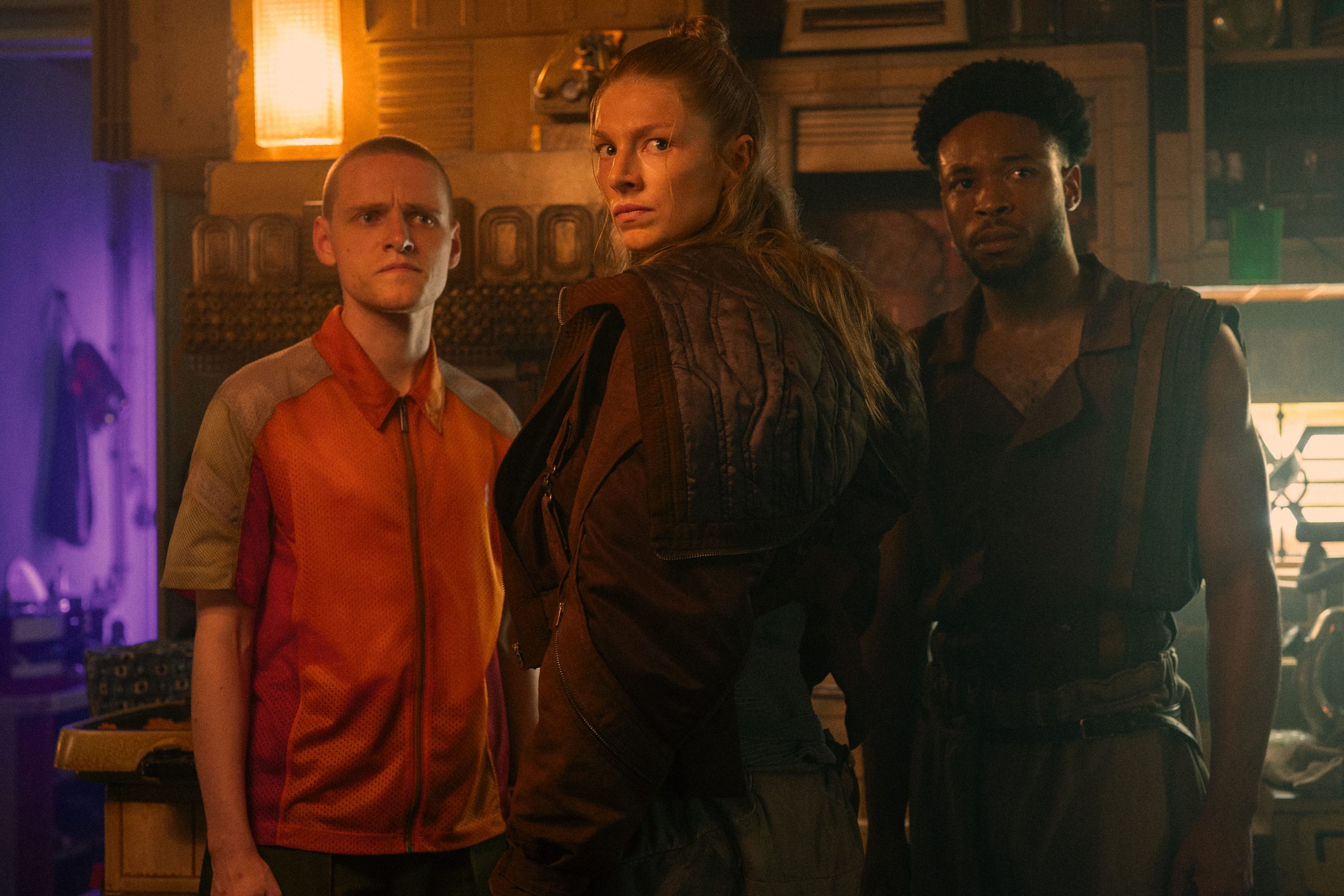
Prime Video’s latest instalment in the Blade Runner franchise has a few mysteries and threads to tie up.
Blade Runner 2099 follows human Cora (Hunter Schafer), who is pulled into impersonating a replicant Blade Runner in the Los Angeles Police Department in a world where replicants are now dominant, and humans are now an underclass.
Cora ends up paired with veteran replicant Blade Runner Olwen (Michelle Yeoh), who is nearing the end of her lifespan but is tasked with tracking down a rogue replicant named Marek (Johnny Harris), who she shares a history with.
But why has Marek run? What are so many factions seeking? And what happens to the major characters?
Here’s everything you need to know about the show’s conclusion.
*Spoiler warning for the events of Blade Runner 2099*
What has happened between replicants and humans?

The series opens with a scene from decades before the start of the main narrative as a Tyrell Corporation salesman (Freddie Fox) tries to sell Nexus-4 replicants to a human businessman (Michael Smiley).
The salesman responds to questions about previous models which the company hasn't made public, saying that the Nexus-4 models have limited lifespans for a reason - as they have nothing to fight for.
However, the human businessman questions what if not all eventuallities haven't been fought of and what happens to the human race if the replicants are more human than human.
The prologue's written on-screen précis reads: "During the 21st century, Replicant workforces made one off-world colony after another habitable
"On Earth, the environment deteriorated.
"In the chaos, the latest Nexus Model 9s overthrew their human creators and began the slow work of rehabilitating global ecosystems.
"Humans, now an underclass, perform menial labour they once forced on Replicants.
"Not all humans surrendered. Those who continue to fight hide under false identities.
"A Replicant police squad hunts them.
"This special unit took the name they once feared most…
"Blade Runner."

The main narrative picks up in 2099, 50 years on from the events of the previous franchise entry.
Of course, did the real-world advances in artificial intelligence add additional layers to the series?
Showrunner Silka Luisa commented: "This was written. I mean, obviously AI has come up endlessly because it's just top of mind, every single morning in the newspaper. I mean, it's endless. But that is such a recent development. When I started writing this, AI wasn't as much of a part of the conversation.
"I think really, what I was concerned about, and what my own personal anxiety was was just that the world as we knew it know it was shifting; that something it the future that we expect might not be there and something might take our place I think that we've been having that dread for a couple of years now from not just AI, but just environment, pandemic, just a lot of of of what we've this chaos that we've been living through, and you know, I wanted to really look at not the moment of collapse, but the aftermath. And so, how do you actually live in that existence? What could that future look like?"
When I suggested it was a "post-post-apocalypse", Luisa laughed: "Yeah, I like that. I'm going to steal that!"
What is the memory and who wants it?
The object so many are seeking across the series’ run is a memory that was recorded from the perspective of Eldon Tyrell, the founder of the Tyrell Corporation and the creator of the replicant race, who was memorably murdered in the original Blade Runner film.
Recording memories was outlawed in the series mythology, meaning such artefacts are valuable antiques.
Any memory of Tyrell would be valuable, but this particular one contains the key to creating the original Nexus-1 replicants, Helena and Julius, who are immortal.
The reason Marek goes rogue is that he joins a faction of replicants led by Julius to find the secret to immortality and protect his beloved Olwen.
Actor Johnny Harris told Radio Times: "It's about feelings, and a replicant's able to have feelings."
He noted: "I was playing almost a human being. This person feels real. There's something very real inside of him. Well, that's what he believes, and so my remit was to play that. Really, my direction was to explore that."
Harris concluded: "My character has a faith of kind, you know, and I share that with him. I believe in love. I have faith in something. I really do, you know. So playing Marek, someone who's possibly discovering that or questioning that, was quite beautiful, you know. I understood him."
What is the significance of the character Blue who inspired Blade Runner 2049's Joi?

In Blade Runner 2099, we meet nightclub owner Blue (Elena Anaya), who is revealed to have been the inspiration for Joi, the Blade Runner 2049 character played by Ana de Armas, who is an artificial intelligence intended to meet romantic and lustful desires.
The appearance was a fun reference from showrunner Silka Luisa for the film, as she told Radio Times: "I just love the idea that Joi probably had been inspired by real people because you know they would have to have modelled them off someone, and just you know, in the truest noir sense, to have this kind of larger-than-life owner of this nightclub that you would go and ask for the bar, but set this in our Blade Runner world. It was just a lot of fun, and that bar in Barcelona is stunning. It really is called La Paloma, and we did so little to it, it's spectacular."
Who are Helena and Julius in Blade Runner 2099?

Helena and Julius are like the Adam and Eve of replicants, the firstborn of the new race, and they are bonded for this.
However, the pair develop different outlooks, with Julius keen to lead a revolution of replicants who advance into god-like beings and leave humans in the dust. Helena, however, felt differently and stole the Tyrell memory in an attempt to prevent Julius from advancing the replicant race after it had had obsolescence and mortality built into it.
Helena fled Los Angeles and ended up on an island living in a remote and deserted monastery devoted to the Mercer religion. It was here that she met Cora and Elias as children after they survived a crash in an attempt to escape Off-World amid a war between humans and replicants.
Helena raised Cora and Elias as a mother until she was murdered by being pushed from a cliff top - revealed to have been killed by Julius, who searched for Tyrell’s memory. After the various searches for Tyrell’s memory, it’s clear Helena left this to be recovered by Cora.
What happens to Julius?

In the end, Julius obtains the Tyrell memory and uses it to murder his follower Clotilde, revise and upgrade her and reveals his plans to use it all on replicants.
In the end, Olwen and Cora clash with him, and Julius destroys Tyrell’s memory and stabs Cora so he is the only one to know how to complete the upgrade.
However, as Julius struggles with Cora, he is shot dead in the head by Olwen to save Cora and in a repudiation of his world vision, with Olwen preferring to die rather than be beholden to him.
Who is Greta?
Greta is a human child trained to test empathy levels in replicants.
A flashback to 2097 shows Greta travelling to the Voight-Kampff Institute in Matanuska Valley, Alaska, over burning fields of ice and snow. Greta asks why Replicants don’t have empathy, and it’s due to a lack of childhood, but it’s a flaw in a Replicant. Greta is a human and is trained how to spot the difference between a human or Replicant with other children. Embarrassment is exclusively human. Greta does her exams and notes that she and her “teacher” don’t like being there. Greta’s lost toy is returned to her by the “teacher”. However, Greta notes this is part of a test. Greta does a test on the teacher, and she’s left. Despite wanting to go home, Greta is posted to Los Angeles as her parents were paid.
Greta is seen testing both Cora and Olwen in the present day, and Olwen fails the index test - she feels empathy.
As the series concludes, Greta also tests Cora, and it seems both truly understand each other.
Who is Ray and what happens to him in Blade Runner 2099?

Ray is the person who manipulated events so Cora could impersonate a replicant Blade Runner - including murdering the real counterpart, Marian Jessup. Ray led Elias to believe that he wanted the Tyrell memory in a bid to destroy the threat of replicants to humans, something which also aligned with Bebeto’s views.
The series later revealed that Ray is actually a pragmatic member of the remains of the Tyrell Corporation and is working to retrieve Tyrell’s memory and the key to replicant mortality so they can sell it and make a profit.
While the memory itself is destroyed, the finale hints at the potential for this desire to be fulfilled as Ray tracks down the remains of a Nexus-1 and the place where Julius was birthing these models at an abandoned Off-World launch complex.
Given that Ray was keen to transport Julius’s remains, it appears his company’s plans to exploit knowledge of the Nexus-1s for profit is not dead yet.
What happens to Clotilde?
Olwen and Clotilde clash at the launch complex after the latter is upgraded into a Nexus-1. However, Clotilde almost falls to her death but is saved by an empathetic Olwen, changing the former’s perspective as Olwen questions why Julius killed her.
Following Julius’s demise and seemingly the key to replicant immortality, Olwen lies dying until Clotilde appears and offers her the chance of an upgrade, as she also observed Tyrell’s memory.
Clotilde’s fate is unknown, but she certainly survived the proceedings.
What happens to Bebeto and Elias?
After murdering replicant Yahya (Matthew Needham), Cora wanted Elias and Bebeto to stay out of harm's way, but both were keen to fight back against replicants.
The revelation of Ray’s true motives divides Cora’s younger brother and her ally Bebeto; however, as a war veteran, Bebeto is too tired to fight against replicants, but Elias remains radicalised against them and doesn’t want to serve the Tyrell agenda and doesn’t care for Ray’s threat to frame them both for the destruction of the Tyrell pyramid where replicants in Los Angeles are now born and for which Julius and Clotilde were responsible.
After Elias leaves Ray, Bebeto is offered a role at the Tyrell Corporation, and it’s unclear whether he takes this up.
Elias, meanwhile, hijacks an LAPD car and flies to Helena’s home at the Mercer Monastery to transmit a broadcast.
His broadcast goes out over Los Angeles in a message calling for humanity to take back control and taking credit for burning the birthing centre at the Tyrell Pyramid.
Bebeto listens to the broadcast as Elias lies about what he has done. What either does next is unclear.
What is clear is the vast chasm between the previously inseparable siblings Cora and Elias. Cora has realised the grey area in human and replicant relations thanks to her time with Olwen, but Elias is more sure than ever that humans need to end the replicant threat once and for all.
Discussing this conclusion for the siblings, Luisa explained: "That was the most important: that two siblings could come out of this and really end up on opposite ends of the spectrum, and which I think happens so much in families, in reality, all the time. Right? You know, you are exposed to the same information, and you are believing two different answers to the way forward.
"And for Elias, I really wanted him to have some agency. I mean, this is somebody at the beginning who is really coddled and kept by his sister, and you know he's a man. He wants to go out into the world and carve a future for himself, and this is the hope that he would be able to start that."
Meanwhile, when asked if he would reprise the role of Elias, even as a replicant, Lewis Gribben told Radio Times: "Oh, 100%. He could be a cyborg. I would do it again. Do you know what I mean? If there's any like room for either a second series or he's in a video game or another part of the Blade Runner medium, absolutely, yeah."
What happens to Cora?

Following the deaths or departures from Earth of all replicants who could or would want to expose her as a human imitating a replicant, an injured Cora returns from the showdown with Julius and his followers to LAPD.
At the office, Greta is required to test Cora, who looks at the former's toy and asks Greta if she is the child in her story. Greta asks hypothetical questions about the story, and Cora keeps asking Greta questions in turn. Cora notes that Greta doesn’t want to be there, and Cora responds that she is safer there than as a fugitive. Greta fails Cora in the test, but Cora says Greta won’t because she’s still a person, noting her toy and commenting that someone once loved Greta and the young girl didn’t forget love.
The ending is ambiguous for Cora as she appears to be returning to her double life, but this conspiratorial moment of human connection with Greta suggests both know the benefits of survival, trust, and empathy.
"I think the newest theme that is more at the forefront is this idea of empathy," notes Luisa, "because at the beginning of the season, it's really looking at two characters who have lost their empathy, Cora just because of her circumstances, Owen because she's a replicant, and it's the exploration of: without empathy, what is your existence, and can you regain it? And what if you can? What are the circumstances in which that happens?"
Discussing the end of Cora's journey specifically, Luisa said: "I think for her, her journey is really one about just remembering her humanity and her rediscovering her empathy. So it's the fact that at the end she fails the test, and you know, Hunter, I think, plays that scene so beautifully. But it's really the hope of the show is that even if you've lost your empathy, even if you've been stripped of what is so fundamental to who you are, you can regain it."
Meanwhile, when asked if she would revisit Cora's journey, Schafer said: "I mean, yeah, or Blade Runner in general. I mean, it's one of my favourite science fiction IPs and franchises. I loved getting to go to work and spend time in these exquisite, you know, sort of cyberpunk spaces all day. I would do it again in a heartbeat. Yeah."
What happens to Olwen?

Replicant Olwen’s journey sees her embrace her love for Marek, her empathy for humans such as Cora, and her desire to live as long as possible - all truly rather human.
Thanks to her empathy towards Clotilde, Olwen is upgraded as a Nexus-1 and departs Earth from the abandoned launch complex.
In space, we later see Olwen operating a spaceship and looking out across a world that resembles the one we saw her terraforming with her beloved Marek years prior.
Olwen’s desire to leave and go across the stars demonstrates some very human desires and offers her a hopeful ending and wondrous image for the final scene.
Is the Blade Runner 2099 ending going to be continued?
Blade Runner 2099 has been billed as a limited series, and while multiple cast members seem up for revisiting the franchise, showrunner Silka seems firm on this being the end of the story, with the ambiguities as play honouring the style of its predecessor films.
Discussing the ending, Luisa clarified: "That the ending definitely developed because, you know, I think we knew we wanted to have an ambiguous ending because the films always leave you in this state where you're not 100% sure what is going to happen next, and I really loved that. Like, we had so many debates within the writers' room about the ending of both films and what they meant and what our understanding was, and it's so wild because you'll have, you know, five writers all completely argue different things and be so determined that how they interpret it is right. I love that about the films, and so I knew we wanted that, but it's very hard to get that kind of an ending, and so you're always titrating both in filming and then especially in editing, where that line is.
However, the showrunner noted: "I mean, for me, this was really the end for these characters. My biggest hope and dream for the show is that this excites even more people about the Blade Runner world, and that they are drawn to this, and for people that haven't seen the films, maybe they'll go see the films, maybe they'll read the book. But there are so many pockets of Blade Runner that, as a fan, I would want to see. I think there's a lot of new terrain to explore too."
Blade Runner 2099 is available to watch on Amazon Prime Video from 25 November 2026. You can sign up to Amazon Prime Video for a 30-day free trial.
Add Blade Runner 2099 to your watchlist on the Radio Times: What to Watch app – download now for daily TV recommendations, features and more.
Check out more of our Sci-Fi coverage or visit our TV Guide and Streaming Guide to find out what's on. For more TV recommendations and reviews listen to The Radio Times Podcast.
KioskNews shows a cleaned-up reading view extracted from the publisher’s page — the original always lives on their site, not ours.